Serunya Materi Morfologi "Reduplikasi dan Komposisi" (Medpem PJJ)
Summary
TLDRThis lecture, delivered by Doni Uji Windiatmoko, explores the morphological concepts of reduplication and composition in the Indonesian language. Reduplication involves repeating a word, wholly or partially, sometimes with affixes or phoneme changes, to convey specific meanings, with examples like 'buku-buku' and 'menendang-nendang.' Composition refers to combining two or more morphemes to create new words with distinct meanings, illustrated by terms such as 'rumah makan' and 'kerja keras.' The lecture details characteristics, types, and classification methods for both processes, providing students with clear explanations and practical examples to aid understanding, memorization, and application in language studies.
Takeaways
- 😀 The lecture covers two main topics in morphology: reduplication and composition (compound words).
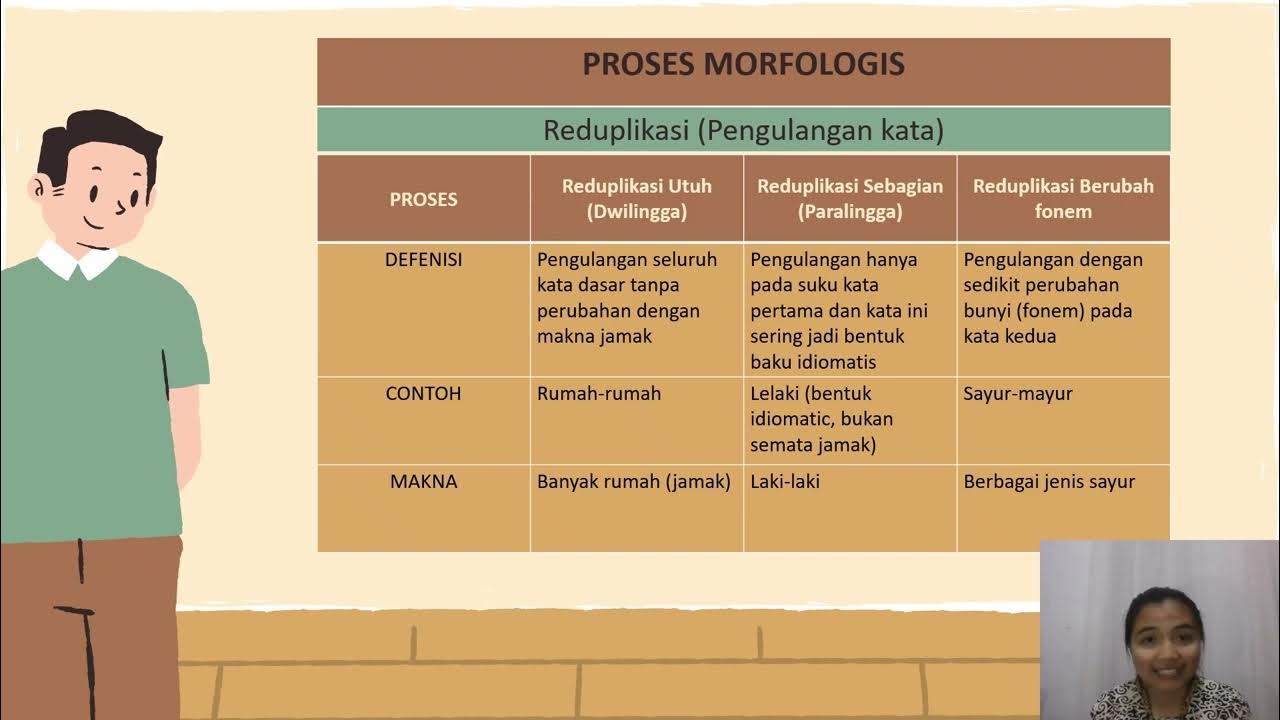
- 😀 Reduplication is the process of forming words by repeating the base form, either fully or partially.
- 😀 Reduplicated words can involve affixation or phoneme changes to alter meaning or nuance.
- 😀 There are four types of reduplication: full repetition, partial repetition, combination with affixes, and phoneme change.
- 😀 Examples of reduplication include 'menendang-nendang', 'gerak-gerik', and 'mobil-mobilan'.
- 😀 Composition involves combining two or more morphemes to create a new word with a relatively new meaning.
- 😀 Compositional words are analyzed based on their construction (tight or open) and their elements (whether the morphemes have undergone morphological processes).
- 😀 Types of composition are classified by the relationship between elements, number of elements, and grammatical word classes (noun, verb, adjective, etc.).
- 😀 Examples of compound words include 'tanggung jawab', 'kerja keras', and 'mata kaki'.
- 😀 Understanding reduplication and composition helps students create summaries, memorize concepts, and better comprehend the structure of the Indonesian language.
Q & A
What is reduplication in morphology?
-Reduplication is the process of forming a word by repeating the basic form of a word, either fully or partially, with or without affixes, and may involve phonemic variation.
What are the main characteristics of a reduplicated word?
-The main characteristics are: 1) It has the same form as the base word. 2) The base form is always used when the meaning is related to it. 3) Each type of reduplication has specific criteria that differentiate it.
How many types of reduplication exist, and what are they?
-There are four types of reduplication: 1) Full or complete reduplication, 2) Partial reduplication, 3) Reduplication combined with affixation, 4) Reduplication with phonemic changes.
Can you provide examples of each type of reduplication?
-Examples include: Full reduplication: 'buku-buku'; Partial reduplication: 'menendang-nendang'; Reduplication with affixation: 'mobil-mobilan'; Reduplication with phonemic changes: 'gerak-gerik'.
What is composition or compounding in morphology?
-Composition is the process of combining two or more morphemes or base words to create a new word with a relatively new meaning.
What are some examples of compound words?
-Examples include: 'buku tulis', 'kakitangan rumah makan', 'cuci mata', and 'mata kaki'.
What are the properties of compound words in terms of construction?
-Compound words have construction properties that are 'fixed', meaning they cannot be interrupted by other words or elements. For example, 'tanggung jawab' and 'kerja keras' are fixed constructions.
How are compound words classified based on their elements?
-They are classified based on: 1) The relationship of elements (one element explains the other or they do not explain each other), 2) Number of elements (more than three), and 3) Word class (noun, verb, adjective, etc.).
Why is it important to understand reduplication and composition in language study?
-Understanding these processes helps in creating accurate resumes of language patterns, aids memory and comprehension, and deepens understanding of morphological structures in Indonesian.
What does 'sifat unsur' refer to in compound words?
-'Sifat unsur' refers to the elements of a compound word that have not undergone morphological processes and retain their original form, such as 'mata kaki'.
How can studying reduplication and composition help students in practice?
-It helps students recognize patterns in word formation, create new words correctly, and classify words effectively, which is essential for linguistic analysis and proper language use.
According to the lecture, what attitude should students maintain while learning morphology?
-Students are encouraged to remain healthy, motivated, and enthusiastic while learning morphology to maximize understanding and engagement with the material.
Outlines

Этот раздел доступен только подписчикам платных тарифов. Пожалуйста, перейдите на платный тариф для доступа.
Перейти на платный тарифMindmap

Этот раздел доступен только подписчикам платных тарифов. Пожалуйста, перейдите на платный тариф для доступа.
Перейти на платный тарифKeywords

Этот раздел доступен только подписчикам платных тарифов. Пожалуйста, перейдите на платный тариф для доступа.
Перейти на платный тарифHighlights

Этот раздел доступен только подписчикам платных тарифов. Пожалуйста, перейдите на платный тариф для доступа.
Перейти на платный тарифTranscripts

Этот раздел доступен только подписчикам платных тарифов. Пожалуйста, перейдите на платный тариф для доступа.
Перейти на платный тарифПосмотреть больше похожих видео
Video Pembelajaran Bahasa Indonesia Materi Morfologi

Tata Kata Bahasa Indonesia

English Morphology Week 13: Onomatopoeia and Reduplication

Guru Virtual: Analisis Kesalahan Berbahasa #6 Kesalahan Berbahasa Tataran Morfologi #1

TANDA BACA DAN UNSUR SERAPAN

Essentials of Linguistics 5.3 Morphology Beyond Affixes
5.0 / 5 (0 votes)

