About Magnetism
Summary
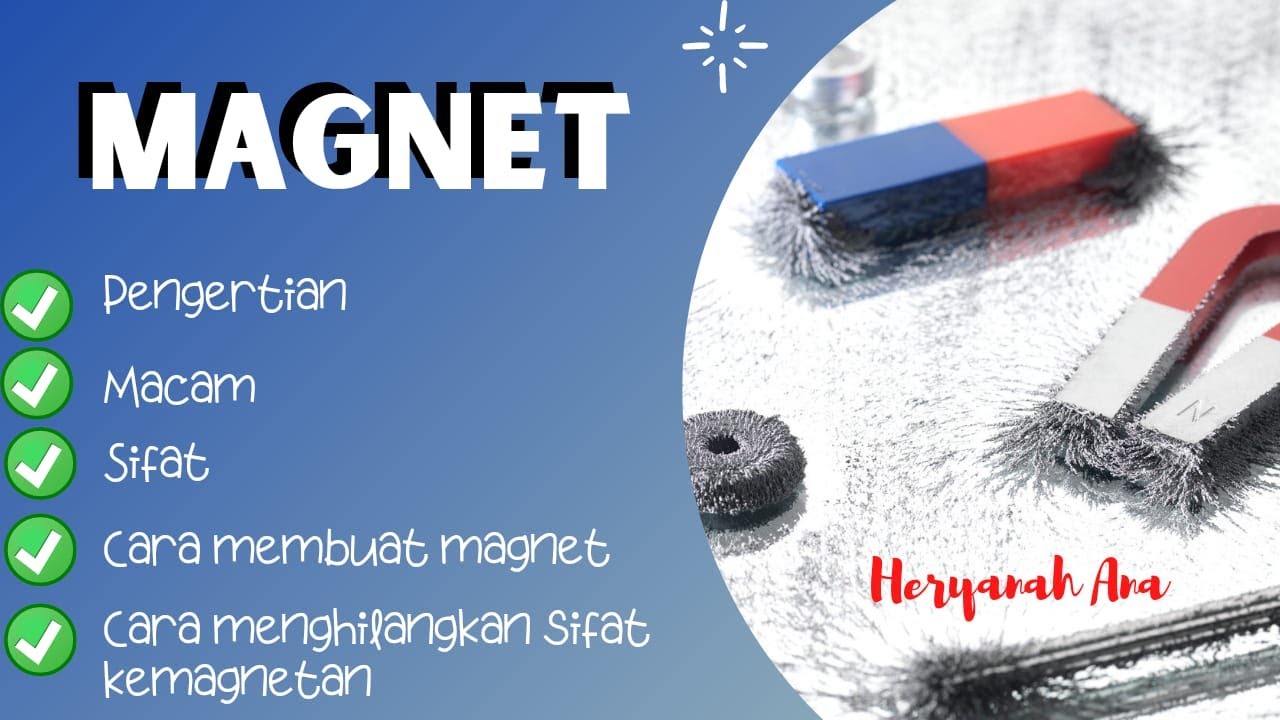
TLDRThis script explores the fascinating world of magnetism, detailing the discovery of magnetic properties in ancient times, the classification of materials as magnetic or non-magnetic, and key magnetic properties like attraction and directionality. It explains the laws of magnetism, demonstrated through simple experiments, where like poles repel and unlike poles attract. Additionally, the concept of magnetic keepers is introduced, showing how soft iron pieces preserve a magnet's strength by maintaining a continuous magnetic field. This comprehensive overview of magnetism provides both historical context and practical applications.
Takeaways
- 😀 Magnetic phenomena were first observed over 2,500 years ago in magnetized iron ore near the ancient city of Magnesia.
- 😀 Magnetite, a form of iron ore, attracts materials like steel, iron, nickel, and cobalt and was historically used in navigation.
- 😀 Materials are classified as either magnetic (iron, steel, nickel, cobalt) or non-magnetic (wood, rubber, glass, plastic).
- 😀 The attractive property of magnets enables them to attract magnetic substances like iron, which is useful for separating materials.
- 😀 The directive property of magnets causes them to align in the north-south direction, which is the principle behind a mariner's compass.
- 😀 Magnetic poles are strongest at the poles of a magnet, and if a magnet is cut, both pieces will remain magnetic.
- 😀 Like poles of magnets repel each other, and opposite poles (unlike poles) attract each other.
- 😀 An experiment demonstrates that when like poles (North-North or South-South) are brought together, they repel, while opposite poles attract.
- 😀 The laws of magnetism can be summarized as: like poles repel each other, unlike poles attract each other.
- 😀 Magnetic keepers, typically made from soft iron, are used to preserve a magnet's strength by providing a continuous path for its magnetic field.
Q & A
What is magnetite and how was it discovered?
-Magnetite is a naturally magnetized iron ore that was discovered over 2,500 years ago near the ancient city of Magnesia. It attracts materials like steel, iron, nickel, and cobalt.
What materials are classified as magnetic?
-Iron, steel, nickel, and cobalt are classified as magnetic materials because they are attracted to magnets.
Which materials are considered non-magnetic?
-Materials such as wood, rubber, glass, and plastic are non-magnetic because they do not exhibit attraction to magnets.
What is the attractive property of a magnet?
-The attractive property allows a magnet to attract magnetic substances like iron, steel, nickel, and cobalt. This property is used to separate iron from mixtures and remove iron filings from eyes.
What is the directive property of a magnet?
-The directive property refers to a freely suspended magnet aligning itself in the north-south direction. This principle is used in constructing mariner's compasses.
What happens when a magnet is broken into two parts?
-If a magnet is broken in the middle, each part becomes a new magnet with its own north and south poles.
Where is the magnetic property strongest on a magnet?
-The magnetic property is strongest at the poles, meaning the ability to attract magnetic substances is greater at the ends of a magnet.
What are the laws of magnetism regarding poles?
-The laws of magnetism state that like poles repel each other while unlike poles attract each other.
What is the purpose of using magnetic keepers?
-Magnetic keepers, made of soft iron, are placed across the poles of magnets to provide a continuous path for magnetic field lines. This helps preserve the magnetism and prevents weakening caused by repulsion or attraction between adjacent magnets.
How can you demonstrate that like poles repel and unlike poles attract?
-By suspending a bar magnet and bringing the poles of another magnet close: like poles move away from each other (repulsion), while unlike poles move towards each other (attraction).
Why did ancient mariners use lodestones?
-Ancient mariners used lodestones for navigation because of their natural magnetic property, which allowed them to determine direction using the north-south alignment.
How does the soft iron in magnetic keepers preserve magnetism?
-Soft iron provides a path for magnetic field lines to form a continuous loop, reducing loss of magnetic strength and maintaining the magnet's effectiveness over time.
Outlines

Этот раздел доступен только подписчикам платных тарифов. Пожалуйста, перейдите на платный тариф для доступа.
Перейти на платный тарифMindmap

Этот раздел доступен только подписчикам платных тарифов. Пожалуйста, перейдите на платный тариф для доступа.
Перейти на платный тарифKeywords

Этот раздел доступен только подписчикам платных тарифов. Пожалуйста, перейдите на платный тариф для доступа.
Перейти на платный тарифHighlights

Этот раздел доступен только подписчикам платных тарифов. Пожалуйста, перейдите на платный тариф для доступа.
Перейти на платный тарифTranscripts

Этот раздел доступен только подписчикам платных тарифов. Пожалуйста, перейдите на платный тариф для доступа.
Перейти на платный тариф



5.0 / 5 (0 votes)

