Earthquake Faults, Plate Boundaries, & Stress (2019_Educational)
Summary
TLDRThis video explains how Earth's constant tectonic stress shapes the landscape, focusing on the formation of faults and plate boundaries. It covers the different types of stress—compressional, tensional, and shear—and how they cause deformation in rocks, from elastic to brittle. Using examples like spaghetti and granite, the video demonstrates how rocks can bend, break, or shift. The video also explores fault types (normal, reverse, and strike-slip) and their relation to plate tectonics, illustrating how tectonic movement forms mountain ranges, ocean ridges, and earthquake zones. In conclusion, stress plays a key role in Earth's dynamic geology.
Takeaways
- 😀 Stress is a force that changes the shape or volume of an object, like rock, by applying force per unit area.
- 😀 There are three main types of stress: tension (pulling), compression (squeezing), and shear (opposite horizontal forces).
- 😀 The amount of stress in Earth’s crust can reach up to 200,000 pounds per square inch at 30 miles deep.
- 😀 Deformation in rock can be elastic (temporary), ductile (permanent bending), or brittle (breaking).
- 😀 Elastic deformation occurs when stress is removed and the rock returns to its original shape, similar to how a rubber band works.
- 😀 Ductile deformation happens under high pressure and temperature, causing rock to bend permanently, as seen in road cuts.
- 😀 Brittle deformation occurs when rocks break beyond their strength limit, creating fractures or faults.
- 😀 A fault forms when a fracture in rock experiences movement, unlike a simple fracture where there is no movement.
- 😀 Faults can be classified into three types: normal (due to tension), reverse (due to compression), and strike-slip (due to shear).
- 😀 Tensional stress at divergent boundaries causes plates to move apart, forming ridges and faults like those seen in oceanic spreading centers.
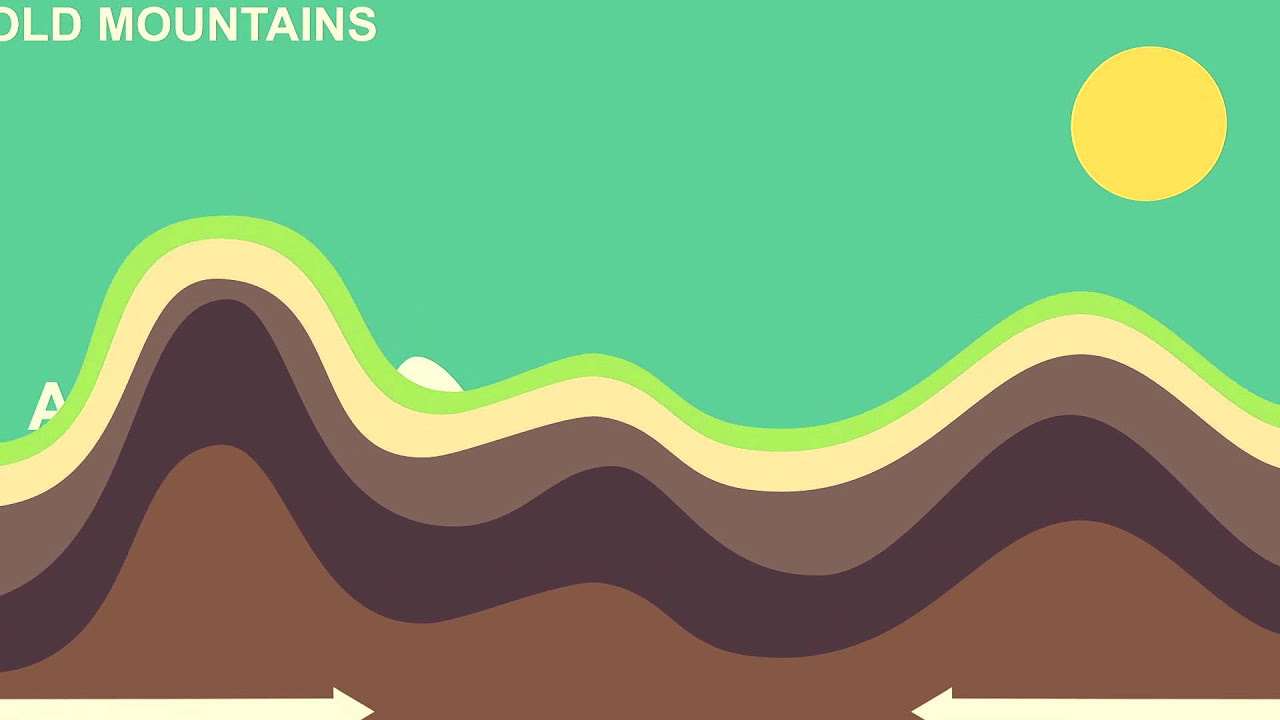
- 😀 Compressive stress at convergent boundaries causes plates to collide, forming mountain ranges and reverse faults.
- 😀 Shear stress at transform boundaries causes plates to slide past each other, forming strike-slip faults like the San Andreas Fault.
Q & A
What is stress in the context of Earth's geology?
-Stress is a force that acts on an object, such as a rock, to change its shape or volume. It is described as force per unit area, and can be caused by various factors like compression, tension, or shear.
What are the different types of stress that affect rocks?
-The three main types of stress are: 1) Tension (pulling), 2) Compression (pushing), and 3) Shear (opposite horizontal forces). These stresses can lead to different forms of deformation in rocks.
How does stress cause earthquakes?
-Stress causes earthquakes by building up elastic energy in rocks. When this accumulated stress exceeds friction along a fault, the energy is released suddenly, causing the ground to shake, which we experience as an earthquake.
What is the process of elastic deformation?
-Elastic deformation occurs when a rock is deformed under stress but returns to its original shape once the stress is removed. An example is squeezing a piece of uncooked spaghetti and seeing it return to its original form.
What is the difference between elastic and ductile deformation?
-Elastic deformation allows rocks to return to their original shape once stress is removed, while ductile deformation results in permanent bending of the rock, even after the stress is removed. Ductile deformation occurs under high temperature and pressure conditions.
What causes brittle deformation in rocks?
-Brittle deformation occurs when the applied stress exceeds the strength of the rock, causing it to fracture or break. This type of deformation results in faults, where one side of the rock shifts relative to the other.
What are faults, and how are they different from fractures?
-A fault is a break in Earth's crust where one side moves relative to the other, whereas a fracture is a crack in the rock that does not experience movement. Faults result from stress and can lead to earthquakes, while fractures do not.
What are the three types of faults based on the direction of stress?
-The three main types of faults are: 1) Normal faults (tensional stress, hanging wall drops), 2) Reverse faults (compressive stress, hanging wall rises), and 3) Strike-slip faults (shear stress, horizontal movement with minimal vertical motion).
How do tectonic plate boundaries relate to faulting?
-Tectonic plate boundaries are areas where stresses cause deformation in Earth's crust. At divergent boundaries, tension creates normal faults. At convergent boundaries, compression creates reverse faults. At transform boundaries, shear stress creates strike-slip faults.
What is the San Andreas Fault, and how is it related to plate movement?
-The San Andreas Fault is a major transform fault that separates the Pacific Plate and the North American Plate. It is a strike-slip fault where the plates slide horizontally past each other, causing frequent earthquakes.
Outlines

Этот раздел доступен только подписчикам платных тарифов. Пожалуйста, перейдите на платный тариф для доступа.
Перейти на платный тарифMindmap

Этот раздел доступен только подписчикам платных тарифов. Пожалуйста, перейдите на платный тариф для доступа.
Перейти на платный тарифKeywords

Этот раздел доступен только подписчикам платных тарифов. Пожалуйста, перейдите на платный тариф для доступа.
Перейти на платный тарифHighlights

Этот раздел доступен только подписчикам платных тарифов. Пожалуйста, перейдите на платный тариф для доступа.
Перейти на платный тарифTranscripts

Этот раздел доступен только подписчикам платных тарифов. Пожалуйста, перейдите на платный тариф для доступа.
Перейти на платный тарифПосмотреть больше похожих видео



5.0 / 5 (0 votes)

