Snell's Law
Summary
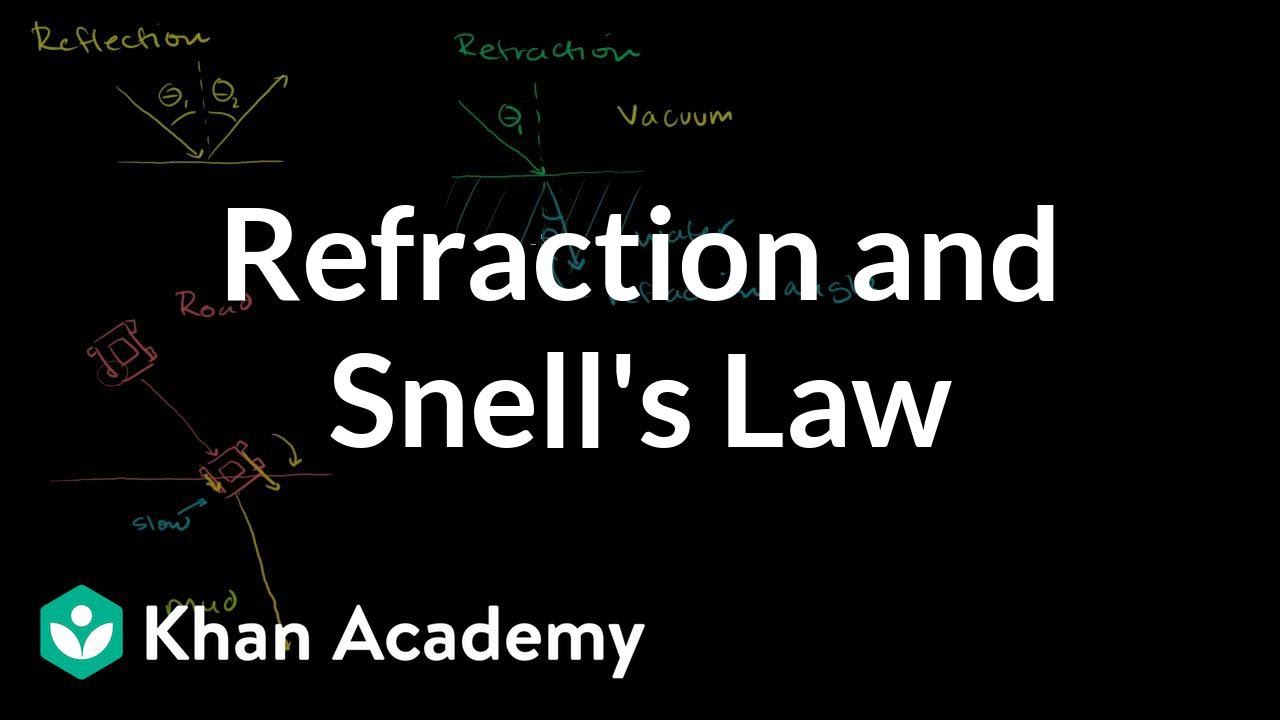
TLDRIn this video, we explore Snell's Law, a principle that describes how light bends when transitioning between different transparent media. Snell's Law relates the angle of incidence to the angle of refraction, with light bending depending on the speed difference between the media. The video demonstrates how to calculate the angle of refraction using the law, with an example involving sunlight entering water at a 35° angle from air. By understanding Snell’s Law and applying it with the right indices of refraction, we can predict how light behaves when passing through different mediums.
Takeaways
- 😀 Snell's Law relates the angle of incidence to the angle of refraction when light travels between two different transparent mediums.
- 😀 Light travels fastest in a vacuum at a speed of 3 × 10^8 m/s, and its speed decreases in other mediums like air and water.
- 😀 When light moves from air to water, it bends due to a decrease in speed, causing the light ray to refract towards the normal line.
- 😀 The normal line is a perpendicular reference line used to measure the angles of incidence and refraction.
- 😀 The angle of incidence is the angle between the incident ray (incoming ray) and the normal line.
- 😀 The angle of refraction is the angle between the refracted ray and the normal line in the second medium.
- 😀 If the second medium is slower than the first, the light bends towards the normal line, and if it's faster, it bends away from the normal line.
- 😀 Snell's Law can be used to calculate the angle of refraction given the angle of incidence and the refractive indices of the two mediums.
- 😀 The refractive index is a number that represents how much slower light travels in a medium compared to its speed in a vacuum.
- 😀 The refractive index of air is approximately 1, while water has a refractive index of 1.33.
- 😀 Using Snell's Law, the angle of refraction can be calculated by rearranging the formula and plugging in known values for the incident angle and refractive indices, as demonstrated in the example with sunlight entering water.
Q & A
What is Snell's Law?
-Snell's Law is a mathematical relationship developed by Willebrord Snell that relates the angle of incidence to the angle of refraction when light passes from one transparent medium to another.
Why does light bend when it passes from one medium to another?
-Light bends because it changes speed when entering a medium with a different optical density. If it slows down, it bends toward the normal; if it speeds up, it bends away from the normal.
What is the normal line and why is it important?
-The normal line is an imaginary line perpendicular to the boundary between two media. Angles of incidence and refraction are measured from this line, making it crucial for applying Snell's Law.
How is the angle of incidence defined?
-The angle of incidence is the angle between the incoming light ray and the normal line at the point of entry into the second medium.
How is the angle of refraction defined?
-The angle of refraction is the angle between the refracted light ray and the normal line in the second medium.
What happens to light when it moves from a faster medium to a slower medium?
-When light enters a slower medium, such as from air to water, it bends toward the normal line because it slows down.
What is the index of refraction?
-The index of refraction is a ratio that compares the speed of light in a vacuum to its speed in a specific medium. It indicates how much slower light travels in that medium compared to a vacuum.
How is Snell's Law mathematically expressed?
-Snell's Law is expressed as n₁ * sin(θ₁) = n₂ * sin(θ₂), where n₁ and n₂ are the indices of refraction of the first and second medium, and θ₁ and θ₂ are the angles of incidence and refraction, respectively.
How would you calculate the angle of refraction if the angle of incidence and indices of refraction are known?
-Rearrange Snell's Law to solve for θ₂: θ₂ = arcsin((n₁ * sin(θ₁)) / n₂). Then plug in the known values and use a calculator to find θ₂ in degrees.
In the example of light entering water from air at 35°, what is the resulting angle of refraction?
-Using Snell's Law with n₁ = 1 (air), n₂ = 1.33 (water), and θ₁ = 35°, the angle of refraction θ₂ is approximately 25°.
Why is light fastest in a vacuum?
-Light is fastest in a vacuum because there are no particles or obstacles to impede its motion, allowing it to travel at the maximum speed of approximately 3 × 10⁸ meters per second.
What determines whether light bends toward or away from the normal?
-The bending direction depends on the relative speeds of light in the two media: if the second medium is slower, light bends toward the normal; if faster, it bends away.
Outlines

Этот раздел доступен только подписчикам платных тарифов. Пожалуйста, перейдите на платный тариф для доступа.
Перейти на платный тарифMindmap

Этот раздел доступен только подписчикам платных тарифов. Пожалуйста, перейдите на платный тариф для доступа.
Перейти на платный тарифKeywords

Этот раздел доступен только подписчикам платных тарифов. Пожалуйста, перейдите на платный тариф для доступа.
Перейти на платный тарифHighlights

Этот раздел доступен только подписчикам платных тарифов. Пожалуйста, перейдите на платный тариф для доступа.
Перейти на платный тарифTranscripts

Этот раздел доступен только подписчикам платных тарифов. Пожалуйста, перейдите на платный тариф для доступа.
Перейти на платный тарифПосмотреть больше похожих видео

Refração da luz: Lei de Snell. 2/4

RESUMEN DE ÓPTICA FÍSICA EN 10 MINUTOS FÍSICA 2º BACHILLERATO

REFRAÇÃO DA LUZ E DISPERSÃO LUMINOSA - ÓPTICA - Aula 8 - Prof Boaro
Refraction and Snell's law | Geometric optics | Physics | Khan Academy
La Física de los Hologramas Caseros

Cahaya dan Sifatnya - Materi IPAS Kelas 5 Kurikulum Merdeka
5.0 / 5 (0 votes)

