Dinamika Penduduk (part 1) - Materi Geografi Kelas XI
Summary
TLDRThis video explains the concept of population dynamics, focusing on birth rates, death rates, and migration patterns. It covers the factors influencing population changes, such as natality, mortality, and migration, as well as how to calculate key indicators like crude birth rate, crude death rate, and infant mortality rate. The video also explores Indonesia's demographic trends, including its large population and the ongoing demographic bonus. It concludes with an overview of data collection methods, such as censuses, registries, and surveys, all vital for planning development.
Takeaways
- 🌍 Population dynamics refers to changes in population conditions within a region over time, including size, growth, distribution, density, and composition.
- 📊 Population is not static—it can increase, decrease, or shift due to various influencing factors.
- 🏠 According to official definitions, population includes individuals living in a country for at least 6 months or intending to stay, regardless of citizenship.
- 🇮🇩 Indonesia has a very large population (around 270–287 million), making it one of the most populous countries in the world.
- ⚖️ A large population brings both benefits (like abundant labor) and challenges (such as job availability and education needs).
- 👨👩👧👦 Indonesia is experiencing a demographic bonus, with over 70% of its population in the productive age group.
- 📈 Three main factors affecting population dynamics are birth (natality), death (mortality), and migration.
- 👶 Pronatalist factors (e.g., early marriage, cultural beliefs) increase birth rates, while antinatalist factors (e.g., family planning) reduce them.
- 🧮 Crude Birth Rate (CBR) measures total births per 1,000 population, while Age-Specific Fertility Rate (ASFR) focuses on births within certain age groups.
- ⚰️ Mortality is influenced by promortal factors (e.g., disasters, poor healthcare) and antimortal factors (e.g., good healthcare, clean environment).
- 📉 Crude Death Rate (CDR), Age-Specific Death Rate (ASDR), and Infant Mortality Rate (IMR) are key indicators used to measure death rates.
- 🚶 Migration is the movement of people from one place to another, either within a country (national) or between countries (international).
- 🏙️ Examples of national migration include urbanization, ruralization, transmigration, and commuting (circulation).
- 🌐 International migration includes immigration (entering a country), emigration (leaving a country), and remigration (returning home).
- 📋 Population data is collected through census, registration (continuous records), and surveys, all crucial for development planning.
Q & A
What is meant by population dynamics?
-Population dynamics refers to changes in the population of a region over time, including variations in population size, growth, density, distribution, and composition. These changes can be due to births, deaths, and migration.
How does the Indonesian government define 'population'?
-According to the Indonesian government, population includes Indonesian citizens and foreigners residing in Indonesia. People are considered part of the population if they live in Indonesia for six months or more, or less than six months but intend to stay.
What are the three main factors influencing population dynamics?
-The three main factors are natality (birth rate), mortality (death rate), and migration (movement of people from one place to another). These factors determine whether a population increases or decreases.
What are pronatality and antinatality factors?
-Pronatality factors increase birth rates, such as early marriage or cultural beliefs favoring many children. Antinatality factors decrease birth rates, like family planning programs and restrictions on marriage age.
How is the Crude Birth Rate (CBR) calculated?
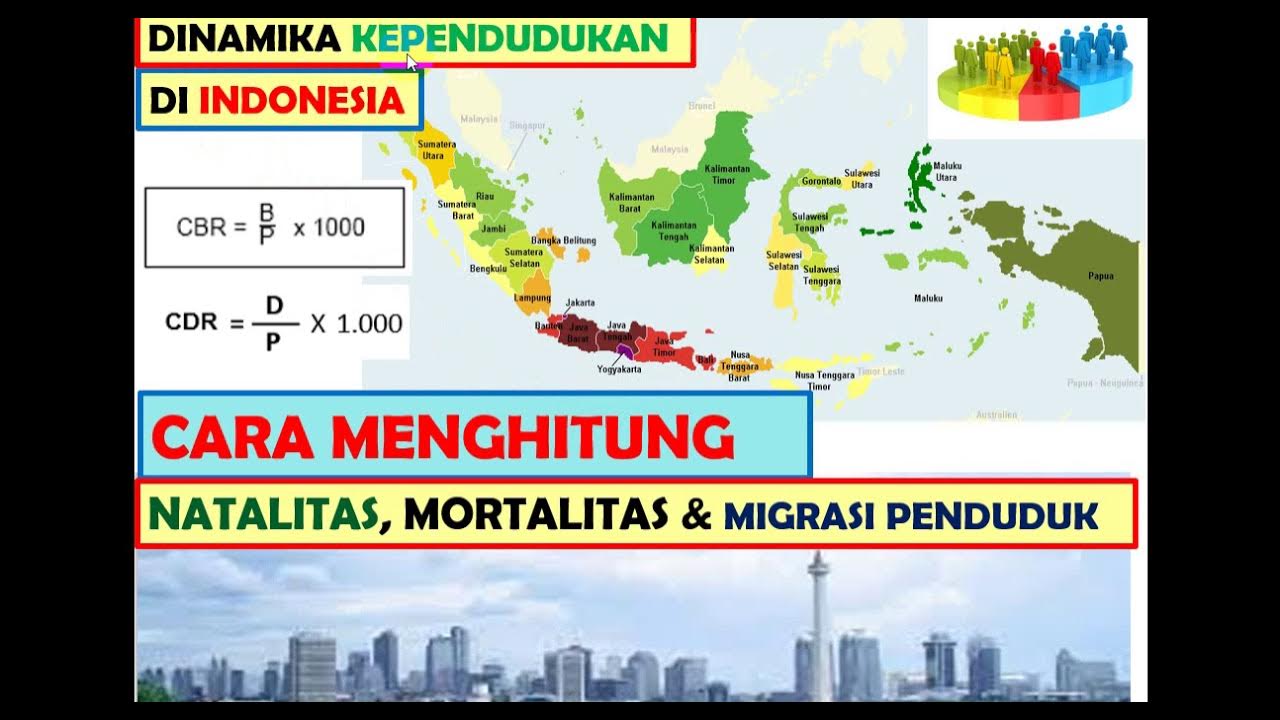
-CBR is calculated by dividing the total number of births in a year by the mid-year population and multiplying by 1,000. For example, if a city has 4,500 births and 225,000 residents, the CBR is 20 per 1,000 population.
What are promortality and antimortality factors?
-Promortality factors increase death rates, such as poor healthcare, natural disasters, accidents, or wars. Antimortality factors decrease death rates, such as good healthcare, clean environment, and higher quality of life.
What is the difference between Crude Death Rate (CDR) and Age-Specific Death Rate (ASDR)?
-CDR measures the total number of deaths per 1,000 people in the overall population, while ASDR measures deaths per 1,000 people within a specific age group.
What is the Infant Mortality Rate (IMR) and how is it calculated?
-IMR is the number of deaths of infants under one year old per 1,000 live births. It is calculated by dividing the number of infant deaths by the number of live births and multiplying by 1,000.
What types of migration exist within a country and internationally?
-Within a country (national migration), there are urbanization, ruralization, transmigration, and circulation. International migration includes immigration (moving into a country), emigration (leaving a country), and remigration (returning to the home country).
Why is population data important?
-Population data is essential for planning and development, such as providing education, healthcare, employment opportunities, and infrastructure. Accurate data ensures effective government policies and programs.
What percentage of Indonesia's population lives on Java and what does this imply?
-About 56.10% of Indonesia's population resides on Java. This indicates a high population concentration, which can lead to challenges in resource allocation, urban planning, and public services.
What is meant by the 'demographic bonus' in Indonesia?
-The demographic bonus occurs when a large portion of the population is of productive age (15–64 years), which in Indonesia is 70.72%. This can boost economic growth if the workforce is effectively utilized.
Outlines

Этот раздел доступен только подписчикам платных тарифов. Пожалуйста, перейдите на платный тариф для доступа.
Перейти на платный тарифMindmap

Этот раздел доступен только подписчикам платных тарифов. Пожалуйста, перейдите на платный тариф для доступа.
Перейти на платный тарифKeywords

Этот раздел доступен только подписчикам платных тарифов. Пожалуйста, перейдите на платный тариф для доступа.
Перейти на платный тарифHighlights

Этот раздел доступен только подписчикам платных тарифов. Пожалуйста, перейдите на платный тариф для доступа.
Перейти на платный тарифTranscripts

Этот раздел доступен только подписчикам платных тарифов. Пожалуйста, перейдите на платный тариф для доступа.
Перейти на платный тарифПосмотреть больше похожих видео

Dinamika Penduduk

Geografi Kelas XI (18) Dinamika Penduduk Indonesia | Faktor dinamika penduduk

Geografi Kelas XI (19) Kuantitas Penduduk | Kelahiran, Kematian, Pertumbuhan dan Proyeksi Penduduk
Geo XI. 23. Menghitung Natalitas, Mortalitas, dan Migrasi Penduduk.
Geo XI. 22. Dinamika Penduduk Di Indonesia.

Tema 4 || C. Dinamika Penduduk, IPS Kelas 8, kurikulum merdeka
5.0 / 5 (0 votes)

