INFRASTRUKTUR E-BISNIS - EGGA ASOKA,M.MSI. - POLITEKNIK NEGERI SRIWIJAYA
Summary
TLDRIn this educational video, Ega Soka, a lecturer at Politeknik Negeri Sriwijaya, introduces the fundamentals of e-business infrastructure. The video explains the essential components, including hardware, software, communication technologies, and the human expertise needed to implement e-business effectively. Key characteristics such as connectivity, compatibility, modularity, and professionalism are highlighted as critical for supporting business innovation and efficient system development. The discussion emphasizes the strategic importance of flexible, well-aligned e-business infrastructure to enhance organizational performance, enable rapid adaptation to technology changes, and maintain competitiveness in the digital era. Practical insights are offered for applying these concepts in real-world business settings.
Takeaways
- 😀 E-business infrastructure refers to the architecture of hardware, software, content, and data used to deliver e-business services to employees, customers, and business partners.
- 🌐 Advances in communication technology, networking, and especially the internet provide the essential infrastructure that enables modern digital business operations.
- ⚙️ A well-developed e-business infrastructure is crucial for companies because it directly affects service quality, system speed, and accessibility experienced by users.
- 🏢 Companies must decide which infrastructure components are managed internally and which are outsourced to third-party providers such as application, data, or network service providers.
- 🔧 E-business infrastructure must remain flexible so organizations can adopt new technologies and adapt to changing business needs to stay competitive.
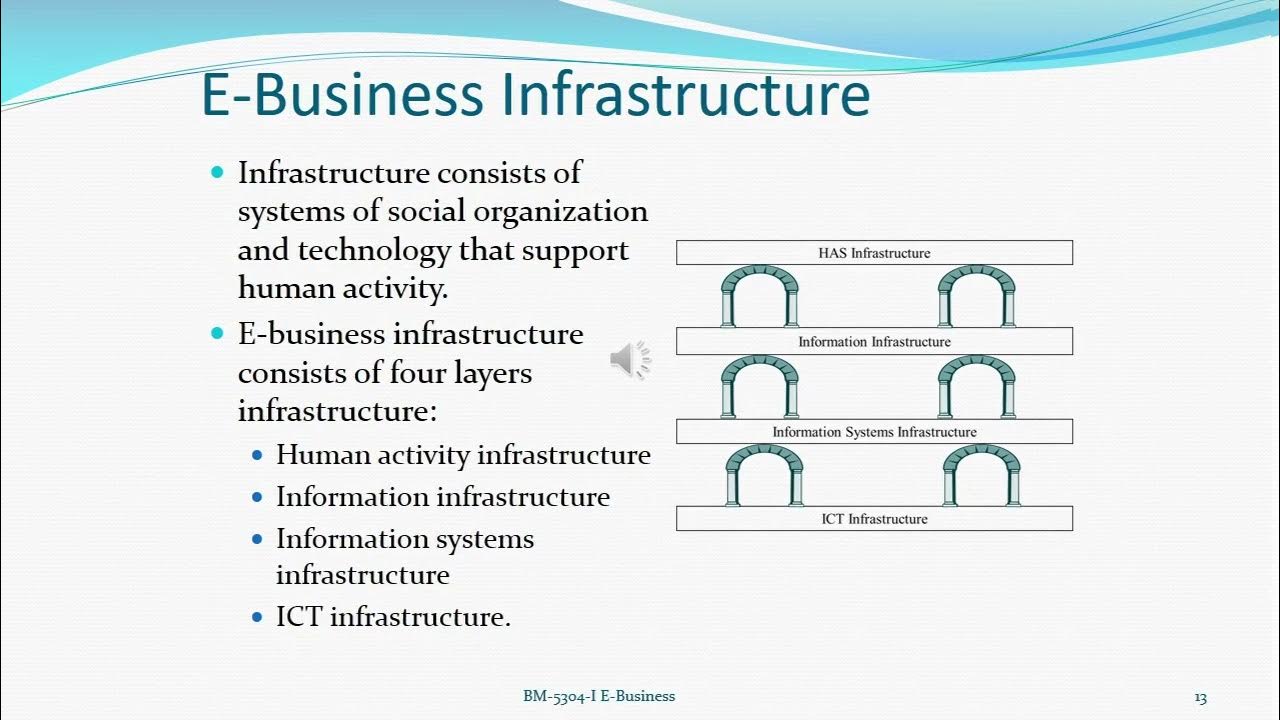
- 🧩 E-business infrastructure consists of two main components: technical infrastructure (hardware, software, communication technology, data, and applications) and human infrastructure (skills, experience, knowledge, and organizational values).
- 🤝 The integration of technical and human infrastructure forms the foundation that supports communication, information exchange, and business application development across the organization.
- 📈 A scalable infrastructure allows companies to handle increased customer demand without significantly increasing operational costs.
- 🔗 Key characteristics of effective e-business infrastructure include connectivity, which enables users, functional areas, and applications to share information seamlessly.
- 🔄 Compatibility is another important characteristic, allowing different technological components within the organization to exchange and process information efficiently.
- 🧱 Modularity enables organizations to build new applications quickly and modify existing ones by organizing software functions into manageable modules.
- 👨💻 Skilled IT personnel are critical for implementing and managing e-business systems, as they understand both the technology and the company’s business processes.
- 🚀 Information technology has created a new era of business development because it enables economic activities to spread and operate beyond traditional physical infrastructures.
- 📊 Unlike traditional manufacturing technologies, information technology is not heavily dependent on physical infrastructure and is less capital-intensive.
- 🎯 Aligning e-business infrastructure strategy with overall business strategy is essential to ensure that technology initiatives support the company's mission, goals, and long-term plans.
Q & A
Who is presenting the video and what is their affiliation?
-The video is presented by Ega Soka, a lecturer at Politeknik Negeri Sriwijaya, in the Department of Management Informatics.
What is the main topic of the video?
-The main topic is an introduction to e-business, its infrastructure, and alternative methods organizations can use to implement e-business.
How is e-business infrastructure defined in the video?
-E-business infrastructure is defined as the combination of hardware, software, data, and network systems used to deliver e-business services to employees, customers, and partners.
Why is having adequate e-business infrastructure important for companies?
-Adequate infrastructure is critical because it affects service quality, decision-making speed, and flexibility to adopt new technologies, which are essential for competing effectively.
What are the two main components of e-business infrastructure mentioned?
-The two components are: 1) Technical e-business infrastructure, which includes hardware, software, communication technologies, data, and main applications; and 2) Business infrastructure, which includes expertise, experience, competencies, values, norms, and knowledge.
What characteristics should an e-business infrastructure have?
-An e-business infrastructure should have connectivity (linking users and applications), compatibility (ability to integrate information across technologies), modularity (flexible design for building and modifying applications), and professional personnel (skilled in utilizing internal and external resources and understanding business processes).
How does connectivity benefit an organization’s e-business infrastructure?
-Connectivity allows all users, functional areas, and applications to share information, enabling wider implementation of applications and smoother communication across the organization.
What is the role of professional personnel in e-business infrastructure?
-Professional personnel are crucial as they know how to use the company's resources and external technology, understand business processes, and can implement both new and existing business applications effectively.
Why is e-business infrastructure considered different from traditional industrial infrastructure?
-Unlike industrial infrastructure, e-business infrastructure is less dependent on physical systems like transportation networks and instead focuses on information services, economic activity distribution, and knowledge management rather than tangible capital.
What is the strategic importance of aligning e-business infrastructure with business strategy?
-Aligning infrastructure with business strategy ensures that e-business supports the company’s mission, goals, and planning, which helps the organization gain competitive advantages and implement technology effectively.
Why must e-business infrastructure be flexible?
-It must be flexible to handle increasing customer demand without significantly raising costs and to quickly adapt to technological and business changes.
How does modularity in e-business infrastructure improve application management?
-Modularity allows companies to build new applications and modify existing ones quickly by separating routines into manageable modules, making software easier to maintain and update.
Outlines

Этот раздел доступен только подписчикам платных тарифов. Пожалуйста, перейдите на платный тариф для доступа.
Перейти на платный тарифMindmap

Этот раздел доступен только подписчикам платных тарифов. Пожалуйста, перейдите на платный тариф для доступа.
Перейти на платный тарифKeywords

Этот раздел доступен только подписчикам платных тарифов. Пожалуйста, перейдите на платный тариф для доступа.
Перейти на платный тарифHighlights

Этот раздел доступен только подписчикам платных тарифов. Пожалуйста, перейдите на платный тариф для доступа.
Перейти на платный тарифTranscripts

Этот раздел доступен только подписчикам платных тарифов. Пожалуйста, перейдите на платный тариф для доступа.
Перейти на платный тариф




5.0 / 5 (0 votes)

