AMD’s Actually DOING IT!
Summary
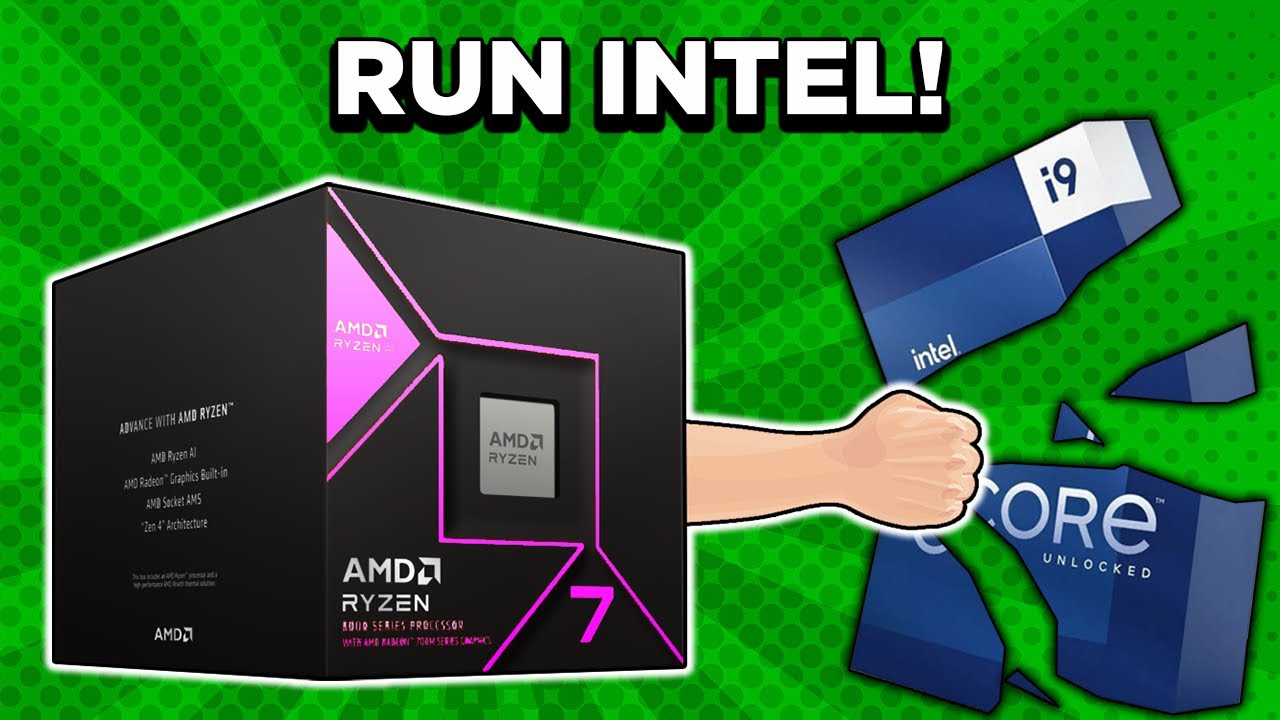
TLDRAMD has unveiled its next-gen desktop APUs, but the release has been met with disappointment due to underwhelming specs. The high-end Ryzen AI7450G is based on Zen 5 but offers only four full Zen 5 cores, and its integrated GPU is limited compared to notebook models. While AMD aims to provide affordable solutions for gamers amidst a memory crisis, the chips seem to be a downgrade. Meanwhile, Microsoft’s new DXR technology promises major performance boosts for GPUs, including a 40% FPS increase for Nvidia's RTX 4090 and up to 90% for Intel's ARC B series, without relying on upscaling or fake frames.
Takeaways
- 😀 AMD has officially announced its next-gen desktop APUs, but the release is being met with disappointment due to several performance limitations.
- 😀 The Ryzen AI7450G, AMD's highest-end APU, is based on Zen 5 architecture but only includes 4 Zen 5 cores and 4 Zen 5C cores, which underperforms compared to last gen's 8700G.
- 😀 The new APU's base clock is lower than last gen's, clocking at just 2 GHz, compared to 4.2 GHz on the previous 8700G.
- 😀 The integrated graphics (iGPU) in the 450G are based on RDNA 3.5, with only 8 compute units (CU), fewer than last generation's 12 CUs.
- 😀 Despite the lower iGPU cores, the new APUs feature 50 AI tensor cores, a notable upgrade from the previous 16.
- 😀 AMD has not released pricing details, leaving uncertainty about whether these chips will be competitively priced when released in Q2 2026.
- 😀 AMD is attempting to offer affordable gaming solutions in light of the ongoing memory crisis by offering lower-cost parts for gamers.
- 😀 AMD’s Ryzen 5 5500X3D, a budget gaming CPU with 3D vCache, is expanding availability from Latin America to China, and might eventually come to the US.
- 😀 Intel's next-gen CPUs, Core Ultra 200K Plus, are expected to be released soon, with a leaked refresh including 6 performance cores and 12 efficiency cores for the 250K Plus model.
- 😀 Microsoft’s new shader execution reordering (SER) technology promises a massive performance boost of up to 90% on Intel's Arc B GPUs, with potential gains on AMD and Nvidia GPUs as well.
- 😀 The SER tech could offer a 20-40% free performance increase without relying on upscaling or fake frames, but its impact will depend on developers adopting the technology in future games.
Q & A
What is AMD's new APU announcement and how does it compare to last generation?
-AMD announced their next-generation desktop APUs, including both pro and consumer versions with their 400G series processors. However, the release is disappointing due to limited improvements over last generation. The Ryzen AI7450G, for example, is based on Zen 5 but has only 8 cores (4 Zen 5 cores and 4 Zen 5C cores), which is a downgrade from the previous 8700G, which had better specs including 12 CUs in its iGPU.
What issues were pointed out regarding AMD's Ryzen AI7450G APU?
-The Ryzen AI7450G features a base clock of 2 GHz, which is lower than its predecessor, the 8700G, which had a base clock of 4.2 GHz. Additionally, the iGPU has only 8 CUs compared to 12 in the 8700G, making it underwhelming. While the chip is based on RDNA 3.5, the overall hardware appears to be a downgrade rather than an upgrade.
Why is AMD targeting both pro and consumer markets with the same hardware?
-AMD has released both pro and non-pro APUs under the 400G series, with most of their marketing focused on the pro side. However, the hardware is identical between the consumer and enterprise chips, except for ECC memory support. The primary difference lies in AMD's platform software features included with the Pro chips.
What role does AI play in AMD's new APUs?
-The Ryzen AI7450G includes 50 AI tensor cores, which is a significant increase over the previous 16 in last gen chips. This indicates AMD's effort to integrate more AI-driven features, though the performance and overall impact of these cores haven't been fully detailed yet.
What is AMD's stance on the high GPU prices and how are they attempting to address it?
-AMD is attempting to provide cheaper parts for gamers, particularly in response to the rising costs of memory and GPUs. The company is also promoting alternative options like cheaper pre-built PCs and the trade-in program offered by retailers like Jawa, which gives gamers the option to save money on new builds.
What new feature from Microsoft is set to boost GPU performance significantly?
-Microsoft's new technology, Shader Execution Reordering (SER), is expected to provide a massive performance boost in ray-tracing tasks without relying on upscaling or fake frames. The technology can increase performance by up to 90% on certain GPUs, like Intel's ARC B-series, and is likely to benefit AMD and Nvidia GPUs as well.
What is the difference between DXR and RTX in the context of ray tracing?
-DXR, or DirectX Raytracing, is the programming interface for ray tracing within DirectX12, while RTX is Nvidia's branding for their hardware built to accelerate the DXR interface. Essentially, DXR is the software framework, and RTX refers to Nvidia's specific hardware optimized for it.
How does Shader Execution Reordering (SER) work to improve ray tracing performance?
-SER allows game engines to provide hints to the GPU on how to reorder ray tracing shaders, enabling the GPU to group similar tasks together and better parallelize workloads. This improves efficiency and ultimately results in higher frame rates without the need for upscaling or fake frames.
Why is AMD's release of the Ryzen 5 5500X3D significant?
-The Ryzen 5 5500X3D, a 6-core, 12-thread CPU with 3D V-Cache, was originally released only in Latin America but is now set to launch in China and potentially other regions. Its price, around $175, offers an affordable option for gamers looking for a decent gaming CPU with a large amount of L3 cache, especially as the 5800X3D has become more expensive.
What do the leaked Intel Core Ultra 200K series specs suggest about Intel's next-generation CPUs?
-The leaked specs reveal Intel's Core Ultra 200K series, which includes the 250K Plus and 270K Plus chips. These CPUs feature a mix of performance cores and efficiency cores, with the 250K Plus offering 6 performance cores and 12 efficiency cores. The new chips are expected to have competitive prices, and Intel's pricing strategy will be crucial to their success.
Outlines

Этот раздел доступен только подписчикам платных тарифов. Пожалуйста, перейдите на платный тариф для доступа.
Перейти на платный тарифMindmap

Этот раздел доступен только подписчикам платных тарифов. Пожалуйста, перейдите на платный тариф для доступа.
Перейти на платный тарифKeywords

Этот раздел доступен только подписчикам платных тарифов. Пожалуйста, перейдите на платный тариф для доступа.
Перейти на платный тарифHighlights

Этот раздел доступен только подписчикам платных тарифов. Пожалуйста, перейдите на платный тариф для доступа.
Перейти на платный тарифTranscripts

Этот раздел доступен только подписчикам платных тарифов. Пожалуйста, перейдите на платный тариф для доступа.
Перейти на платный тарифПосмотреть больше похожих видео




5.0 / 5 (0 votes)

