All about the COSO framework
Summary
TLDRThis video explains the COSO Framework, a set of principles designed to guide organizations in implementing internal controls to prevent, detect, and manage fraud risks. Developed in response to corporate fraud scandals in the 1970s and 1980s, the framework has evolved to address modern challenges, including sustainability reporting. It outlines five key pillars: control environment, risk assessment, control activities, information and communication, and monitoring activities. COSO's framework is used by companies to strengthen internal controls and comply with regulations like SOX, though it offers broad principles rather than specific methods for control implementation.
Takeaways
- 😀 COSO (Committee of Sponsoring Organizations) was formed to address fraud scandals in the 1970s and 1980s, leading to the development of an internal control framework.
- 😀 COSO's 1992 internal control framework provides guidance for organizations to implement controls to prevent, detect, and manage fraud risks related to external financial reporting.
- 😀 The COSO Framework gained increased importance following high-profile fraud cases in the 1990s and 2000s, influencing companies subject to SOX regulations.
- 😀 COSO also offers guidance on establishing an enterprise risk management program, which aligns with a company’s internal control environment.
- 😀 The COSO framework is periodically updated, with the most recent update in March 2023 focusing on internal controls for sustainability reporting.
- 😀 COSO's framework introduces a visual model known as the COSO cube, highlighting five key components of internal controls.
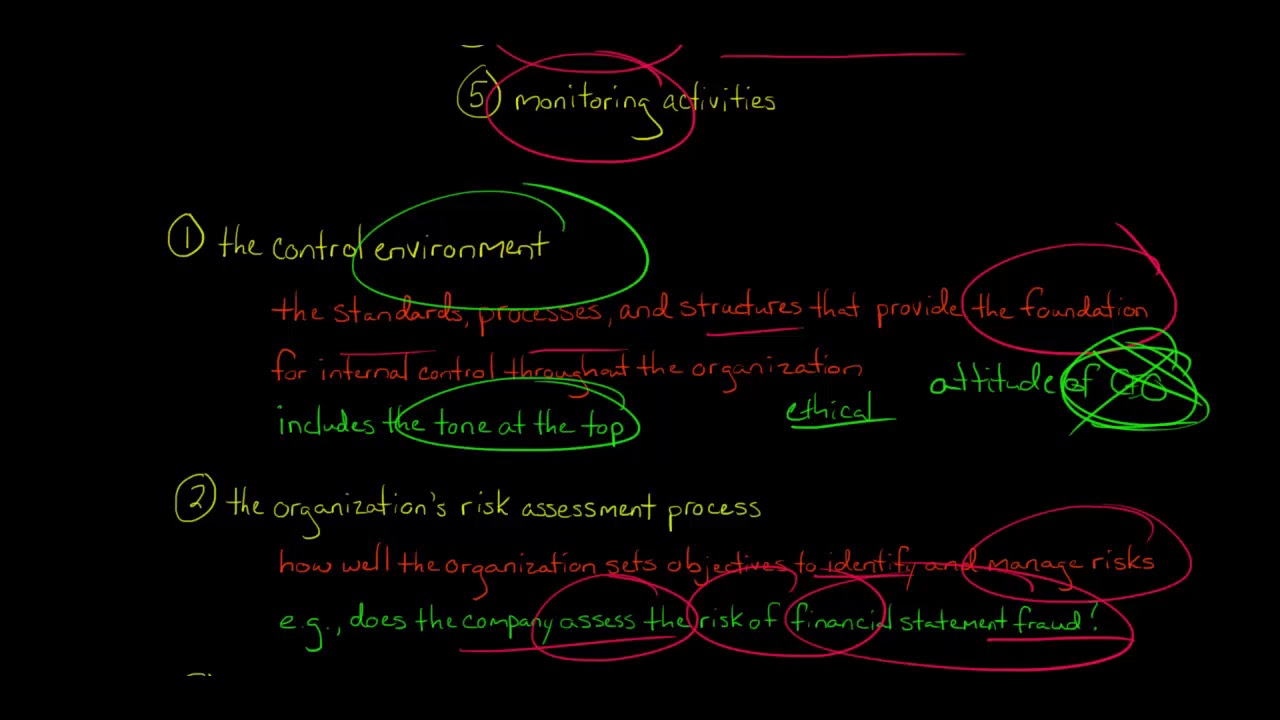
- 😀 The first pillar, the control environment, represents the organization’s overall culture of internal controls, emphasizing the importance of leadership and ethical tone at the top.
- 😀 Risk assessments are a crucial element of the COSO framework, ensuring organizations identify and analyze risks that could hinder achieving their objectives.
- 😀 Control activities—processes, procedures, actions, and communications—are vital to mitigating risks and maintaining effective internal controls.
- 😀 Effective information and communication are key to ensuring timely and consistent distribution of relevant data to stakeholders, both internally and externally.
- 😀 Monitoring activities within the COSO framework focus on evaluating and reporting the effectiveness of internal controls, identifying deficiencies, and taking corrective actions in a timely manner.
Q & A
What is the COSO framework and why was it originally created?
-The COSO framework is a set of internal controls guidelines developed by the Committee of Sponsoring Organizations of the Treadway Commission. It was originally created to investigate and address fraud scandals in the 1970s and 1980s, providing organizations with a structured approach to prevent and manage fraud risks related to financial reporting.
How has the COSO framework evolved over time?
-The COSO framework has evolved to address emerging risks and regulatory requirements. It gained more importance in the 1990s and 2000s due to increased fraud cases. Most recently, in 2023, COSO introduced guidance on internal controls for sustainability reporting to help businesses manage environmental, social, and governance (ESG) risks and meet regulatory demands.
What is the COSO 'cube' and how is it used to visualize the framework?
-The COSO 'cube' is a visual representation of the framework that outlines its five foundational pillars: control environment, risk assessment, control activities, information and communication, and monitoring activities. These pillars help organizations structure and implement effective internal controls.
What is the 'control environment' pillar of the COSO framework?
-The control environment refers to the overall culture of internal controls within an organization, which is shaped by leadership. It sets the ethical tone and influences the behaviors and actions of all employees. A strong control environment is critical to preventing fraud, as demonstrated by past scandals like Enron.
Why is risk assessment important in the COSO framework?
-Risk assessment is essential because it helps organizations identify and analyze potential risks that could prevent them from achieving their objectives. Regular risk assessments allow organizations to proactively address issues before they become significant problems, ensuring the success of internal controls.
What are 'control activities' in the COSO framework?
-Control activities refer to the processes, procedures, actions, and communications put in place to mitigate risks and maintain effective internal controls. These activities are critical in ensuring that objectives are achieved and that risks are properly managed.
How does the 'information and communication' pillar contribute to internal controls?
-The 'information and communication' pillar ensures that relevant, timely, and accurate information is shared both internally and externally across the organization. Effective communication enables stakeholders to carry out their responsibilities and helps maintain the integrity of the internal control system.
What role does monitoring play in the COSO framework?
-Monitoring activities involve tracking and evaluating the performance of internal controls. Regular monitoring ensures that all five pillars of the COSO framework are operating effectively. Any deficiencies or weaknesses should be identified and addressed promptly to maintain strong controls.
Why is the COSO framework particularly important for companies that need to comply with SOX regulations?
-The COSO framework is a widely adopted internal controls structure that helps organizations comply with Sarbanes-Oxley (SOX) regulations, which require businesses to establish effective controls over financial reporting. By aligning with COSO, companies can meet SOX requirements and strengthen their governance processes.
How does COSO's guidance on sustainability reporting relate to the overall framework?
-In March 2023, COSO issued guidance for internal controls over sustainability reporting (ICSR) to help companies meet growing demands for transparency in environmental, social, and governance (ESG) matters. This guidance builds on the COSO framework to address the risks and controls needed for accurate, reliable sustainability reporting.
Outlines

Этот раздел доступен только подписчикам платных тарифов. Пожалуйста, перейдите на платный тариф для доступа.
Перейти на платный тарифMindmap

Этот раздел доступен только подписчикам платных тарифов. Пожалуйста, перейдите на платный тариф для доступа.
Перейти на платный тарифKeywords

Этот раздел доступен только подписчикам платных тарифов. Пожалуйста, перейдите на платный тариф для доступа.
Перейти на платный тарифHighlights

Этот раздел доступен только подписчикам платных тарифов. Пожалуйста, перейдите на платный тариф для доступа.
Перейти на платный тарифTranscripts

Этот раздел доступен только подписчикам платных тарифов. Пожалуйста, перейдите на платный тариф для доступа.
Перейти на платный тарифПосмотреть больше похожих видео
Sistem Informasi Akuntansi #8 Sistem pengendalian internal & Sistem Informasi Akuntansi-Eko Triyanto

Internal Controls Framework

Control Frameworks: COSO & COBIT | Fundamentals of Internal Auditing | Part 5 of 44

Internal Control Basics | Principles of Accounting
The 5 Components of Internal Control

Internal Controls
5.0 / 5 (0 votes)

