Konsep Foton (Defenisi, Sifat dan Energi Foton) - Fisika Kelas 12
Summary
TLDRThis lesson introduces the concept of wave–particle duality by focusing on photons. It explains the historical development of photon theory by Max Planck and defines photons as packets of electromagnetic energy emitted or absorbed by matter. The script highlights key photon properties, including having no mass or charge, traveling at the speed of light, interacting with electrons, and displaying both wave and particle behavior. It also presents the formula for photon energy, unit conversions between joules and electron volts, and several worked examples. These examples demonstrate how to calculate photon energy, wavelength, power, and photon quantity in real-world contexts such as light sources and visual perception, reinforcing students’ understanding through practical problem solving.
Takeaways
- 😀 Photon is a quantum of energy or a packet of electromagnetic radiation emitted or absorbed by matter.
- 😀 Photon behaves as both a wave and a particle, demonstrating the wave-particle duality concept.
- 😀 Photons do not have mass or charge but are stable particles moving at the speed of light (3 x 10^8 m/s).
- 😀 Photon energy is directly proportional to its frequency, with the formula: E = h * f, where 'h' is Planck's constant.
- 😀 Photon energy can be expressed in joules or electronvolts (1 eV = 1.6 x 10^-19 joules).
- 😀 Photons can interact with other particles, such as electrons, a phenomenon explored in the Compton Effect.
- 😀 The energy of a photon is also inversely proportional to its wavelength: E = h * c / λ, where 'λ' is the wavelength.
- 😀 To calculate photon energy, both frequency and wavelength can be used depending on the information available.
- 😀 Example problems help to demonstrate photon energy calculations based on frequency and wavelength.
- 😀 The lesson includes real-world examples, such as calculating photon energy for light emitted by a lightbulb and determining photon numbers based on power consumption.
Q & A
What is the concept of dualism in the wave-particle theory of photons?
-Dualism refers to the ability of photons to exhibit both wave-like and particle-like properties. As waves, photons can undergo phenomena such as reflection and refraction. As particles, photons carry momentum and can interact with other particles, such as electrons.
Who discovered the concept of photons, and what is their significance?
-The concept of photons was discovered by Max Planck, a German theoretical physicist. Photons are quantum units of energy that make up electromagnetic radiation, including radio waves, visible light, and gamma rays.
What are the key properties of photons?
-Photons are massless, electrically neutral particles that travel at the speed of light (3 × 10^8 m/s). They are stable and can interact with other particles, like electrons.
How is the energy of a photon calculated?
-The energy of a photon is directly proportional to its frequency. The formula to calculate photon energy is E = h × f, where E is the energy, h is Planck's constant (6.626 × 10^-34 J·s), and f is the frequency of the photon.
What is the relationship between photon energy and its wavelength?
-The energy of a photon is inversely proportional to its wavelength. This relationship can be expressed using the equation E = h × c / λ, where E is energy, h is Planck's constant, c is the speed of light, and λ is the wavelength.
What is the unit of photon energy in physics?
-Photon energy is often measured in electron volts (eV), where 1 eV is equivalent to 1.6 × 10^-19 joules.
How do we convert photon energy from joules to electron volts?
-To convert photon energy from joules to electron volts, divide the energy value in joules by 1.6 × 10^-19 J/eV.
What is the formula to calculate the energy of a photon when multiple photons are involved?
-For multiple photons, the total energy is calculated using the formula E = n × h × c / λ, where n is the number of photons, h is Planck's constant, c is the speed of light, and λ is the wavelength of the photon.
How do you calculate the wavelength of light emitted by a lamp based on its power output?
-To calculate the wavelength of light emitted by a lamp, first determine the energy used by the lamp, then relate it to the energy of photons using the formula E = n × h × c / λ. From there, rearrange the equation to solve for λ (wavelength).
How do you determine the power of light emitted by a photon in a specific scenario?
-The power of light emitted can be determined by dividing the energy of the photons by the time over which they are emitted. For instance, in the example where a lamp emits a known number of photons per second, the energy of each photon is calculated, and then the power is obtained by multiplying by the number of photons per second.
Outlines

Этот раздел доступен только подписчикам платных тарифов. Пожалуйста, перейдите на платный тариф для доступа.
Перейти на платный тарифMindmap

Этот раздел доступен только подписчикам платных тарифов. Пожалуйста, перейдите на платный тариф для доступа.
Перейти на платный тарифKeywords

Этот раздел доступен только подписчикам платных тарифов. Пожалуйста, перейдите на платный тариф для доступа.
Перейти на платный тарифHighlights

Этот раздел доступен только подписчикам платных тарифов. Пожалуйста, перейдите на платный тариф для доступа.
Перейти на платный тарифTranscripts

Этот раздел доступен только подписчикам платных тарифов. Пожалуйста, перейдите на платный тариф для доступа.
Перейти на платный тарифПосмотреть больше похожих видео
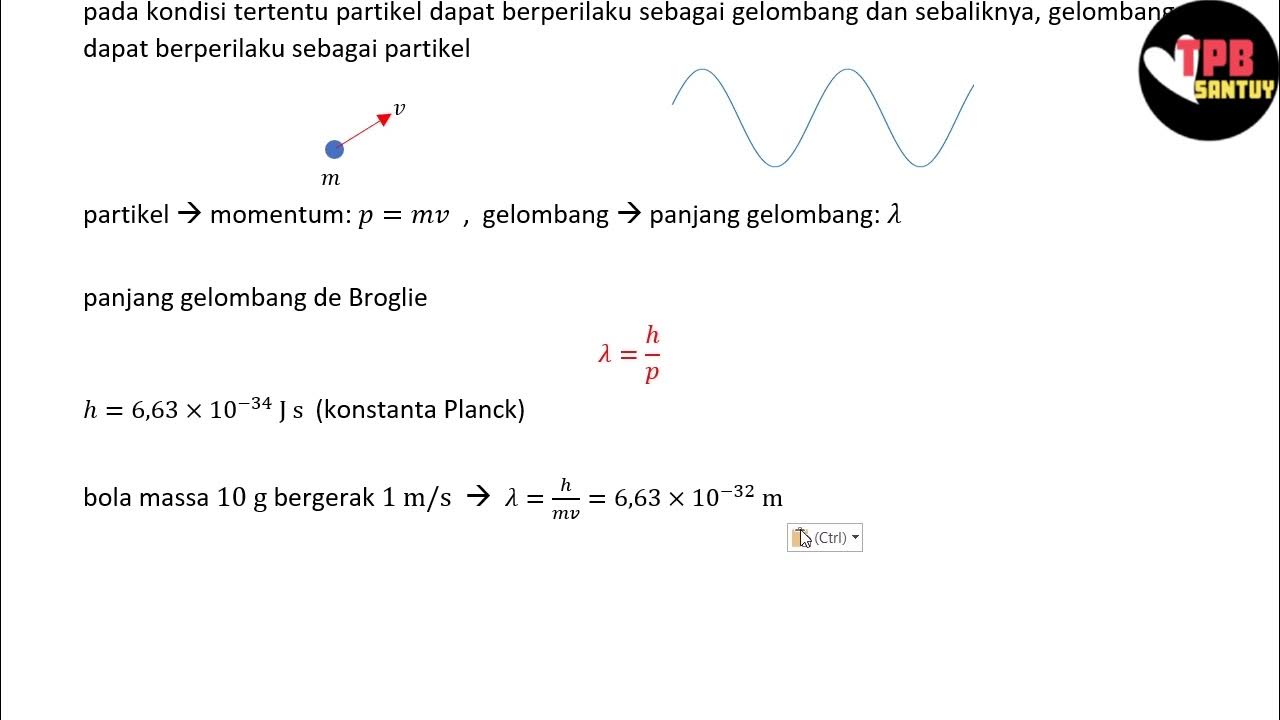
Dualisme Gelombang-Partikel | Fenomena Kuantum | Part 1 | Fisika Dasar

Konsep tentang foton - fisika kuantum kelas 12
Top 6 Discoveries By Albert Einstein || The Great Theories By Einstein || Explained ||
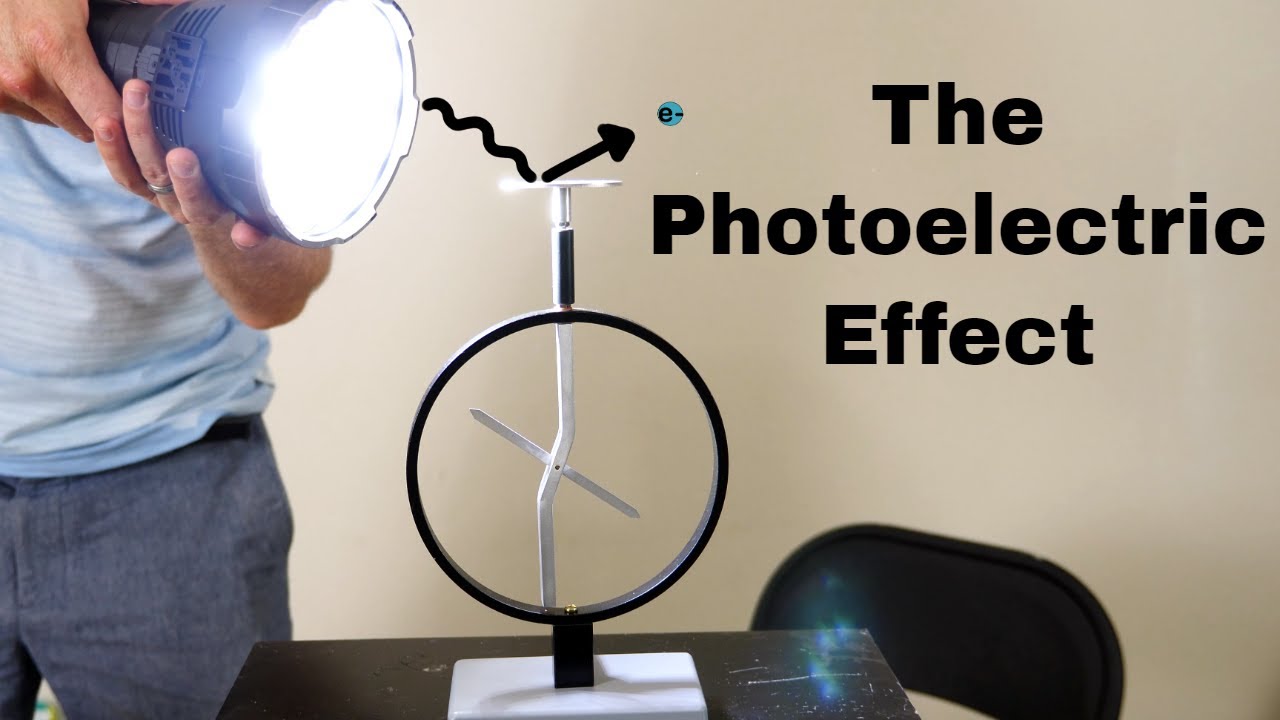
Knocking Electrons With Light—The Photoelectric Effect

Quantum Mechanics and the Schrödinger Equation

Particles and waves: The central mystery of quantum mechanics - Chad Orzel
5.0 / 5 (0 votes)

