STUDI AL-QURAN: pengertian, ruang lingkup, dan perkembangannya (part 2)
Summary
TLDRThis video script provides a detailed exploration of various Qur'anic sciences, such as the circumstances of the Qur'an's revelation (Nuzulul Qur'an), the reasons behind specific verses (Asbabun Nuzul), and the differentiation between verses revealed in Makkah and Madinah. It also covers the preservation and compilation of the Qur'an, the rules of proper recitation (Tajwid), variations in pronunciation (Qira'at), and the writing system used in the Qur'an (Rasm). Additionally, the script delves into the use of parables (Amsal) and the moral lessons from stories (Qasas) within the Qur'an, emphasizing the importance of context, language, and interpretation in understanding the sacred text.
Takeaways
- 😀 Nuzulul Quran studies the circumstances of Quranic revelations, including the time, place, and the condition of Prophet Muhammad when the verses were revealed.
- 😀 Understanding the context of Quranic revelations helps to interpret the Quran more accurately, making the meanings clearer and more profound.
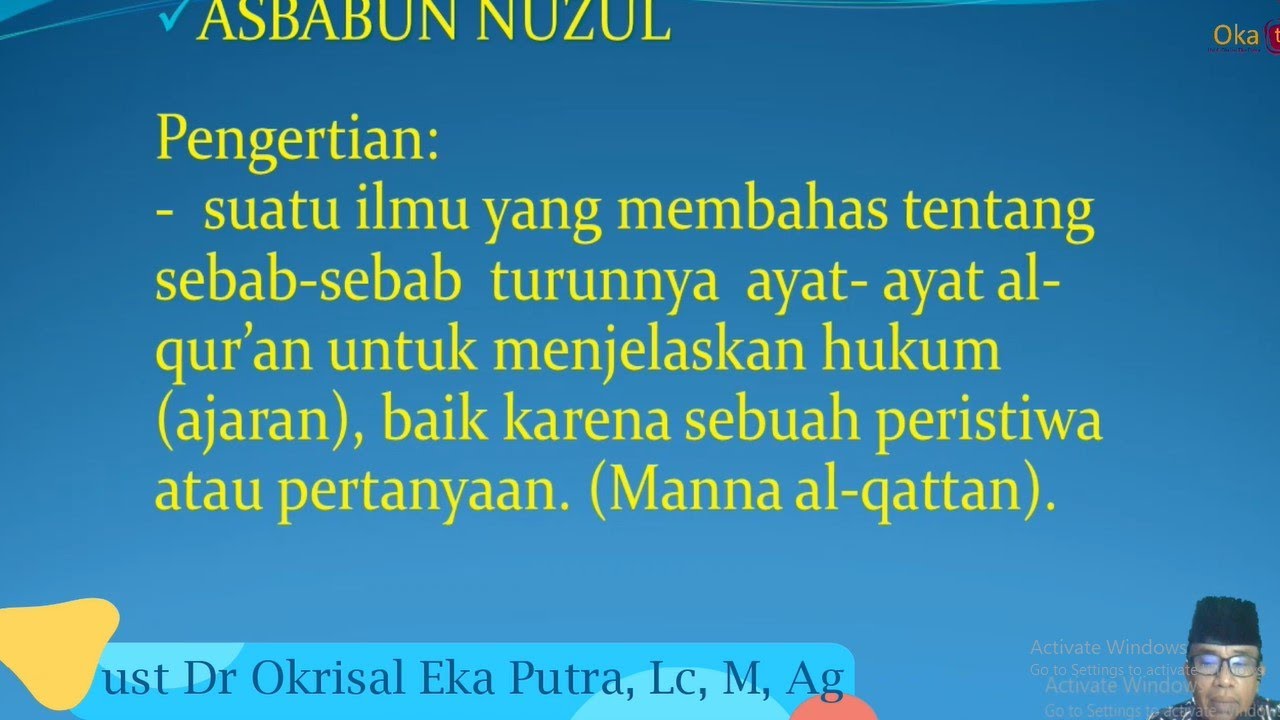
- 😀 Asbabun Nuzul refers to the reasons behind the revelation of certain Quranic verses, and this knowledge is derived from the narratives of the companions of Prophet Muhammad.
- 😀 Quranic verses can have multiple causes of revelation, and there can be differing reports on why a particular verse was revealed.
- 😀 Makki and Madani classifications help identify whether a verse was revealed in Mecca or Medina, each carrying its own characteristics.
- 😀 There are ongoing debates regarding whether certain Surahs, like Al-Fatihah, were revealed in Mecca or Medina.
- 😀 The Quran was not fully compiled during Prophet Muhammad’s time; it was collected and compiled under Caliph Uthman after the Prophet’s death.
- 😀 The Quranic order in the mushaf we have today differs from the chronological order of the revelations.
- 😀 Tartib refers to the arrangement of the Quranic verses and Surahs, and there are specific questions regarding the placement of verses like those in Surah Al-Infal and At-Tawbah.
- 😀 I’raab (grammatical case markings) plays a vital role in reading the Quran correctly and can significantly affect its meaning.
- 😀 Tajwid is the study of correct pronunciation and articulation of the Quranic verses, ensuring accurate recitation according to established rules.
- 😀 Qira’at refers to the different valid readings of the Quran, with variations in how certain words or phrases are pronounced, influencing their meaning.
- 😀 The Quran includes many examples (Amthal), where stories or metaphors are used to convey deeper meanings, such as the comparison of disbelievers to blind men.
- 😀 The Quran also contains repeated stories (Qasas) of various prophets, like the story of Prophet Musa, which appears multiple times with slight variations.
Q & A
What is the concept of 'Nuzul al-Quran' and why is it important?
-Nuzul al-Quran refers to the circumstances and context surrounding the revelation of the Qur'an, including the time, place, and conditions under which the verses were revealed. Understanding these factors is important because it helps interpret the Qur'an's meaning in a more precise and contextually relevant way.
What does the term 'Asbabun Nuzul' mean in Qur'anic studies?
-Asbabun Nuzul refers to the reasons behind the revelation of specific verses of the Qur'an. These reasons are often based on narrations from the companions of the Prophet, detailing specific events or circumstances that triggered the revelation of certain verses.
How do 'Makki' and 'Madani' verses differ in the Qur'an?
-Makki verses are those revealed in Mecca before the migration (Hijrah), while Madani verses were revealed in Medina after the migration. These two categories have different thematic focuses, with Makki verses often focusing on faith and spirituality, while Madani verses address social, legal, and political issues.
What was the process of preserving and compiling the Qur'an during the time of Prophet Muhammad?
-During the time of Prophet Muhammad, the Qur'an was not compiled into a single book but was written on various materials like parchment, stones, and palm leaves. It was preserved orally as well, with many companions memorizing it. The complete compilation into a standard mushaf happened later under the caliphate of Uthman ibn Affan.
Why does the order of verses in the Qur'an differ from the chronological order of their revelation?
-The order of verses in the Qur'an is not based on the chronological order of their revelation but rather on divine wisdom. The arrangement of verses in the current mushaf was established during Uthman's time, and the sequence is meant to support thematic coherence rather than reflect the chronological flow of events.
What is the concept of 'I'jaz al-Quran'?
-I'jaz al-Quran refers to the inimitability and miraculous nature of the Qur'an. It highlights the uniqueness and eloquence of the Qur'an that cannot be replicated by human beings, proving its divine origin.
How does the science of Tajwid contribute to the correct recitation of the Qur'an?
-Tajwid refers to the set of rules governing the proper pronunciation and articulation of Qur'anic verses. It ensures that each letter is pronounced correctly, with the appropriate intonation and emphasis, which is essential for preserving the intended meaning of the text.
What does 'Rasm al-Quran' refer to, and how was the Qur'an written during the time of Uthman ibn Affan?
-Rasm al-Quran refers to the script and orthography of the Qur'an. During the time of Uthman ibn Affan, a standardized script was developed, known as the 'Uthmanic script,' which became the basis for the Qur'anic text as it is written today. This script eliminated ambiguities in the text and provided a uniform way to write the Qur'an.
What is the significance of 'Qira'at' (readings) in the Qur'an?
-Qira'at refers to the different accepted methods of reciting the Qur'an. These variations in pronunciation and recitation, such as in the reading of certain letters or words, can affect the meaning of a verse and offer deeper insights into its interpretation.
Why are there repeated stories of certain prophets, like Musa, in the Qur'an?
-The Qur'an repeats the stories of certain prophets, such as Prophet Musa (Moses), to emphasize important lessons and moral teachings. These repeated narratives are intended to reinforce key messages and provide different perspectives on similar themes, offering deeper understanding each time they are mentioned.
Outlines

Этот раздел доступен только подписчикам платных тарифов. Пожалуйста, перейдите на платный тариф для доступа.
Перейти на платный тарифMindmap

Этот раздел доступен только подписчикам платных тарифов. Пожалуйста, перейдите на платный тариф для доступа.
Перейти на платный тарифKeywords

Этот раздел доступен только подписчикам платных тарифов. Пожалуйста, перейдите на платный тариф для доступа.
Перейти на платный тарифHighlights

Этот раздел доступен только подписчикам платных тарифов. Пожалуйста, перейдите на платный тариф для доступа.
Перейти на платный тарифTranscripts

Этот раздел доступен только подписчикам платных тарифов. Пожалуйста, перейдите на платный тариф для доступа.
Перейти на платный тарифПосмотреть больше похожих видео




5.0 / 5 (0 votes)

