Significant Figures and Scientific Notation
Summary
TLDRIn scientific experiments, data can be either qualitative, based on observations, or quantitative, based on numerical measurements. Precision and accuracy are critical, and the quality of measuring instruments impacts the precision of the data recorded. Significant figures play a crucial role in indicating the precision of measurements, with certain rules governing which digits are significant. For example, nonzero numbers and zeros between nonzero numbers are significant, while leading zeros are not. Proper use of significant figures is important in calculations, especially when adding or subtracting values, to ensure correct reporting of results.
Takeaways
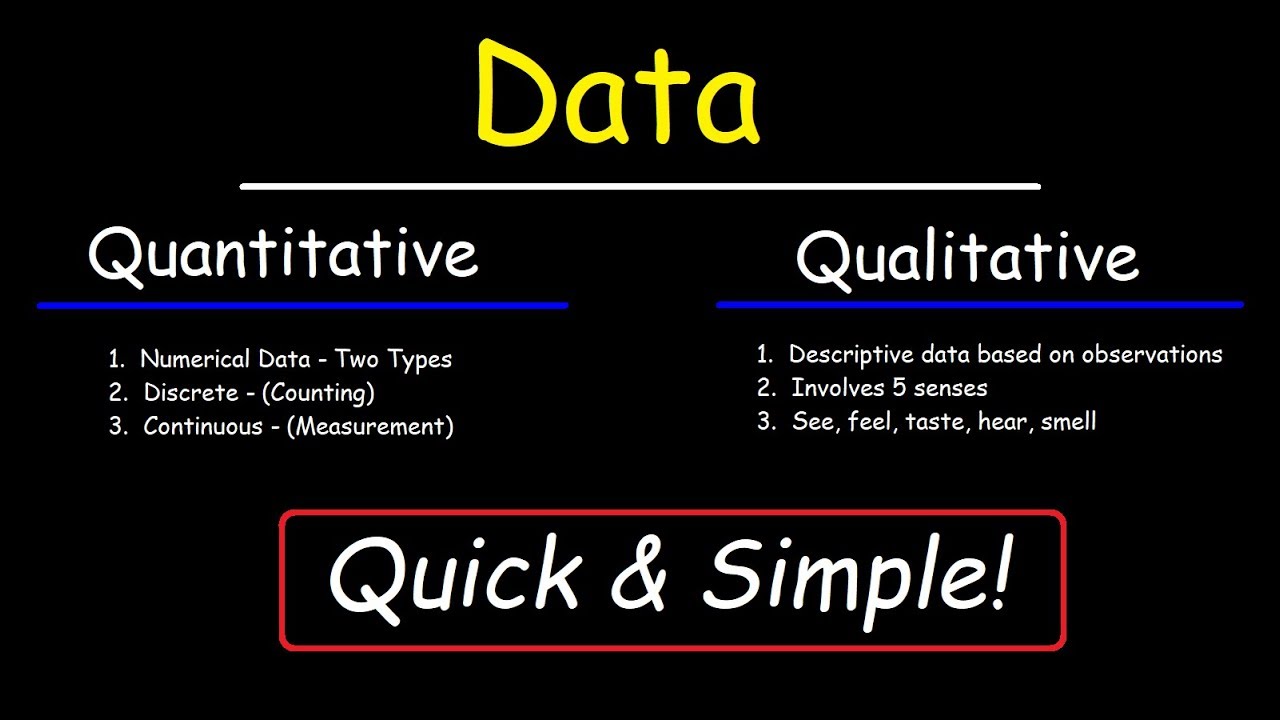
- 😀 Qualitative data is based on observation and is not measured numerically, such as 'the water is warm'.
- 😀 Quantitative data is measured and reported numerically, such as 'the water is 87°'.
- 😀 Measurements may vary slightly each time due to inherent uncertainty in the measurement process.
- 😀 The quality of a measuring instrument affects the precision of the measurement.
- 😀 Precision refers to the smallest repeatable digit a measuring instrument can record.
- 😀 A significant figure is a number that indicates the precision of a measurement.
- 😀 Non-zero numbers are always significant figures, such as in '524' (three significant figures).
- 😀 Sandwiched zeros (zeros between non-zero digits) are also considered significant, such as in '9,201'.
- 😀 Leading zeros (zeros before non-zero digits) are not significant, as in '0.3'.
- 😀 Trailing zeros are significant only if there is a decimal point, as in '7.50'.
- 😀 Trailing zeros without a decimal point are not significant, as in '25,000', which suggests a rounded value.
- 😀 When performing calculations, report results with the correct number of significant figures, and pay attention to decimal places during addition or subtraction.
Q & A
What is the difference between qualitative and quantitative data in scientific experiments?
-Qualitative data is based on observations that cannot be measured numerically, such as 'the water in the beaker is warm.' Quantitative data is based on measurements and can be reported numerically, such as 'the water in the beaker is 87°.'
Why is there uncertainty in measurements during scientific experiments?
-There is uncertainty because no measuring device is perfect, and slight variations may occur each time a measurement is taken. The precision of the instrument can affect the degree of uncertainty.
What does the term 'precision' refer to in scientific measurements?
-Precision refers to the smallest repeatable digit or the level of detail that an instrument can measure. For example, a balance that reads 7.50 grams is more precise than one that reads 7.5 grams.
What is a significant figure?
-A significant figure is a number that plays a role in determining the precision of a measurement. It is used to communicate how precise a measurement is, especially when reporting results or making calculations.
Are all numbers in a measurement considered significant?
-No, not all numbers are significant. Nonzero numbers are always significant. Leading zeros are not significant, while trailing zeros are only significant if the number has a decimal point.
How do leading zeros affect the significance of a measurement?
-Leading zeros are not significant because they only serve as placeholders. For example, 0.3 has one significant figure, and it could be written as 3 * 10^-3 without those leading zeros.
What role do trailing zeros play in determining significant figures?
-Trailing zeros are significant only when there is a decimal point present. For example, 7.50 has three significant figures, but 25,000 only has two significant figures unless it is written as 25,000.
How does the presence of a decimal point affect the interpretation of trailing zeros?
-When a number has a decimal point, trailing zeros are significant because they indicate the precision of the measurement. Without a decimal point, trailing zeros are not considered significant.
What should you pay attention to when performing calculations involving significant figures?
-When performing calculations, especially with a calculator, you need to ensure the results reflect the correct number of significant figures. For addition or subtraction, the result should have the same number of decimal places as the least precise number in the calculation.
What happens when you add or subtract numbers with different decimal places in terms of significant figures?
-When adding or subtracting, the result should be rounded to the same number of decimal places as the number with the fewest decimal places. For example, if adding 5113 and 2.0, the result should be rounded to one decimal place.
Outlines

Этот раздел доступен только подписчикам платных тарифов. Пожалуйста, перейдите на платный тариф для доступа.
Перейти на платный тарифMindmap

Этот раздел доступен только подписчикам платных тарифов. Пожалуйста, перейдите на платный тариф для доступа.
Перейти на платный тарифKeywords

Этот раздел доступен только подписчикам платных тарифов. Пожалуйста, перейдите на платный тариф для доступа.
Перейти на платный тарифHighlights

Этот раздел доступен только подписчикам платных тарифов. Пожалуйста, перейдите на платный тариф для доступа.
Перейти на платный тарифTranscripts

Этот раздел доступен только подписчикам платных тарифов. Пожалуйста, перейдите на платный тариф для доступа.
Перейти на платный тариф



5.0 / 5 (0 votes)

