ARM Register Set | ES | Embedded Systems | Lec-13 | Bhanu Priya
Summary
TLDRThis video explains the different ARM modes of operation, highlighting the roles of user/system modes, fast interrupt requests (FIQ), interrupt requests (IRQ), supervisor mode, undefined mode, and abort mode. The script outlines how each mode interacts with the ARM's 16-bit register set, including key registers like R0-R15 and CPSR. Special registers such as the saved program status register (SPSR) are discussed, with distinctions on which modes support them. The focus is on how registers are replaced or modified in response to specific interrupt or exception events, and the role of SPSR in privileged modes of operation.
Takeaways
- 😀 User and system modes in ARM architecture have access to all 15 registers and CPSR.
- 😀 In fast interrupt request (FIQ) mode, registers R8 to R14 are replaced with corresponding FIQ-specific registers (R8_FIQ to R14_FIQ).
- 😀 When an interrupt request is raised, registers R13 to R15 are replaced with interrupt request-specific registers (R13_IRQ and R14_IRQ).
- 😀 In supervisor mode, only R13 and R14 are replaced with R13_SVC and R14_SVC to handle privileged operations.
- 😀 In undefined mode, R13 and R14 are replaced with R13_UNC and R14_UNC, and the saved program status register (SPSR) is added.
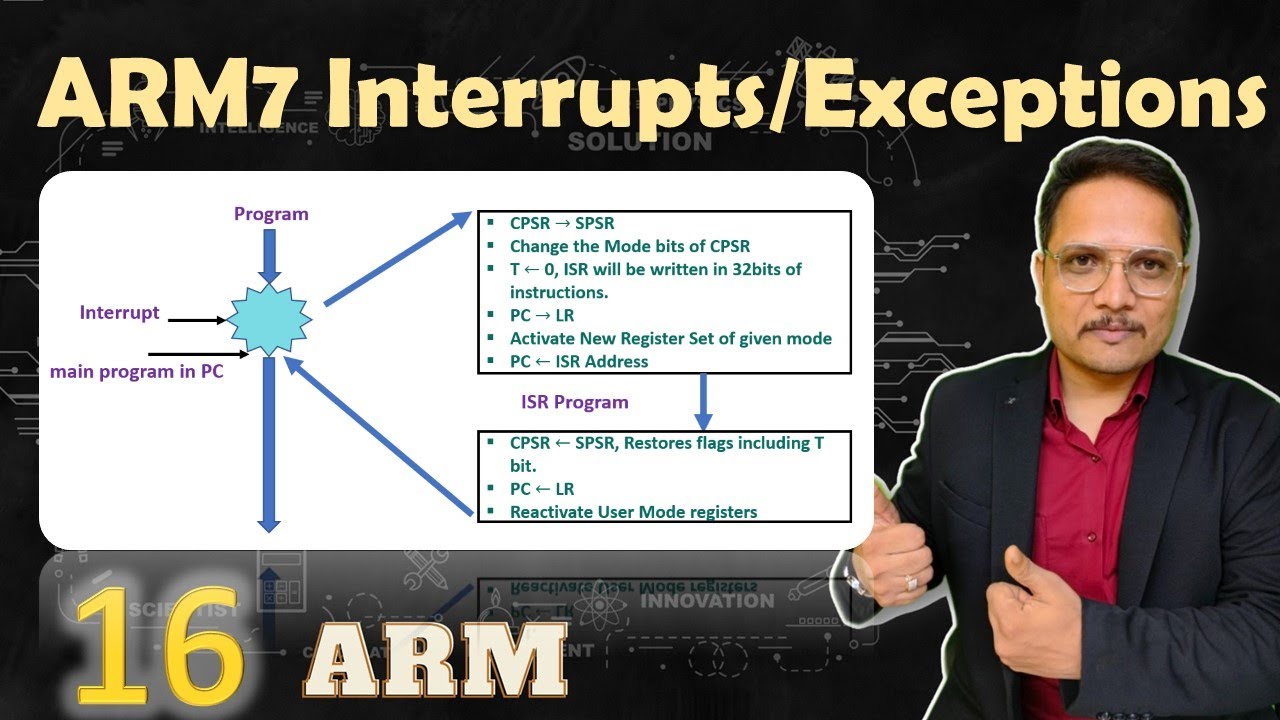
- 😀 The SPSR (Saved Program Status Register) is used to store the status of CPSR during privileged modes of operation.
- 😀 User and system modes do not support the use of SPSR, while other modes like FIQ, IRQ, supervisor, and undefined modes do.
- 😀 The register set in ARM architecture consists of 16 general-purpose registers (R0 to R15) and special status registers like SPSR.
- 😀 The SPSR helps in storing the current status of the CPSR to allow safe recovery of state during interrupts and exceptions.
- 😀 ARM architecture uses specific registers for different interrupt modes, ensuring that each mode has distinct registers for context switching.
Q & A
What are the two primary categories of ARM operating modes?
-The two primary categories are privileged modes and non-privileged modes.
Which registers are accessible in User and System modes?
-In User and System modes, all 15 registers (R0-R15) and the CPSR (Current Program Status Register) are accessible.
What happens to registers R8 to R14 in Fast Interrupt Request (FIQ) mode?
-In FIQ mode, registers R8 to R14 are replaced with specialized registers R8_FIQ to R14_FIQ to handle fast interrupts.
What role does the SPSR (Saved Program Status Register) play in ARM architecture?
-The SPSR stores the current state of the CPSR during mode transitions, particularly in privileged modes such as FIQ, IRQ, Supervisor, Undefined, and Abort modes.
Which ARM modes support the use of the SPSR?
-FIQ, IRQ, Supervisor, Undefined, and Abort modes support the use of SPSR. User and System modes do not.
What happens to registers R13 and R14 in IRQ mode?
-In IRQ mode, R13 and R14 are replaced with R13_IRQ and R14_IRQ to handle interrupt requests.
How are registers R13 and R14 modified in Supervisor and Undefined modes?
-In both Supervisor and Undefined modes, R13 and R14 are replaced with R13_SVC and R14_SVC (for Supervisor mode) or R13_UNDEF and R14_UNDEF (for Undefined mode).
Why is the SPSR not supported in User and System modes?
-SPSR is not supported in User and System modes because these are non-privileged modes, which do not require saving and restoring the state of the CPSR.
What is the significance of the 'Register Bank' in ARM architecture?
-The Register Bank is where all 16 general-purpose registers (R0-R15) and status registers, such as SPSR, are stored. The register set varies depending on the current operating mode.
What does the presence of specialized registers (e.g., R8_FIQ, R13_IRQ) in FIQ and IRQ modes indicate?
-The presence of specialized registers like R8_FIQ and R13_IRQ indicates that the processor has entered a privileged mode (FIQ or IRQ) and these registers are specifically used to handle fast interrupts and interrupt requests efficiently.
Outlines

Этот раздел доступен только подписчикам платных тарифов. Пожалуйста, перейдите на платный тариф для доступа.
Перейти на платный тарифMindmap

Этот раздел доступен только подписчикам платных тарифов. Пожалуйста, перейдите на платный тариф для доступа.
Перейти на платный тарифKeywords

Этот раздел доступен только подписчикам платных тарифов. Пожалуйста, перейдите на платный тариф для доступа.
Перейти на платный тарифHighlights

Этот раздел доступен только подписчикам платных тарифов. Пожалуйста, перейдите на платный тариф для доступа.
Перейти на платный тарифTranscripts

Этот раздел доступен только подписчикам платных тарифов. Пожалуйста, перейдите на платный тариф для доступа.
Перейти на платный тарифПосмотреть больше похожих видео



5.0 / 5 (0 votes)

