Kurikulum Merdeka Matematika Kelas 9 Bab 3 Transformasi Geometri
Summary
TLDRThis educational video explores 9th-grade mathematics, focusing on geometric transformations. It covers translations, reflections, rotations, congruence, and dilations with clear explanations and step-by-step examples. The instructor demonstrates how to calculate new coordinates after transformations, emphasizing the importance of understanding direction, scale, and symmetry. Viewers learn practical methods for solving problems involving movement, mirroring, rotation using a protractor, identifying congruent shapes, and resizing figures with scale factors. The video combines visual illustrations with numerical exercises, making complex concepts accessible, while providing tips and formulas that are crucial for mastering geometry in a fun and engaging way.
Takeaways
- 😀 Translating (translation) involves shifting a point's coordinates by specific amounts determined by the values of 'a' and 'b', using the formula x' = x + a, y' = y + b.
- 😀 The translation formula is easy to apply: if point A (1, 5) undergoes a translation by x + 4 and y - 3, the resulting coordinates for A' would be (5, 2).
- 😀 Reflections in geometry involve creating a mirror image of a shape or point across a line of symmetry. For example, a reflection across the x-axis will flip the y-coordinate's sign.
- 😀 Remembering key formulas for reflection across different axes or points is essential, such as x,y → x,-y for reflection over the x-axis.
- 😀 Rotation in geometry doesn’t rely on a formula but rather on measuring the angle of rotation and visually determining the resulting coordinates using a protractor or other tools.
- 😀 Congruence in geometry means two shapes are identical in size and shape, as shown with squares or other polygons having equal side lengths.
- 😀 For congruence to hold true, both the shape’s size and the angles must be identical, as seen in the example of two squares with side lengths of 3 cm.
- 😀 In congruence problems, corresponding sides and angles in two shapes are equal, so a problem involving congruence might ask to find lengths based on given information.
- 😀 Dilations involve resizing a figure either by scaling up or down based on a center point and a scale factor. For example, a dilation by a factor of 3 will multiply each coordinate by 3.
- 😀 The scale factor for dilation determines whether the image is enlarged or reduced: if the scale factor is greater than 1, it enlarges the shape; if it’s between 0 and 1, it shrinks the shape.
Q & A
What is translation in geometry, and how is it applied?
-Translation is a transformation that shifts a point from one location to another according to a specific rule. The transformation is defined by adding values 'a' and 'b' to the x and y coordinates respectively. For example, if the original point is (1, 5), and the translation rule is x → x + 4, y → y - 3, the new point would be (5, 2).
How can you determine the new coordinates of a point after translation?
-To determine the new coordinates, you use the given translation rules. For example, if the rule is x → x + 4 and y → y - 3, you simply add 4 to the original x-coordinate and subtract 3 from the original y-coordinate. For a point (1, 5), this gives the new coordinates (5, 2).
What are the rules for translation when moving points left, right, up, or down?
-When translating points: moving right (or increasing x) adds a positive value to the x-coordinate, while moving left (or decreasing x) subtracts from the x-coordinate. Moving up (or increasing y) adds a positive value to the y-coordinate, and moving down (or decreasing y) subtracts from the y-coordinate.
What is reflection in geometry, and how does it work?
-Reflection, or mirroring, is a transformation where a point or shape is flipped over a line (like the x-axis or y-axis), creating a mirror image. For example, reflecting a point (1, 1) over the x-axis changes its coordinates to (1, -1), as the y-coordinate is negated.
How do you reflect a point over the x-axis or y-axis?
-To reflect a point over the x-axis, simply negate the y-coordinate, leaving the x-coordinate unchanged. For example, (1, 5) becomes (1, -5). To reflect over the y-axis, negate the x-coordinate while keeping the y-coordinate the same. For example, (-3, 5) becomes (3, 5).
What is the difference between reflection over the x-axis and reflection over the y-axis?
-Reflection over the x-axis negates the y-coordinate of a point, while the x-coordinate remains unchanged. Conversely, reflection over the y-axis negates the x-coordinate, and the y-coordinate stays the same. These transformations create mirror images of the original point.
How does rotation work in geometry, and how is it performed?
-Rotation in geometry involves turning a figure around a fixed point by a specific angle. The degree of rotation determines the new position of the figure. For example, to rotate a figure by 90 degrees, you would use a protractor or other tools to measure the angle and find the new coordinates.
What does 'congruence' mean in geometry, and how is it determined?
-Congruence in geometry means that two shapes or figures are identical in size and shape, with corresponding sides and angles being equal. For example, two squares with sides of 3 cm each are congruent, while two cylinders with different diameters or heights are not congruent.
How can you identify whether two shapes are congruent?
-Two shapes are congruent if they have the same size and shape, meaning their corresponding sides and angles are equal. For example, two squares with equal side lengths are congruent. In contrast, two shapes with different sizes or proportions are not congruent.
What is dilation, and how does the scale factor affect it?
-Dilation is a transformation that changes the size of a figure by multiplying the coordinates of each point by a scale factor. If the scale factor is greater than 1, the figure enlarges; if it is between 0 and 1, the figure reduces in size. For example, a dilation with a factor of 3 would multiply each coordinate by 3.
Outlines

このセクションは有料ユーザー限定です。 アクセスするには、アップグレードをお願いします。
今すぐアップグレードMindmap

このセクションは有料ユーザー限定です。 アクセスするには、アップグレードをお願いします。
今すぐアップグレードKeywords

このセクションは有料ユーザー限定です。 アクセスするには、アップグレードをお願いします。
今すぐアップグレードHighlights

このセクションは有料ユーザー限定です。 アクセスするには、アップグレードをお願いします。
今すぐアップグレードTranscripts

このセクションは有料ユーザー限定です。 アクセスするには、アップグレードをお願いします。
今すぐアップグレード関連動画をさらに表示
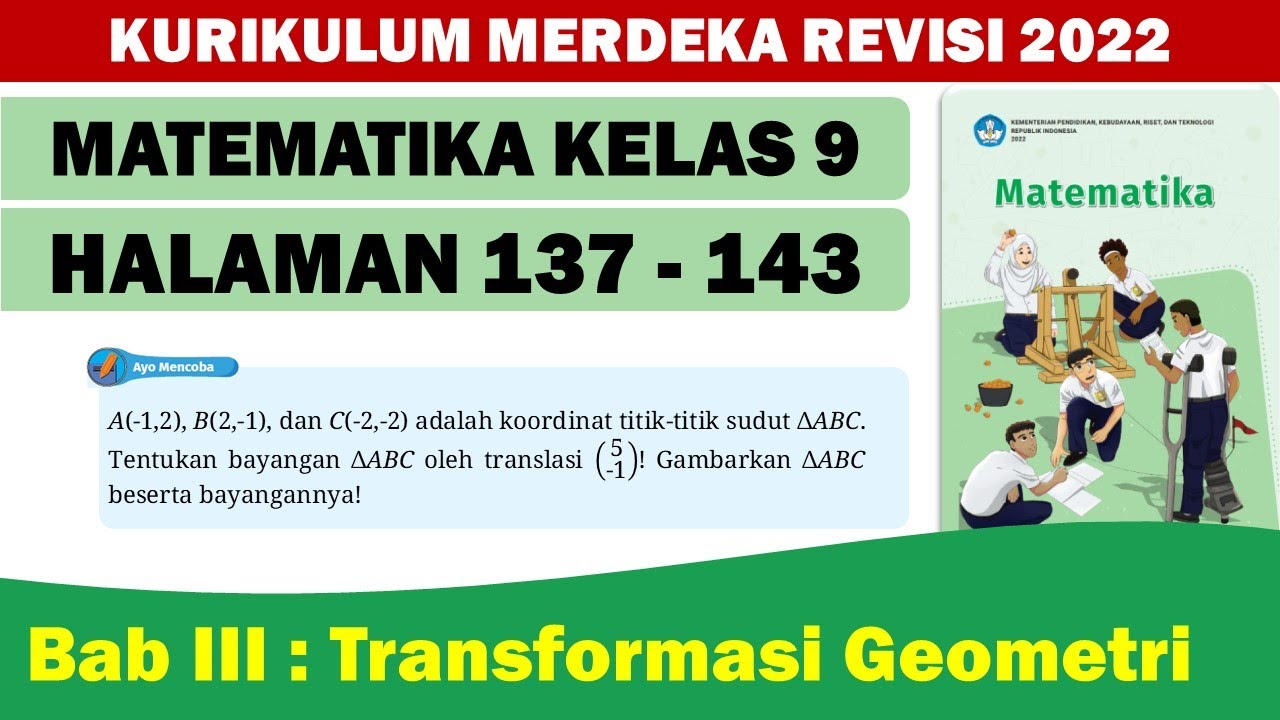
MATEMATIKA KELAS 9 HALAMAN 137-143 KURIKULUM MERDEKA EDISI 2022
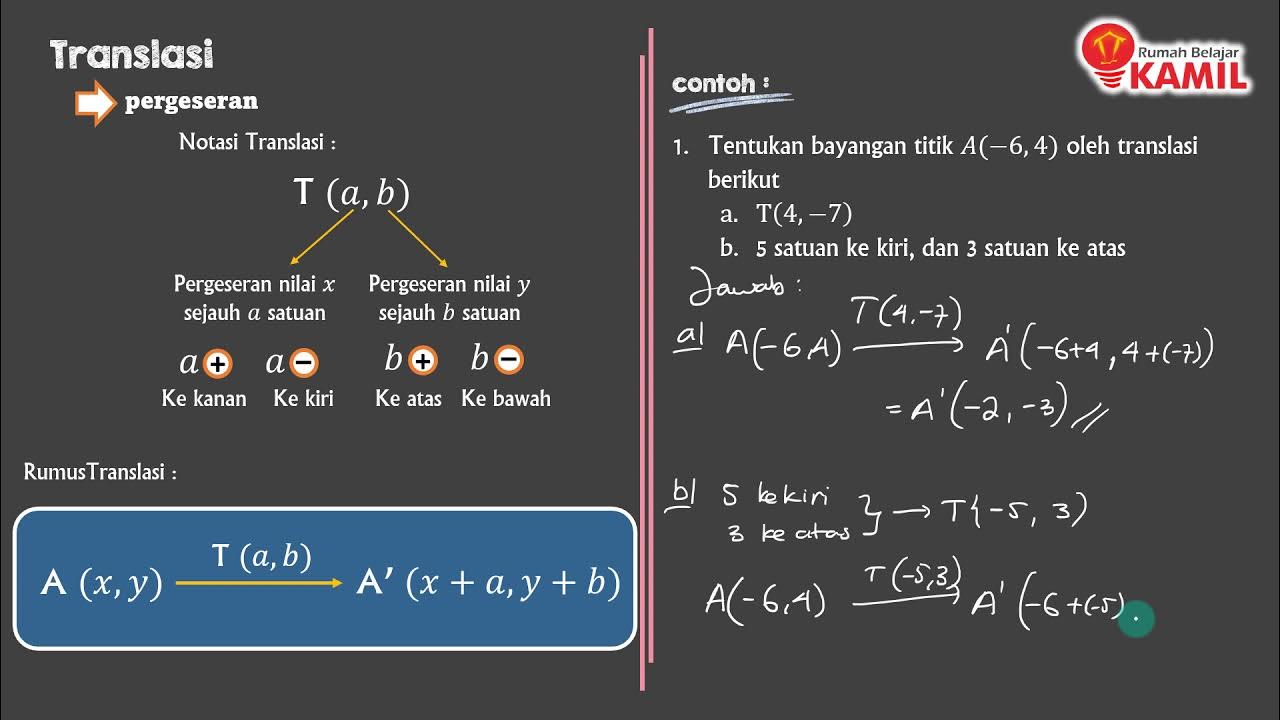
Matematika Kelas 9 : Transformasi Geometri (part 1 : Translasi)

Kurikulum Merdeka Matematika Kelas 9 Bab 2 Bangun Ruang Sisi Datar
Pola Bilangan (5) | Barisan dan Deret Geometri
Transformasi Geometri Bagian 5 -Transformasi Matriks Matematika Wajib Kelas 11

TRANSFORMASI GEOMETRI | TRANSLASI
5.0 / 5 (0 votes)

