LCA Fundamentals: Life cycle inventory (LCI) - LCA phase breakdown
Summary
TLDRThe Life Cycle Inventory (LCI) phase of Life Cycle Assessment (LCA) is the second and often most time-consuming step. It involves quantifying all inputs and outputs, such as materials, energy, transport, and emissions for a product, using software. The data collected forms the system model, which is linked to environmental impact data from suppliers or LCI databases like EcoInvent. Challenges include defining the system boundaries and making assumptions, especially when data is incomplete. The LCI phase is crucial for understanding environmental impacts, laying the groundwork for further analysis in subsequent phases.
Takeaways
- 😀 The Life Cycle Inventory (LCI) is the second phase of Life Cycle Assessment (LCA) and is considered the most time-consuming phase.
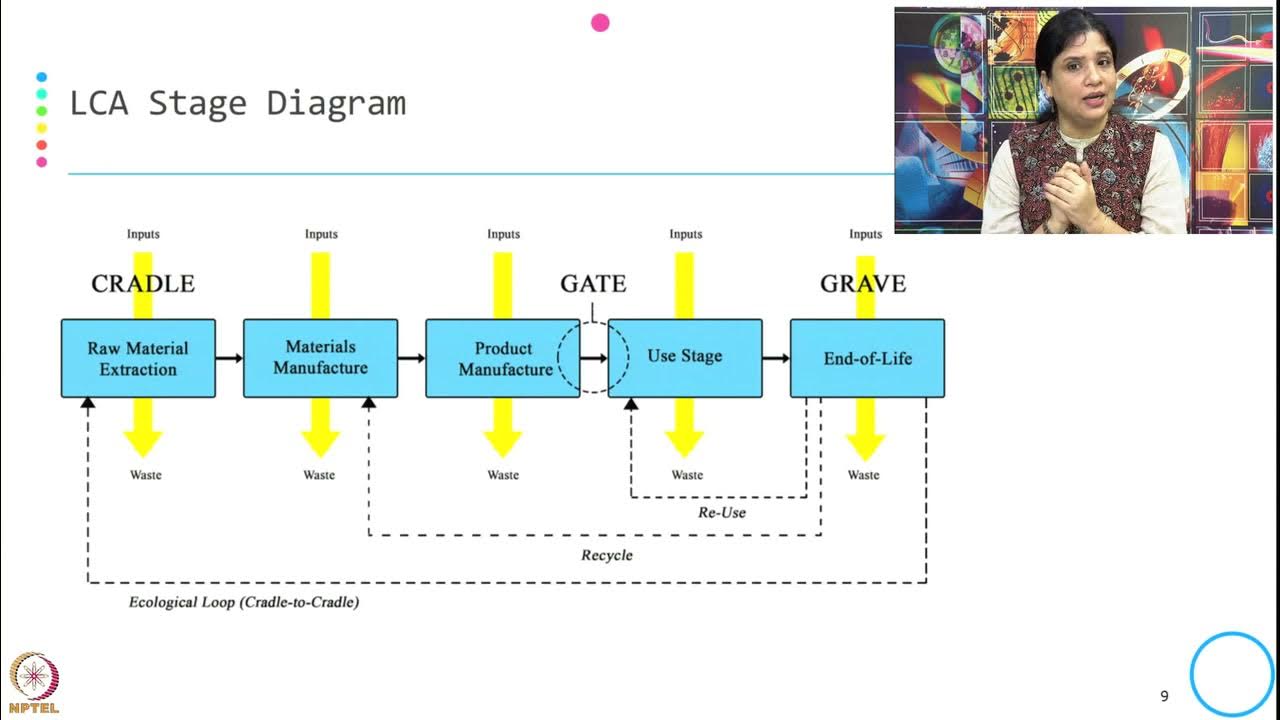
- 😀 In the Goal and Scope phase, you define the system you're assessing, such as a chair, and set the boundaries of your study, like Cradle to Gate.
- 😀 The LCI phase focuses on quantifying all inputs and outputs, such as materials, energy, transport, waste, and emissions.
- 😀 All data related to the product's processes, including material inputs and environmental outputs, is recorded in a table format to ensure replicability.
- 😀 Background data is crucial for linking the product's inputs and outputs to environmental impact, which can come from suppliers or LCI databases like EcoInvent.
- 😀 LCI databases provide environmental impact data based on industry and scientific research, which helps approximate the supply chain's impact.
- 😀 The Life Cycle Inventory lists all interactions between the product system and the environment, including emissions from production or transport and resource extraction.
- 😀 LCI data often stays in the background, but it plays an essential role in calculating the environmental impacts in the next phase of LCA.
- 😀 Challenges in the LCI phase include the blurry line between the Goal and Scope phase, which may require adjustments to the study’s boundaries.
- 😀 Assumptions are inevitable in every LCA, such as approximating material transport or dealing with incomplete data sets. It’s important to note assumptions carefully.
- 😀 The LCI phase has two main outcomes: quantifying the foreground system and adding background data to link the product to broader environmental impacts.
Q & A
What is the Life Cycle Inventory (LCI) phase in LCA?
-The LCI phase is the second phase of Life Cycle Assessment (LCA), where all inputs and outputs of the studied system are quantified. It focuses on collecting detailed data about materials, energy, transport, waste, and emissions related to the product.
Why is the LCI phase considered the most time-consuming in LCA?
-Because it requires detailed modeling of every process in the product system, including material usage, energy consumption, transport, waste, and emissions, to accurately quantify all interactions with the environment.
What is the difference between foreground and background data in LCI?
-Foreground data refers to activities directly controlled by or specific to the studied product, while background data comes from external sources like suppliers or LCI databases to estimate environmental impacts of upstream processes.
How is a product system modeled in the LCI phase?
-The product system is modeled by breaking down each process and quantifying all inputs (materials, energy) and outputs (emissions, waste), often using tables for clarity and replicability.
What are LCI databases and why are they used?
-LCI databases, such as EcoInvent, contain environmental impact information based on industry or scientific data. They are used to approximate the impacts of processes or materials when direct data is unavailable.
What is meant by 'Cradle-to-gate' in LCA?
-'Cradle-to-gate' refers to assessing the product’s life cycle from raw material extraction (cradle) to the factory gate before it is delivered to the consumer, excluding use and disposal phases.
What challenges might arise during the LCI phase?
-Challenges include unclear boundaries between goal and scope, missing data for certain processes or materials, and the need for assumptions when data is incomplete. LCA is iterative, so scope adjustments may be needed.
How should assumptions be handled in the LCI phase?
-Assumptions should be carefully documented, and a conservative or worst-case approach can be used when precise data is unavailable to ensure transparency and reliability.
What is the outcome of the LCI phase?
-The outcome is a life cycle inventory listing all interactions of the modeled system with the environment, including material usage, emissions, resource extraction, energy consumption, and waste production.
Why is the LCI phase important for the next phases of LCA?
-Because it provides the quantified data on inputs and outputs that are required to calculate environmental impacts in the subsequent Life Cycle Impact Assessment (LCIA) phase.
How can the LCI phase ensure replicability?
-By documenting all inputs, outputs, and modeling decisions in tables and clearly specifying assumptions, other researchers can reproduce the study or validate the results.
What two key objectives are achieved in the LCI phase?
-1) Quantification of the product’s foreground system. 2) Integration of environmental interactions through background data, providing a foundation for impact assessment.
Outlines

このセクションは有料ユーザー限定です。 アクセスするには、アップグレードをお願いします。
今すぐアップグレードMindmap

このセクションは有料ユーザー限定です。 アクセスするには、アップグレードをお願いします。
今すぐアップグレードKeywords

このセクションは有料ユーザー限定です。 アクセスするには、アップグレードをお願いします。
今すぐアップグレードHighlights

このセクションは有料ユーザー限定です。 アクセスするには、アップグレードをお願いします。
今すぐアップグレードTranscripts

このセクションは有料ユーザー限定です。 アクセスするには、アップグレードをお願いします。
今すぐアップグレード



5.0 / 5 (0 votes)

