Definisi Hidrolisis Garam | Materi Hidrolisis Garam | Kimia SMA | Pojan.id
Summary
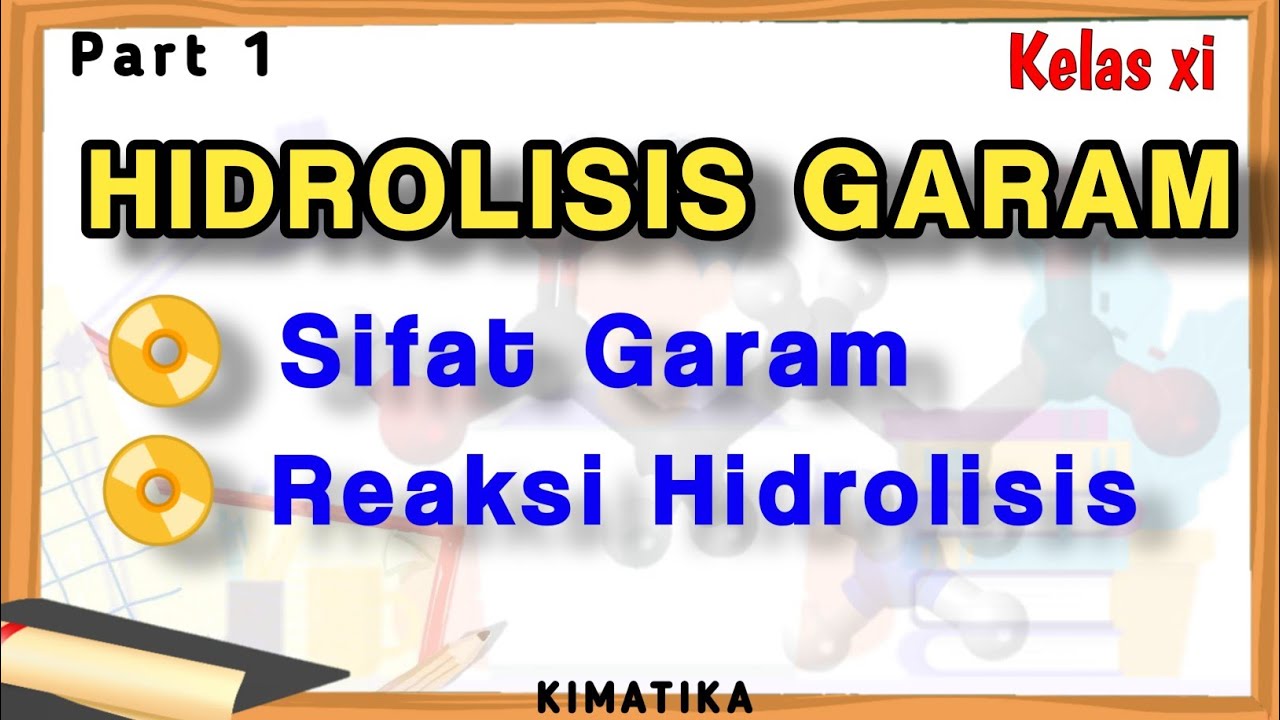
TLDRThis video explains the concept of salt hydrolysis, starting with foundational concepts such as acids and bases according to Arrhenius. It covers the formation of salts from acid-base reactions and categorizes them into four types based on their composition (strong acid + strong base, strong acid + weak base, weak acid + strong base, and weak acid + weak base). The script highlights how salts dissociate into cations and anions, and how their reactions with water (hydrolysis) influence the pH of solutions. The video emphasizes understanding these reactions to determine whether salts are acidic, basic, or neutral.
Takeaways
- 😀 Acids release H⁺ ions in water, while bases release OH⁻ ions according to Arrhenius' definition.
- 😀 The pH scale determines acidity or basicity: acidic <7, neutral =7, basic >7.
- 😀 Acids and bases can be strong or weak, depending on their degree of ionization in water.
- 😀 Salts are products of reactions between acids and bases, sometimes producing water.
- 😀 There are four types of salts based on their origin: strong acid + strong base, strong acid + weak base, weak acid + strong base, and weak acid + weak base.
- 😀 The pH of a salt solution depends on the strength of the parent acid and base: neutral, acidic, or basic.
- 😀 Salts can dissociate into cations (from the base) and anions (from the acid).
- 😀 Cations react with water to form bases, while anions react with water to form acids, a process called hydrolysis.
- 😀 Hydrolysis of salts determines whether a salt solution is acidic, basic, or neutral.
- 😀 The relative values of Ka (acid dissociation constant) and Kb (base dissociation constant) indicate the resulting pH of salts formed from weak acids and weak bases.
- 😀 Understanding the origin of ions helps predict the products of hydrolysis and the resulting pH of salt solutions.
Q & A
What is the definition of salt hydrolysis?
-Salt hydrolysis is a reaction that occurs when either the cation (positive ion) or the anion (negative ion) of a salt reacts with water (H2O), altering the pH of the solution and determining whether the salt solution is acidic, basic, or neutral.
What is the role of acids and bases in salt formation?
-Acids and bases react together to form salts. An acid releases H+ ions (such as HCl), and a base releases OH- ions (such as NaOH). The reaction of an acid and base forms a salt (e.g., NaCl) and sometimes water (H2O).
How is the strength of acids and bases related to the type of salt formed?
-The strength of the acid and base involved in a reaction determines the type of salt formed. Strong acids and strong bases form neutral salts, while weak acids or weak bases result in acidic or basic salts, respectively.
What are the four types of salts based on the strength of the acid and base?
-The four types of salts are: 1) Salts from strong acid + strong base (neutral salts), 2) Salts from strong acid + weak base (acidic salts), 3) Salts from weak acid + strong base (basic salts), and 4) Salts from weak acid + weak base (which can be acidic, basic, or neutral depending on the relative strengths of the acid and base).
What determines whether a salt is acidic, basic, or neutral?
-The pH of a salt solution is determined by the nature of the ions formed during salt dissociation. If the salt produces an acidic ion (from a weak base), the solution is acidic; if it produces a basic ion (from a weak acid), the solution is basic; and if both ions are neutral, the solution is neutral.
How do you calculate the pH of a salt solution?
-To calculate the pH of a salt solution, we must first understand the behavior of the ions produced during salt dissociation. We determine whether the ions hydrolyze in water and whether they shift the equilibrium towards acidic or basic conditions. This requires knowledge of ionization constants (Ka for acids, Kb for bases).
What are the ions involved in the dissociation of NaCl, and what does it mean for its pH?
-NaCl dissociates into Na+ (cation) and Cl- (anion). Both of these ions do not react with water in a way that affects the pH, so the solution of NaCl in water remains neutral with a pH around 7.
What happens during the hydrolysis of NH4Cl?
-NH4Cl dissociates into NH4+ (cation) and Cl- (anion). The NH4+ ion is a weak acid and will react with water to produce H+ ions, making the solution acidic. The presence of NH4+ contributes to a pH less than 7.
Why is the pH of a solution formed by NaOH different from that formed by NH3?
-NaOH is a strong base and dissociates completely in water to form OH- ions, resulting in a basic solution with a pH greater than 7. NH3 is a weak base and reacts partially with water to form OH- ions, but not as completely, so its solution is also basic, but less strongly so than NaOH.
What is the relationship between the ionization constants (Ka and Kb) and the pH of a salt solution?
-The ionization constants Ka (acid dissociation constant) and Kb (base dissociation constant) influence the degree to which an acid or base dissociates in water. If the Ka or Kb is large, the substance is stronger, meaning it will more significantly affect the pH. For salts formed from weak acids and weak bases, the comparison of Ka and Kb determines whether the salt will be acidic, basic, or neutral.
Outlines

このセクションは有料ユーザー限定です。 アクセスするには、アップグレードをお願いします。
今すぐアップグレードMindmap

このセクションは有料ユーザー限定です。 アクセスするには、アップグレードをお願いします。
今すぐアップグレードKeywords

このセクションは有料ユーザー限定です。 アクセスするには、アップグレードをお願いします。
今すぐアップグレードHighlights

このセクションは有料ユーザー限定です。 アクセスするには、アップグレードをお願いします。
今すぐアップグレードTranscripts

このセクションは有料ユーザー限定です。 アクセスするには、アップグレードをお願いします。
今すぐアップグレード



5.0 / 5 (0 votes)

