ENERGI | Usaha dan Energi #2 - Fisika Kelas 10
Summary
TLDRPak Anang's physics lesson focuses on the concepts of kinetic and potential energy, explaining their importance in relation to motion and position. He introduces the formulas for both types of energy, emphasizing how speed influences kinetic energy and height affects potential energy. Through real-world examples, including the motion of a ball and lifting objects, the relationship between work and energy is illustrated. The lesson also includes step-by-step calculations to help students understand how to apply these concepts in practical scenarios. The goal is to help students grasp the fundamental physics of energy transformations.
Takeaways
- ⚡ Energy is defined as the ability to perform activities or do work, and in physics it is mainly discussed in terms of motion and position.
- 🚀 Kinetic energy is the energy of motion and depends on an object's mass and velocity, expressed by the formula KE = 1/2 mv^2.
- 🏃 The faster an object moves, the greater its kinetic energy, which is why faster motion requires more energy.
- 🏔️ Potential energy is the energy due to an object's position or height, especially in Earth’s gravitational field.
- 📏 Gravitational potential energy is calculated using PE = mgh, where m is mass, g is gravitational acceleration, and h is height.
- ⬆️ The higher an object is lifted, the greater its potential energy because more work is required against gravity.
- 🔗 Both kinetic energy and potential energy use the SI unit joule (J).
- 🛠️ Work is directly related to the change in kinetic energy, following the work-energy theorem: W = ΔKE = KE2 - KE1.
- 🏗️ Work is also related to the change in potential energy when an object changes height: W = ΔPE = PE2 - PE1.
- 📚 In the first example problem, a 4 kg object accelerating from rest at 3 m/s^2 for 2 seconds reaches 6 m/s, producing 72 J of work converted into kinetic energy.
- 🧮 The solution to the first problem combines concepts from uniformly accelerated motion (GLBB) with the work-energy theorem.
- 🌍 In the second example, a 0.5 kg object raised from 5 m to 15 m gains 50 J of gravitational potential energy.
- 🎯 The lesson emphasizes understanding formulas through real-life examples such as running faster or lifting objects to higher floors.
- 💡 Mastering the relationship between work, kinetic energy, and potential energy helps solve many mechanics problems in grade 10 physics.
Q & A
What is the definition of energy in the context of physics?
-Energy in physics is the ability of an object to perform work, which can manifest as motion, position, or other physical effects.
What are the two main types of energy discussed in the video?
-The two main types of energy are kinetic energy, which relates to motion, and potential energy, which relates to an object's position or height.
How is kinetic energy calculated?
-Kinetic energy is calculated using the formula E_k = 1/2 m v^2, where m is the mass of the object and v is its velocity.
What factors affect the magnitude of potential energy?
-Potential energy depends on the mass of the object, the acceleration due to gravity, and the height of the object, calculated as E_p = m g h.
What is the unit of energy in the International System of Units?
-The unit of energy in the SI system is the Joule (J).
How is work related to energy?
-Work is the process of transferring energy to an object. The work done on an object equals the change in its energy, either kinetic or potential.
How do you calculate the work done to change the kinetic energy of an object?
-The work done to change kinetic energy is W = 1/2 m (v2^2 - v1^2), where v1 is the initial velocity and v2 is the final velocity of the object.
How do you calculate the work done to change the potential energy of an object?
-The work done to change potential energy is W = m g (h2 - h1), where h1 is the initial height and h2 is the final height of the object.
In the example of a 4 kg object accelerated at 3 m/s² for 2 seconds from rest, what is the kinetic energy gained?
-The kinetic energy gained is 72 Joules, calculated as W = 1/2 * 4 * (6^2 - 0^2) = 72 J.
In the example of a 0.5 kg object lifted from 5 m to 15 m, what is the change in potential energy?
-The change in potential energy is 50 Joules, calculated as ΔE_p = 0.5 * 10 * (15 - 5) = 50 J.
Why is it important to convert mass to kilograms when calculating energy in SI units?
-It is important because the SI unit for energy (Joule) requires mass in kilograms; using grams without conversion will give incorrect results.
How can understanding energy help in solving physics problems?
-Understanding energy allows one to relate forces, motion, and positions of objects, making it easier to calculate work, velocity, and changes in height systematically.
Outlines

このセクションは有料ユーザー限定です。 アクセスするには、アップグレードをお願いします。
今すぐアップグレードMindmap

このセクションは有料ユーザー限定です。 アクセスするには、アップグレードをお願いします。
今すぐアップグレードKeywords

このセクションは有料ユーザー限定です。 アクセスするには、アップグレードをお願いします。
今すぐアップグレードHighlights

このセクションは有料ユーザー限定です。 アクセスするには、アップグレードをお願いします。
今すぐアップグレードTranscripts

このセクションは有料ユーザー限定です。 アクセスするには、アップグレードをお願いします。
今すぐアップグレード関連動画をさらに表示

Bab 3 ENERGI | usaha, energi dan pesawat sederhana IPA KELAS 8 KURIKULUM merdeka #ipakelas8

Materi Inti Jenis Jenis Energi
A Level Physics Revision: All of Work, Energy and Power (in 18 minutes)

Belajar IPA - Energi Kinetik, Potensial dan Mekanik Kelas 7 SMP/MTs #Energi #energikinetik
Molecular Kinetic Theory
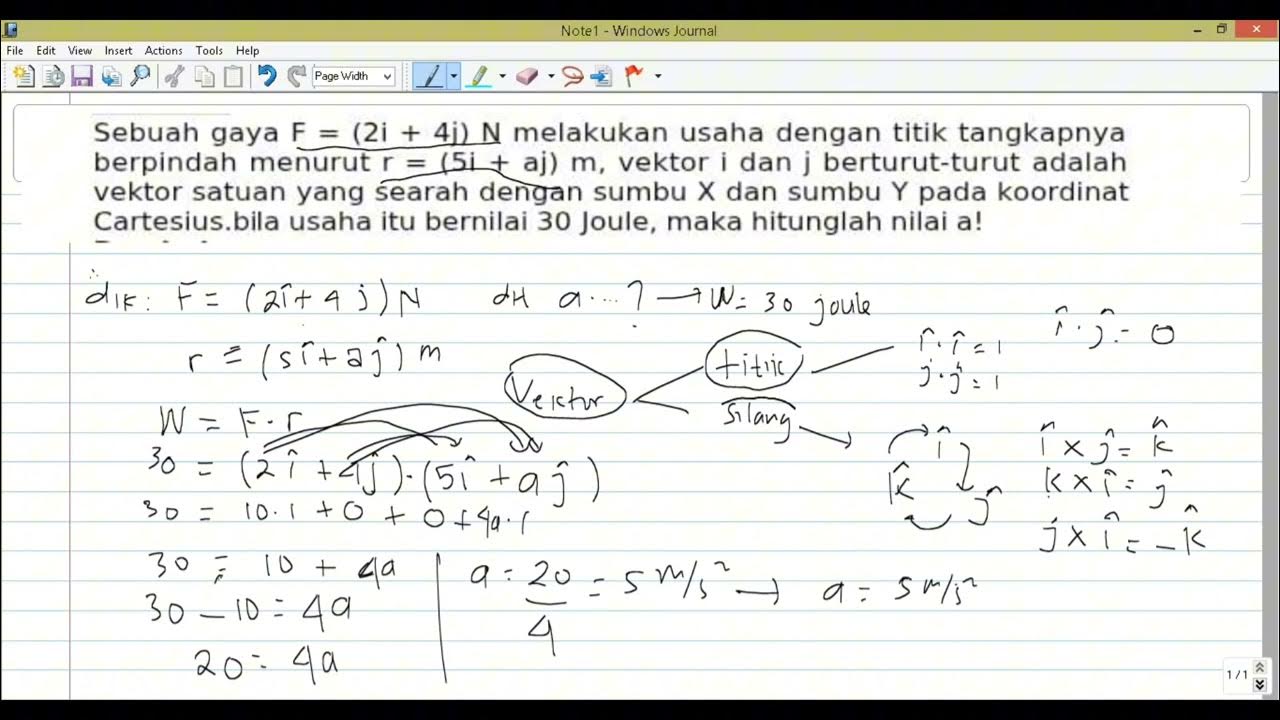
contoh soal usaha dan energi #part 1#
5.0 / 5 (0 votes)

