Sifat Sifat Relasi Biner
Summary
TLDRThis video provides a clear and detailed explanation of the properties of binary relations in discrete mathematics. It covers the four main properties: reflexive, transitive, symmetric, and antisymmetric, with definitions, examples, and methods for verifying each property. The video illustrates how to identify these properties using sets, matrices, and directed graphs, highlighting specific cues such as diagonal elements in matrices for reflexivity and mirrored elements for symmetry. Through step-by-step examples, the content helps viewers understand how to determine whether a relation possesses these properties, making it a practical guide for students studying discrete mathematics.
Takeaways
- 😀 The video explains binary relations and focuses on three key properties: reflexive, transitive, and symmetric/antisymmetric.
- 😀 A relation R on a set A is reflexive if every element in A relates to itself, i.e., (a, a) ∈ R for all a ∈ A.
- 😀 Reflexive relations in matrix form have all diagonal elements equal to 1, and in graph form, each node has a loop.
- 😀 A relation R is transitive if whenever (a, b) ∈ R and (b, c) ∈ R, then (a, c) must also be in R for all a, b, c ∈ A.
- 😀 Transitive relations may be analyzed using a table to systematically verify if all necessary pairs exist.
- 😀 A relation R is symmetric if for every (a, b) ∈ R, the pair (b, a) is also in R.
- 😀 A relation R is antisymmetric if for all (a, b) ∈ R and (b, a) ∈ R, it must follow that a = b.
- 😀 Symmetric relations have matrices where elements below the diagonal mirror the elements above it, and in directed graphs, edges are bidirectional.
- 😀 Antisymmetric relations have matrices where opposite pairs (i, j) and (j, i) cannot both be 1 unless i = j, and in graphs, no two nodes have edges in both directions.
- 😀 The video includes multiple examples with sets and relations to illustrate reflexive, transitive, symmetric, and antisymmetric properties clearly.
- 😀 Understanding these properties helps in analyzing relations in discrete mathematics, especially in matrices and graph representations.
Q & A
What is a reflexive relation in a set?
-A relation R on a set A is reflexive if every element of A is related to itself, meaning (a, a) is in R for all a in A.
How can you identify a reflexive relation in a matrix representation?
-In a matrix, a reflexive relation is identified by all the diagonal elements being 1, indicating that each element is related to itself.
What is the graphical representation of a reflexive relation?
-In a graph, a reflexive relation is represented by a loop on every node, showing that each element is related to itself.
Define a transitive relation and give an example.
-A relation R is transitive if whenever (a, b) and (b, c) are in R, then (a, c) is also in R. For example, if R = {(3,2), (2,1), (3,1)}, it is transitive because 3→2 and 2→1 imply 3→1.
How can transitivity be checked in a set of ordered pairs?
-To check transitivity, find all pairs (a, b) and (b, c). If for every such pair, (a, c) exists in the relation, then it is transitive.
What is the difference between symmetric and antisymmetric relations?
-A symmetric relation requires that if (a, b) is in R, then (b, a) must also be in R. An antisymmetric relation requires that if both (a, b) and (b, a) are in R, then a must equal b.
How do you identify a symmetric relation using a graph?
-In a graph, a relation is symmetric if for every arrow from a to b, there is a corresponding arrow from b to a.
What is the matrix characteristic of an antisymmetric relation?
-In a matrix, an antisymmetric relation has the property that if m[i][j] = 1 and m[j][i] = 1, then i must equal j; otherwise, one of the elements must be 0.
Give an example of a relation that is symmetric but not antisymmetric.
-If R = {(1,1),(1,2),(2,1),(2,2),(4,2),(2,4),(4,4)}, it is symmetric because each pair is mirrored, but it is not antisymmetric because some mirrored pairs have distinct elements (e.g., 2 and 4).
Can a relation be both reflexive and transitive but not symmetric?
-Yes. For example, R = {(1,1),(2,2),(1,2)} is reflexive because all elements relate to themselves, transitive because there are no violations, but it is not symmetric because (2,1) is missing.
What is the significance of understanding reflexive, transitive, symmetric, and antisymmetric properties in discrete mathematics?
-These properties are fundamental for analyzing relations, constructing graphs, designing matrices, and understanding structures like partial orders, equivalence relations, and mathematical functions.
Outlines

このセクションは有料ユーザー限定です。 アクセスするには、アップグレードをお願いします。
今すぐアップグレードMindmap

このセクションは有料ユーザー限定です。 アクセスするには、アップグレードをお願いします。
今すぐアップグレードKeywords

このセクションは有料ユーザー限定です。 アクセスするには、アップグレードをお願いします。
今すぐアップグレードHighlights

このセクションは有料ユーザー限定です。 アクセスするには、アップグレードをお願いします。
今すぐアップグレードTranscripts

このセクションは有料ユーザー限定です。 アクセスするには、アップグレードをお願いします。
今すぐアップグレード関連動画をさらに表示
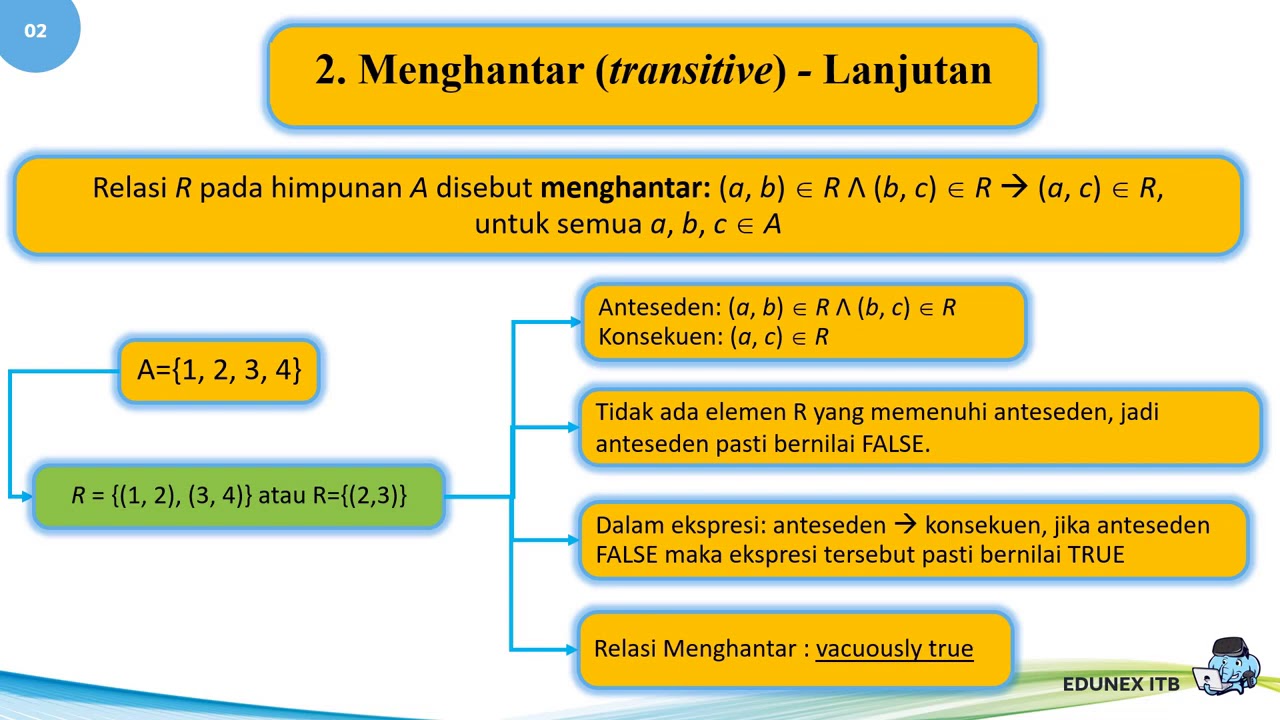
Matdis 06 : Relasi&Fungsi (Segmen 3: sifat-sifat relasi)
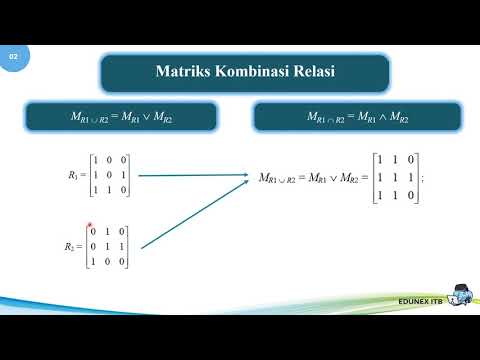
Matdis 07: Relasi & Fungsi (Segmen 4: Relasi Inversi, Kombinasi dan Komposisi Relasi)

Lec 06 - Relations

Relations and Functions | Class 12 Maths | Complete NCERT Chapter 1 | Harsh Sir @VedantuMath

Discrete Math - 9.3.2 Representing Relations Using Digraphs

Introduction to Discrete Mathematics
5.0 / 5 (0 votes)

