KEDATANGAN ISLAM KE NUSANTARA
Summary
TLDRThe script covers the introduction of Indonesian history lessons, focusing on the spread of Islam in the archipelago. It highlights various theories about Islam’s arrival, including the Gujarat, Persia, and Mekkah theories. The narrative explores the role of trade, intermarriage, Sufism, education, and cultural arts in the Islamization process. Key historical events and figures, such as Sultan Malik as-Saleh and Sunan Kalijaga, are discussed to show how Islam gradually integrated with the local cultures. The lesson emphasizes how these factors contributed to the establishment of Islamic culture in Indonesia over centuries.
Takeaways
- 😀 The lesson begins with a warm greeting and an introduction to the subject of Indonesian History, focusing on Islamization and cultural exchanges in the archipelago.
- 😀 The primary learning objective is to analyze the arrival of Islam in the archipelago and the interaction between Islam and local cultures.
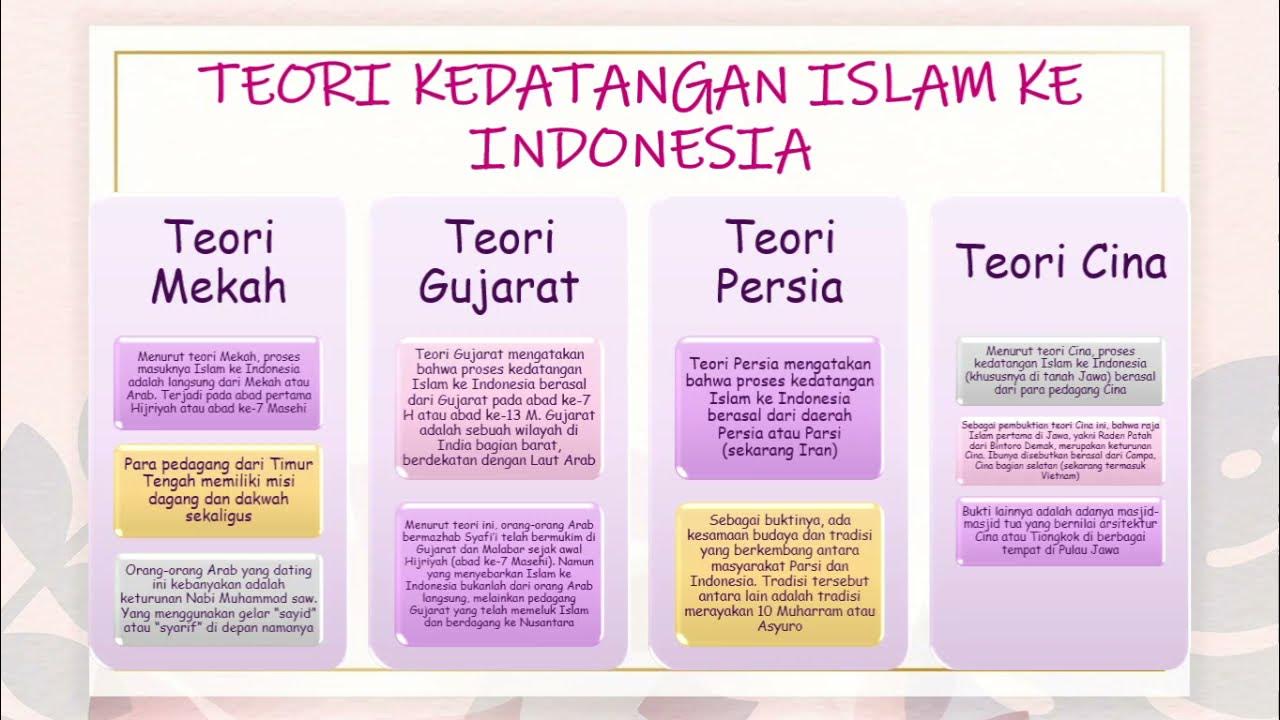
- 😀 The script introduces the theory that Islam spread in the archipelago through trade routes, brought by merchants from Gujarat, Persia, and Arabia.
- 😀 The first theory (Gujarat Theory) suggests that Islam arrived in the archipelago around the 13th century through merchants from Gujarat, India, who passed through the Strait of Malacca.
- 😀 The second theory (Persia Theory) claims that Islam entered Indonesia through Persian traders, supported by the spread of Shia Islam in the 13th century and cultural similarities between Indonesia and Persia.
- 😀 The third theory (Makkah Theory) proposes that Islam spread directly from Arabia through Muslim travelers, backed by the establishment of an Arab settlement in North Sumatra in the 7th century.
- 😀 The script explores the various channels through which Islam spread in the archipelago, with trade being the most prominent, involving Muslim merchants from Arabia, Persia, and Gujarat.
- 😀 Marriage between Muslim traders and local nobility helped strengthen Islam’s presence, with royal families converting to Islam and influencing the larger population.
- 😀 Sufism played a significant role in the spread of Islam, particularly in Java, where the mystical and philosophical aspects of Islam appealed to the local population.
- 😀 The establishment of pesantren (Islamic schools) helped spread Islam, with graduates becoming missionary teachers, further solidifying the religion’s presence across Indonesia.
- 😀 Islamic art and culture, such as architecture, literature, and performance arts like wayang, were used as tools for spreading the Islamic faith and making it accessible to local communities.
Q & A
What is the main topic of the lesson in this script?
-The main topic of the lesson is the arrival of Islam in the Nusantara (Indonesian archipelago) and its cultural interactions with local societies.
What are the three main theories regarding the arrival of Islam in Nusantara?
-The three main theories are: the Gujarat Theory, the Persia Theory, and the Mekkah Theory.
What does the Gujarat Theory suggest about the spread of Islam in Nusantara?
-The Gujarat Theory suggests that Islam was brought to Nusantara by traders from Gujarat, India, via the Malacca Strait in the 13th century. It is supported by the discovery of a tombstone in Samudra Pasai with Gujarat-style inscriptions.
What is the basis of the Persia Theory about Islam's arrival in Nusantara?
-The Persia Theory posits that Islam entered Nusantara through Persian traders, and it highlights the presence of Shi'a Islam, which originated in Persia. It is supported by cultural practices such as the Tabuik festival in Sumatra, which has similarities to Persian traditions.
How does the Mekkah Theory explain the arrival of Islam in Nusantara?
-The Mekkah Theory suggests that Islam was brought to Nusantara by Muslim travelers and missionaries from the Arabian Peninsula. This theory is supported by the presence of an Arab settlement in Sumatra and the spread of the Shafi'i school of thought, which was prominent in both the Arabian Peninsula and Nusantara.
What role did trade play in the spread of Islam to Nusantara?
-Trade played a significant role in the spread of Islam as traders from Arabia, Persia, and Gujarat introduced Islamic teachings alongside their goods. This interaction led to the establishment of settlements where local populations learned about Islam.
How did intermarriage contribute to the spread of Islam in Nusantara?
-Intermarriage between Muslim traders and local royalty or nobility helped strengthen the spread of Islam. Marrying into royal families encouraged the adoption of Islam in the courts, leading to the gradual conversion of local kingdoms.
What role did Sufism play in the Islamization of Nusantara?
-Sufism, with its mystical and cultural elements, played a key role in Islamizing Nusantara by appealing to the local populations' existing beliefs. Sufi missionaries, particularly from Persia and India, integrated Islamic teachings with local customs, facilitating acceptance.
How did education contribute to the spread of Islam in Nusantara?
-Education, particularly through the establishment of Islamic boarding schools (pesantren), was instrumental in spreading Islam. These schools served as centers for learning, where students were educated in Islamic teachings and then spread them in their home regions.
What role did art and culture play in the spread of Islam in Nusantara?
-Art and culture were important in spreading Islam, as Islamic teachings were conveyed through various forms of cultural expression, such as music, dance, literature, and architecture. Prominent figures like Sunan Bonang and Sunan Kalijaga used art to make Islam more accessible and acceptable to local populations.
Outlines

このセクションは有料ユーザー限定です。 アクセスするには、アップグレードをお願いします。
今すぐアップグレードMindmap

このセクションは有料ユーザー限定です。 アクセスするには、アップグレードをお願いします。
今すぐアップグレードKeywords

このセクションは有料ユーザー限定です。 アクセスするには、アップグレードをお願いします。
今すぐアップグレードHighlights

このセクションは有料ユーザー限定です。 アクセスするには、アップグレードをお願いします。
今すぐアップグレードTranscripts

このセクションは有料ユーザー限定です。 アクセスするには、アップグレードをお願いします。
今すぐアップグレード関連動画をさらに表示
Kehadiran Islam Mendamaikan Bumi Nusantara (PAI SMP Kelas 9 Bab 6 Semester 1) | Belajar PAI
Zaman Hindu Buddha di Indonesia #belajarsejarah
Kehidupan Masyarakat Pada Masa Islam
Kerajaan-Kerajaan Maritim di Indonesia Pada Masa Islam | KD 3.2 Sejarah Peminatan XI

How Indonesia Became the Largest Muslim Country

Masuknya Islam ke Indonesia Versi Maroko PART #1 | Bersama Ustdz Abdol Ghani Amouklah
5.0 / 5 (0 votes)

