Replikasi DNA
Summary
TLDRThis video explains the central dogma of molecular biology, focusing on DNA replication. It covers the process of copying DNA, from strand separation to the formation of two new strands. Key stages include the action of enzymes such as helicase, primase, DNA polymerase, and ligase. The video highlights the differences between the leading and lagging strands, as well as the formation of Okazaki fragments. Additionally, it explains how complementary nucleotides pair during replication and the proofreading mechanisms that ensure accurate genetic duplication, which is essential for cellular function and division.
Takeaways
- 🧬 The central dogma of molecular biology involves three main processes: replication, transcription, and translation.
- 🔄 DNA replication is the process of creating an identical copy of DNA from a parent molecule.
- 📝 Transcription uses DNA as a template to produce messenger RNA (mRNA).
- 🔧 Translation converts the genetic information carried by mRNA into proteins by assembling amino acids.
- 🧩 DNA is composed of nucleotides with four bases: adenine (A), thymine (T), cytosine (C), and guanine (G).
- 💞 Base pairing is complementary: A pairs with T via 2 hydrogen bonds, and C pairs with G via 3 hydrogen bonds.
- ⚙️ DNA replication involves several enzymes: topoisomerase relaxes supercoils, helicase separates strands, primase adds RNA primers, DNA polymerase synthesizes DNA, exonuclease removes RNA primers, and DNA ligase joins fragments.
- ⏩ The leading strand is synthesized continuously, whereas the lagging strand is synthesized in fragments called Okazaki fragments.
- 🔬 Replacing RNA primers with DNA and joining fragments ensures the production of two complete DNA molecules from one original molecule.
- 🔗 DNA replication is semi-conservative: each new DNA molecule contains one original (parental) strand and one newly synthesized strand.
- 📌 Understanding DNA replication is foundational to learning how genetic information is preserved and transmitted in living organisms.
Q & A
What is the central dogma of molecular biology?
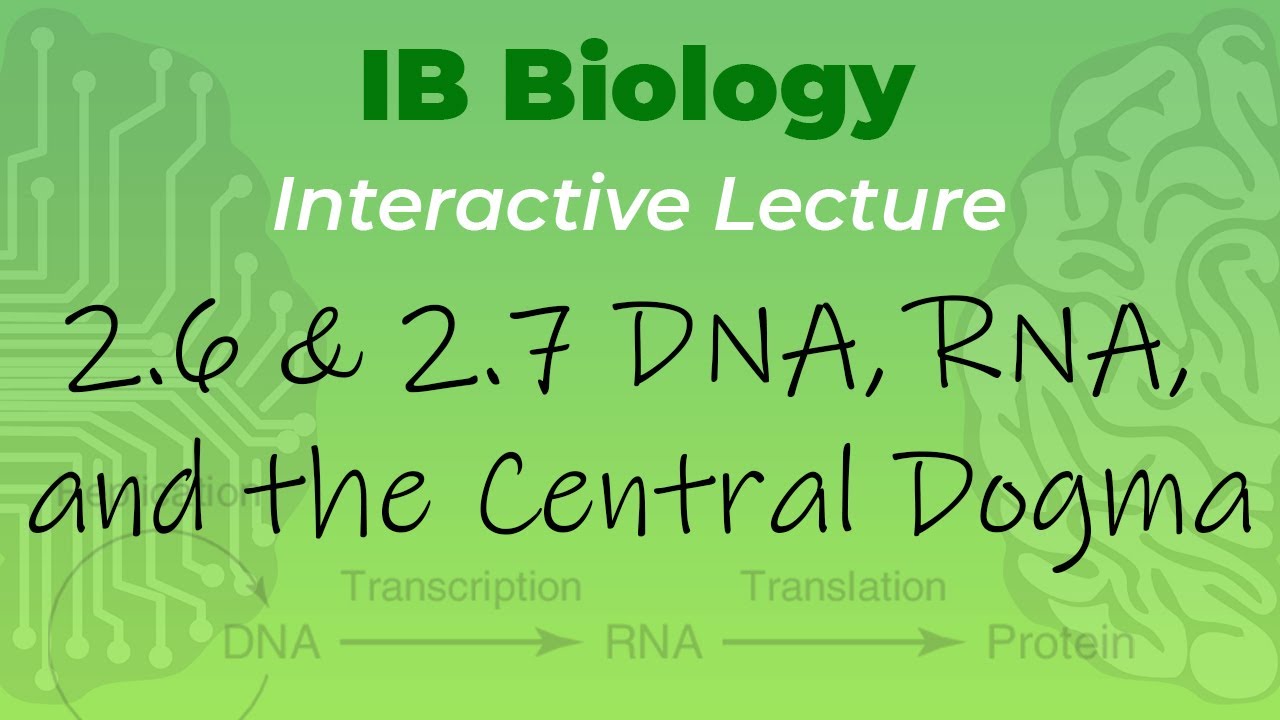
-The central dogma describes the flow of genetic information: DNA is replicated to DNA, transcribed into RNA, and then translated into proteins.
What are the three main stages of the central dogma?
-The three main stages are replication (DNA duplication), transcription (RNA synthesis from DNA), and translation (protein synthesis from RNA).
What is the main focus of this lesson from the transcript?
-The lesson focuses on DNA replication, explaining how DNA is duplicated to produce two identical DNA molecules.
What are the basic components of DNA mentioned in the transcript?
-DNA is composed of nucleotides, each containing a nitrogenous base (adenine, thymine, cytosine, guanine), a sugar (deoxyribose), and a phosphate group.
How do nitrogenous bases pair in DNA?
-Adenine (A) pairs with thymine (T) with two hydrogen bonds, and cytosine (C) pairs with guanine (G) with three hydrogen bonds.
What is the role of topoisomerase in DNA replication?
-Topoisomerase removes supercoils and unwinds the DNA to make it accessible for replication.
What does helicase do during DNA replication?
-Helicase separates the two DNA strands by breaking the hydrogen bonds between the base pairs.
What is the function of primase in DNA replication?
-Primase synthesizes RNA primers, which provide a starting point for DNA polymerase to begin adding nucleotides.
How does DNA polymerase contribute to replication?
-DNA polymerase adds complementary nucleotides to the template strand and replaces RNA primers with DNA nucleotides.
What is the difference between the leading strand and the lagging strand?
-The leading strand is synthesized continuously toward the replication fork, while the lagging strand is synthesized discontinuously in fragments called Okazaki fragments.
How are Okazaki fragments processed to form a complete DNA strand?
-RNA primers on Okazaki fragments are removed by exonuclease, replaced with DNA by DNA polymerase, and the fragments are joined together by DNA ligase.
What does it mean that DNA replication is semi-conservative?
-Each new DNA molecule contains one original (parental) strand and one newly synthesized (daughter) strand, preserving half of the original DNA in each molecule.
Outlines

このセクションは有料ユーザー限定です。 アクセスするには、アップグレードをお願いします。
今すぐアップグレードMindmap

このセクションは有料ユーザー限定です。 アクセスするには、アップグレードをお願いします。
今すぐアップグレードKeywords

このセクションは有料ユーザー限定です。 アクセスするには、アップグレードをお願いします。
今すぐアップグレードHighlights

このセクションは有料ユーザー限定です。 アクセスするには、アップグレードをお願いします。
今すぐアップグレードTranscripts

このセクションは有料ユーザー限定です。 アクセスするには、アップグレードをお願いします。
今すぐアップグレード関連動画をさらに表示

Genetics - Replication Methods and Central Dogma - Lesson 16 | Don't Memorise
Genetic Principles

Dogma Central Biologi Molekuler

Replicação do DNA - Brasil Escola
IB Biology 2.6 & 2.7 - DNA, RNA, and the Central Dogma - Interactive Lecture

Genetica molecular. Replicación, transcripción y traducción. 4º ESO - Bio[ESO]sfera
5.0 / 5 (0 votes)

