Hukum Internasional Pertemuan ke-3
Summary
TLDRThis presentation explores the evolution of international law and Indonesia's role within it. It discusses the historical milestones such as the Westphalian Treaty, the formation of the League of Nations, the United Nations, and the establishment of the International Criminal Court. It highlights Indonesia's journey from its struggle for sovereignty to its active participation in global forums. Key topics include diplomacy, the impact of global issues like human rights, climate change, and technology regulation, and how Indonesia has contributed to shaping international legal norms and fostering peace and cooperation.
Takeaways
- 😀 International law regulates relationships between countries, organizations, individuals, and non-state actors like multinational companies.
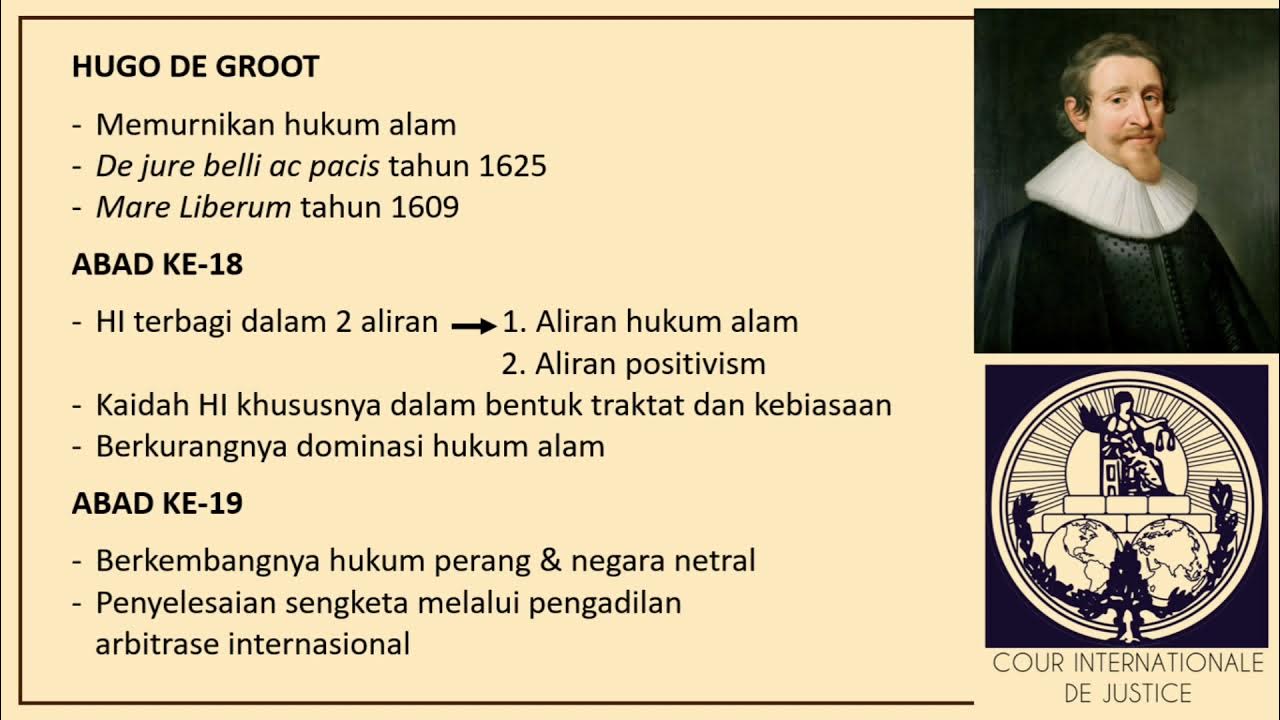
- 😀 The Peace of Westphalia in 1648 marked the birth of modern international law and the concept of state sovereignty.
- 😀 The League of Nations, established in 1919, aimed to maintain world peace, though it failed to prevent World War II.
- 😀 The United Nations, founded in 1945, remains the largest international organization and plays a key role in global peace and security.
- 😀 The creation of the International Criminal Court (2002) allows individuals to be prosecuted for international crimes like genocide and war crimes.
- 😀 International law has evolved to address modern global issues like international trade, human rights, environmental protection, and cybersecurity.
- 😀 Technological advances, such as cybersecurity and AI regulation, present new challenges for international law.
- 😀 Indonesia’s diplomatic journey began after its independence in 1945, with key agreements like Linggarjati (1946) and Renville (1948) shaping its path.
- 😀 The Round Table Conference in 1949 marked Indonesia’s successful fight for international recognition of its sovereignty.
- 😀 Indonesia's legal commitment to international law strengthened after the 1998 reforms, including ratifying the UN Convention on the Law of the Sea (UNCLOS).
- 😀 Indonesia’s active role in global forums like ASEAN, G20, and in issues like climate change and digital regulation showcases its increasing influence in international law.
Q & A
What is international law and what does it regulate?
-International law is a set of rules that governs relationships between countries in the global community. Initially focused on interactions between states, it has expanded to include international organizations, individuals, and non-state actors such as multinational corporations.
Why is international law important in global relations?
-International law helps create an orderly and stable global system. It enables countries to cooperate, resolve disputes peacefully, and establish shared rules that support international stability and justice.
What was the significance of the Peace of Westphalia in 1648?
-The Peace of Westphalia marked the beginning of the modern concept of state sovereignty. It established the principle that each state has full authority over its territory and that other states should not interfere in its internal affairs.
How has international law developed since its early history?
-International law has evolved significantly, producing over one million legal documents including treaties, conventions, agreements, and resolutions. These documents reflect negotiations and cooperation among countries to maintain global order.
What role did the League of Nations play in international law?
-Founded in 1919 after World War I, the League of Nations was the first international organization aimed at maintaining global peace. Although it failed to prevent World War II, it laid the foundation for modern international organizations.
Why is the establishment of the United Nations in 1945 considered a major milestone?
-The United Nations became the largest international organization dedicated to maintaining peace and cooperation. Its Charter established key principles such as the prohibition of the use of force in international relations and the protection of human rights.
What is the purpose of the International Criminal Court established in 2002?
-The International Criminal Court was created to prosecute individuals responsible for serious international crimes such as genocide, war crimes, and crimes against humanity, marking an important step in holding individuals accountable under international law.
How has the scope of international law expanded in modern times?
-International law now addresses a wide range of global issues beyond war and peace, including international trade, environmental protection, human rights, cybersecurity, data protection, and regulations related to artificial intelligence.
What challenges did Indonesia face in gaining international recognition after independence?
-After declaring independence in 1945, Indonesia needed international recognition of its sovereignty. Diplomatic efforts such as the Linggarjati Agreement in 1946 and the Renville Agreement in 1948 were part of negotiations with the Netherlands to resolve conflicts and gain recognition.
What was the significance of the Round Table Conference in 1949?
-The Round Table Conference resulted in the Netherlands officially recognizing Indonesia's sovereignty. This marked the success of Indonesia's diplomatic struggle for independence on the international stage.
What is the meaning of Indonesia’s 'free and active' foreign policy principle?
-The 'free and active' principle means that Indonesia maintains independence in its foreign policy decisions while actively contributing to international peace, cooperation, and global stability.
How did the United Nations contribute to resolving the conflict between Indonesia and the Netherlands?
-The United Nations formed the Committee of Good Offices, consisting of Australia, Belgium, and the United States, to mediate between Indonesia and the Netherlands. This mediation helped facilitate diplomatic negotiations that eventually led to the recognition of Indonesia's sovereignty.
What major legal changes occurred in Indonesia during the Reform Era after 1998?
-After 1998, Indonesia implemented constitutional amendments that strengthened human rights protections and opened greater opportunities for integrating international law into its national legal system.
Why is the United Nations Convention on the Law of the Sea (UNCLOS) important for Indonesia?
-UNCLOS provides the legal framework for maritime boundaries and grants Indonesia rights over its Exclusive Economic Zone (EEZ) extending up to 200 nautical miles, which is crucial for protecting sovereignty and managing marine resources.
How does Indonesia contribute to the development of international law today?
-Indonesia actively participates in global forums such as the G20 and ASEAN, contributing to discussions on sustainable development, climate change, and digital technology regulation, thereby influencing international legal norms.
Outlines

このセクションは有料ユーザー限定です。 アクセスするには、アップグレードをお願いします。
今すぐアップグレードMindmap

このセクションは有料ユーザー限定です。 アクセスするには、アップグレードをお願いします。
今すぐアップグレードKeywords

このセクションは有料ユーザー限定です。 アクセスするには、アップグレードをお願いします。
今すぐアップグレードHighlights

このセクションは有料ユーザー限定です。 アクセスするには、アップグレードをお願いします。
今すぐアップグレードTranscripts

このセクションは有料ユーザー限定です。 アクセスするには、アップグレードをお願いします。
今すぐアップグレード関連動画をさらに表示




5.0 / 5 (0 votes)

