Computer Network and Security Chapter 4 Computer Network Topologies
Summary
TLDRThis video covers various computer network topologies, explaining their structure and functions. It explores point-to-point, bus, star, ring, mesh, hierarchical (tree), DC chain, and hybrid topologies. Each topology is discussed in terms of its design, advantages, challenges, and practical uses. The video emphasizes the importance of choosing the right topology based on factors such as reliability, cost, and network requirements. Key points include the single point of failure in bus and star topologies, the redundancy in mesh, and the scalability of hybrid topologies, offering a comprehensive guide to network design.
Takeaways
- 😀 Network topologies define how computer systems and devices are arranged and connected, both physically and logically.
- 😀 Point-to-Point topology connects exactly two hosts directly, allowing simple and direct communication.
- 😀 Bus topology connects all devices via a single communication line, requiring terminators and sometimes a bus master or CSMA/CD to manage traffic.
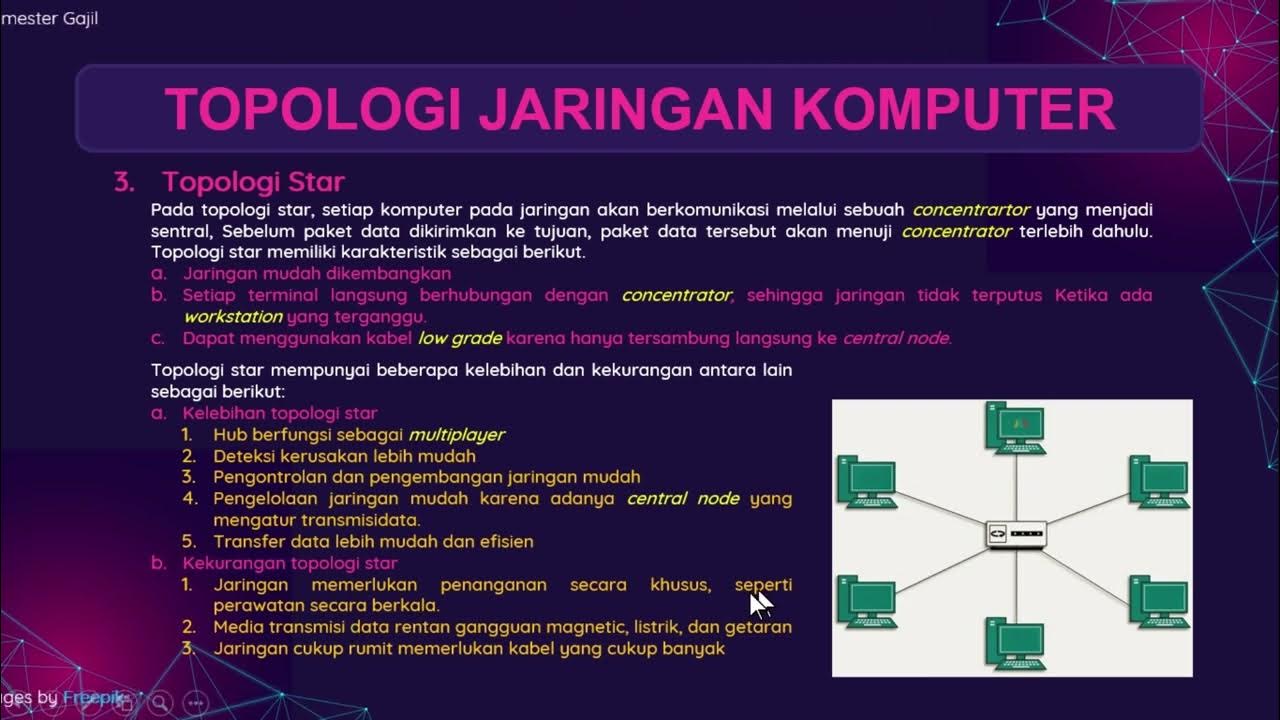
- 😀 Star topology connects all hosts to a central hub, switch, or router, where the hub acts as a single point of communication.
- 😀 Ring topology forms a circular connection where each host connects to two others, and data travels through intermediate hosts.
- 😀 Mesh topology allows hosts to connect to multiple other hosts, providing redundancy and high reliability, with full or partial mesh variants.
- 😀 Tree (Hierarchical) topology combines star and bus topologies, organizing networks into layers: access, distribution, and core.
- 😀 DC Chain topology connects hosts linearly, with endpoints connecting to only one host, making each link a single point of failure.
- 😀 Hybrid topology combines two or more topologies to leverage the strengths of each, with the internet being a prime example.
- 😀 Failures in central devices or key connections, such as hubs in star topology or cables in bus topology, can disrupt the network.
- 😀 Topology choice affects network reliability, scalability, cost, and complexity, making it essential to select the right structure for specific needs.
- 😀 Some topologies, like mesh and hybrid, provide redundancy, while others, like bus or ring, are more vulnerable to single points of failure.
Q & A
What is a network topology?
-A network topology refers to the arrangement of computer systems or network devices in a network. It can be defined both physically and logically, with the logical aspect focusing on how devices are interconnected and communicate with each other.
What is point-to-point topology?
-Point-to-point topology connects exactly two hosts, such as computers, switches, routers, or servers, using a single piece of cable. Although there may be intermediate devices, the end hosts appear to be directly connected, without awareness of the underlying network.
What are the advantages of bus topology?
-Bus topology is simple and cost-effective, as all devices share a single communication line or cable. A failure in one device doesn’t affect the others, but failure in the shared cable can disrupt the entire network.
What is the problem with bus topology when multiple devices send data simultaneously?
-In bus topology, when multiple hosts send data at the same time, collisions can occur. To manage this, technologies like CSMA/CD (Carrier Sense Multiple Access with Collision Detection) are used, or one host may be designated as the bus master.
What is star topology and how does it function?
-In star topology, all hosts are connected to a central device like a hub, switch, or router. Communication takes place through the central device, and if the central device fails, the entire network fails.
What is the major drawback of using hub in star topology?
-A hub in star topology acts as a single point of failure. If the hub fails, all devices connected to it will lose their network connectivity.
How does ring topology work?
-In ring topology, each host is connected to exactly two other hosts, forming a circular structure. Data travels through the network by passing through intermediate hosts until it reaches the intended destination. A failure in any host can cause the entire network to fail.
What is the difference between full mesh and partial mesh topology?
-In full mesh topology, every host is connected to every other host in the network, making it highly reliable. In partial mesh, some hosts are only connected to a few others, reducing the complexity but also lowering reliability.
What are the three layers in hierarchical or extended star topology?
-The three layers in hierarchical topology are the access layer (where computers are connected), the distribution layer (mediates between the access and core layers), and the core layer (the root or center point of the network).
What is hybrid topology and where is it commonly used?
-Hybrid topology is a network structure that combines elements from different topologies like star, ring, or bus. The internet is a prominent example of a hybrid topology, incorporating a variety of network topologies to ensure reliability and scalability.
Outlines

このセクションは有料ユーザー限定です。 アクセスするには、アップグレードをお願いします。
今すぐアップグレードMindmap

このセクションは有料ユーザー限定です。 アクセスするには、アップグレードをお願いします。
今すぐアップグレードKeywords

このセクションは有料ユーザー限定です。 アクセスするには、アップグレードをお願いします。
今すぐアップグレードHighlights

このセクションは有料ユーザー限定です。 アクセスするには、アップグレードをお願いします。
今すぐアップグレードTranscripts

このセクションは有料ユーザー限定です。 アクセスするには、アップグレードをお願いします。
今すぐアップグレード関連動画をさらに表示

Network Topology And its Types In Hindi | BUS, RING, STAR, MESH, TREE, HYBRID

AKM Awal

apasih pengertian topologi jaringan ? #csnet

Topologi Jaringan: Pengertian, Jenis, dan Gambar Topologi Jaringan
Part 1 - Informatika Kelas XI - BAB 2 Jaringan Komputer / Internet

Stanford CS105: Introduction to Computers | 2021 | Lecture 5.1 Computer Networks: Hardware
5.0 / 5 (0 votes)

