I bought 1000 meters of wire to settle a physics debate
Summary
TLDRIn this video, the creator tests a thought experiment proposed by Veritasium, exploring whether a light-speed delay occurs in an electrical circuit with long wires. By setting up a kilometer-long circuit, the creator measures the delay and discovers that while the current does start immediately, it takes about 1.6 microseconds for the full current to flow through. The experiment reveals surprising insights into the capacitive and inductive properties of wires, as well as the physics behind electron movement. Ultimately, the video challenges conventional assumptions and sets the stage for a follow-up exploration in part 2.
Takeaways
- 😀 The experiment is inspired by a thought experiment proposed by Veritasium involving a simple circuit with a long wire, where a light-speed delay is expected when flipping a switch.
- 😀 The key components of the circuit include a battery, a switch (replaced with an electronic switch), and a resistor instead of a light bulb, to allow precise measurements of current over time.
- 😀 The experiment involves approximately a kilometer of wire, which is long enough to show measurable delays in signal propagation (around 1.6 microseconds).
- 😀 The oscilloscope is used to measure voltage and current over time, providing insight into how the signal travels through the circuit and how long it takes for the current to reach steady-state.
- 😀 The initial current is very small and almost immediately measurable, but after the light-speed delay, the current increases significantly, following the expected delay pattern.
- 😀 The experiment confirms that current does not instantly reach the light bulb but instead experiences a delay, matching the theoretical light-speed delay over the 500-meter wire loops.
- 😀 The current measured immediately after the switch is flipped is very small, only about 200 microamps, but after the delay, the current increases to a much higher value (~1.7 milliamps).
- 😀 The phenomenon observed with the current flow is due to the capacitive and inductive properties of the circuit, creating a situation where the current seems to 'bounce back' after reaching a peak.
- 😀 The core idea behind the experiment's results is the interaction between electrons in the wire, with electron motion modulated by electromagnetic fields that propagate at the speed of light.
- 😀 The experiment also reveals interesting effects like the reversal of current flow as the signal reaches the end of the wire and the effects of capacitance and inductance in the circuit, creating oscillations in the current.
- 😀 In the follow-up video, further experiments with different wire lengths and variations of the setup will be explored to better understand the results, which were unexpected and complex.
Q & A
What is the main idea behind this experiment?
-The main idea of the experiment is to explore the concept of light-speed delay in electrical circuits by using a kilometer-long wire and observing how long it takes for a current to flow after flipping a switch.
Why did the creator of the experiment choose to use an electronic switch instead of a mechanical one?
-An electronic switch was chosen because mechanical switches can cause noisy signals due to bouncing contacts, which would make it harder to measure precise timings in the experiment.
What is the role of the resistor in this setup?
-The resistor acts as a stand-in for the light bulb, allowing the experimenter to measure the voltage and current across it. This provides a precise way to observe the effects of current flow in the circuit over time.
How does the length of the wire affect the delay in the circuit?
-The length of the wire causes a delay because the electrical signal has to travel down the wire and back, which introduces a time lag. This delay is on the order of microseconds depending on the wire length.
What does the oscilloscope reveal about the behavior of the circuit?
-The oscilloscope shows how the voltage and current change over time. It reveals a light-speed delay before the full current reaches the light bulb, with an initial small current followed by a larger current once the signal travels the full length of the wire.
What is the significance of the 1.6-microsecond delay observed in the experiment?
-The 1.6-microsecond delay corresponds to the time it takes for the electrical signal to travel down the wire and back, which aligns with the expected delay for a 500-meter-long wire. This delay represents the light-speed travel time for the signal.
Why is the current that flows immediately after the switch is flipped so small?
-The immediate current is small because it's the result of the initial wave of electrons moving through the wire before the full light-speed signal reaches the light bulb. This current doesn't fully activate the light bulb but indicates that the circuit is starting to conduct.
What are the two possible explanations for the initial small current in the circuit?
-The two possible explanations are capacitance and induction. These effects can cause a small amount of current to flow almost immediately, even before the main signal reaches the light bulb.
How does the chain-in-tube analogy help explain the current flow?
-The chain-in-tube analogy helps by illustrating how the motion of electrons in the wire isn't a simple instantaneous process. Instead, the interaction between electrons, modeled as particles or links in a chain, propagates down the wire, influenced by electric fields and photon interactions.
What happens when both ends of the wire are disconnected, and how does it affect the current?
-When both ends of the wire are disconnected, the current doesn't fully reach the light bulb. The circuit shows a transient signal, but since no current can flow through the open wire, the light bulb never turns on.
Outlines

このセクションは有料ユーザー限定です。 アクセスするには、アップグレードをお願いします。
今すぐアップグレードMindmap

このセクションは有料ユーザー限定です。 アクセスするには、アップグレードをお願いします。
今すぐアップグレードKeywords

このセクションは有料ユーザー限定です。 アクセスするには、アップグレードをお願いします。
今すぐアップグレードHighlights

このセクションは有料ユーザー限定です。 アクセスするには、アップグレードをお願いします。
今すぐアップグレードTranscripts

このセクションは有料ユーザー限定です。 アクセスするには、アップグレードをお願いします。
今すぐアップグレード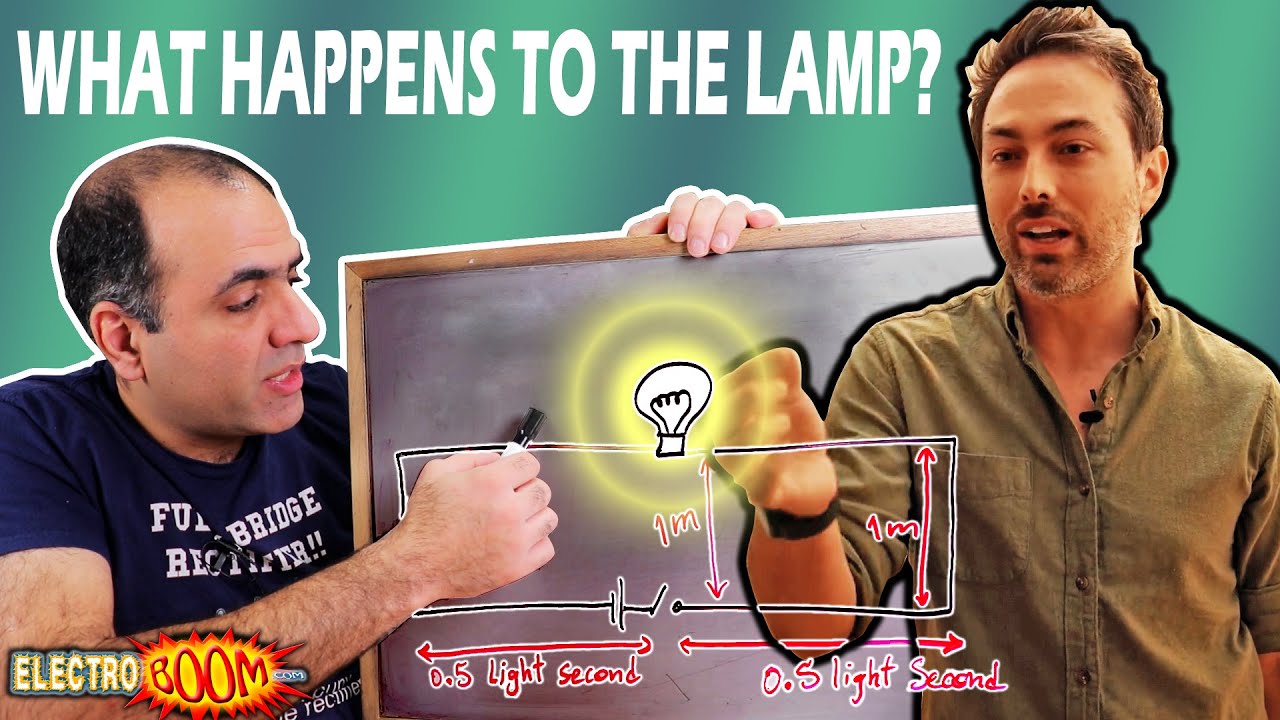


5.0 / 5 (0 votes)

