Reglas para despejar formulas- Explicación y Ejercicios
Summary
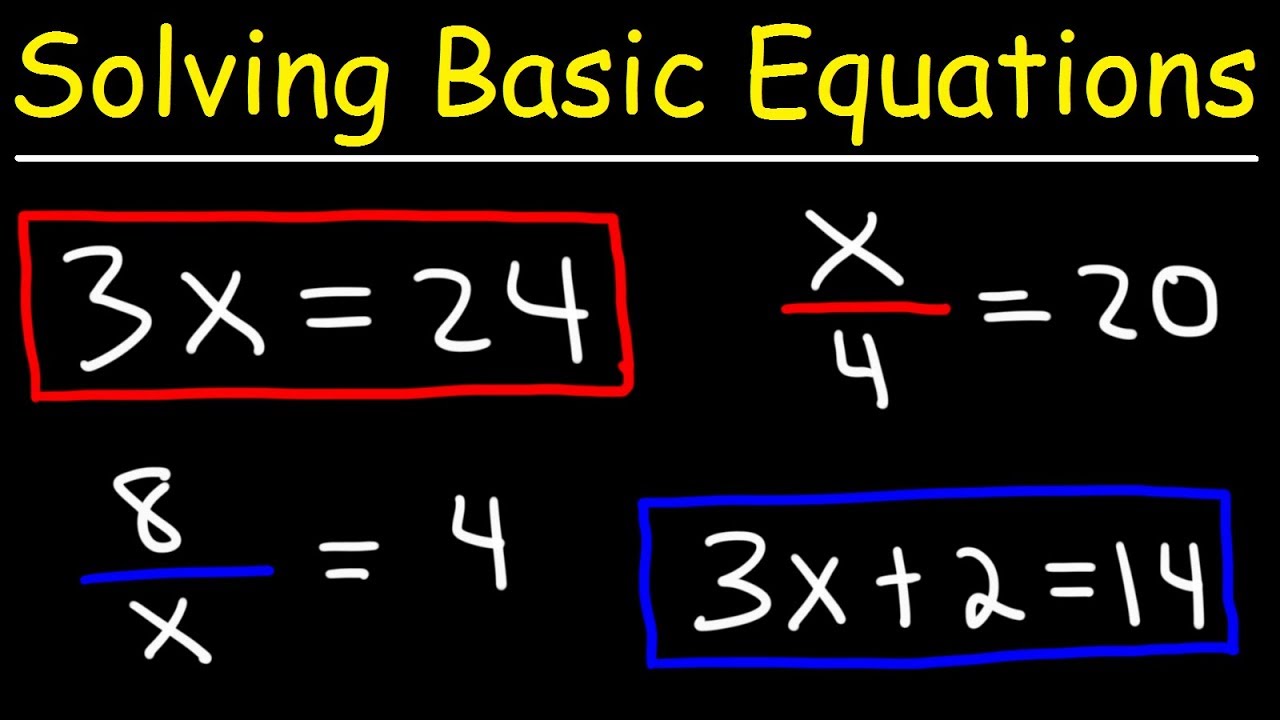
TLDRThis video explains the fundamental rules for isolating a variable in algebraic equations in a clear and practical way. It walks through how operations change when moved across the equals sign—addition becomes subtraction, multiplication becomes division, and powers become roots, and vice versa. The instructor reinforces these rules with step-by-step examples, including simple equations and more complex formulas like velocity in uniform motion. By demonstrating how to systematically rearrange equations, the video helps learners build confidence in solving for unknown variables and understanding the logic behind algebraic manipulation.
Takeaways
- 😀 When a variable is added on one side of an equation and moved to the other side, it changes to subtraction.
- 😀 When a variable is subtracted and moved to the other side of an equation, it becomes addition.
- 😀 If a variable is dividing on one side, moving it to the other side makes it multiply.
- 😀 If a variable is multiplying on one side, moving it to the other side makes it divide.
- 😀 A variable in exponent form moved to the other side changes into a radical (e.g., x² becomes √x).
- 😀 A variable in radical form moved to the other side changes into an exponent (e.g., √x becomes x²).
- 😀 These movement rules apply differently depending on whether the variable is originally on the left or right side of the equation.
- 😀 To solve x + y = 8 for x, move y to the other side as subtraction: x = 8 - y.
- 😀 To solve a division formula, such as velocity = distance / time for distance, multiply: distance = velocity × time.
- -
- 😀 When a variable is multiplied by a coefficient, moving it to the other side divides by that coefficient, and vice versa for division.
- -
- 😀 Complex expressions follow the same rules step by step: move dividing terms as multiplying, multiply as dividing, add/subtract as needed to isolate the variable.
Q & A
What happens when a variable is added to the right side of an equation?
-When a variable is added on the left side of the equation and is moved to the right side, it changes to subtraction. For example, if the equation is x + y = 8, moving y to the right would result in x = 8 - y.
How does a subtraction variable behave when moved to the other side of the equation?
-When a variable that is being subtracted on the left side is moved to the right side, it becomes positive. For instance, if the equation is x - y = 8, moving y to the right side would give x = 8 + y.
What happens when a variable is dividing on the left side of an equation?
-If a variable is dividing on the left side, when moved to the right side, it will multiply. For example, if the equation is x / y = 8, moving y to the right side results in x = 8 * y.
What is the rule when a variable is multiplying on one side of the equation?
-When a variable is multiplying on one side of the equation and is moved to the other side, it changes to division. For example, if the equation is x * y = 8, moving y to the right side will result in x = 8 / y.
How does a power (exponent) affect an equation when moved across the equal sign?
-When a variable is in the form of a power (like x²) and moved to the other side of the equation, it changes to a radical. For example, x² on the left side will turn into √x when moved to the right side.
What happens when a radical (square root) is moved across the equal sign?
-When a radical (like √x) is moved to the other side of the equation, it becomes a power. For example, √x on the left side will change to x² when moved to the right side.
How do you solve for x in the equation x + y = 8?
-To solve for x, move y to the right side of the equation. Since y is adding to x, it will subtract when moved to the other side. The result is x = 8 - y.
What is the process for isolating the variable x in the equation y = 7x?
-In this case, x is multiplied by 7. To isolate x, divide both sides of the equation by 7. The solution is x = y / 7.
How can you solve the equation y = x³ / 2 for x?
-First, move the 2 from dividing to multiplying on the left side. This gives 2y = x³. Then, to isolate x, take the cube root of both sides, which gives x = ∛(2y).
What is the general rule for moving terms across the equal sign in an equation?
-When moving terms across the equal sign, the operation changes. Addition becomes subtraction, subtraction becomes addition, multiplication becomes division, division becomes multiplication, powers become radicals, and radicals become powers.
Outlines

このセクションは有料ユーザー限定です。 アクセスするには、アップグレードをお願いします。
今すぐアップグレードMindmap

このセクションは有料ユーザー限定です。 アクセスするには、アップグレードをお願いします。
今すぐアップグレードKeywords

このセクションは有料ユーザー限定です。 アクセスするには、アップグレードをお願いします。
今すぐアップグレードHighlights

このセクションは有料ユーザー限定です。 アクセスするには、アップグレードをお願いします。
今すぐアップグレードTranscripts

このセクションは有料ユーザー限定です。 アクセスするには、アップグレードをお願いします。
今すぐアップグレード



5.0 / 5 (0 votes)

