tugas kelompok tata surya
Summary
TLDRThis educational video covers key astronomical concepts, starting with the Sun and its layers, such as the core, radiation zone, and corona. It then explores the planets in the Solar System, detailing their characteristics and moons, from Mercury to Neptune. The script also touches on celestial bodies like asteroids, comets, and meteoroids. Further topics include the effects of Earth's rotation and revolution, eclipses, and tides. The video concludes with a discussion on the influence of the Moon and Sun on Earth's tides, particularly the phenomena of spring and neap tides.
Takeaways
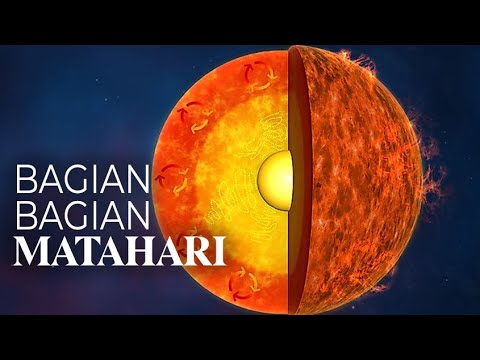
- 😀 The Sun consists of multiple layers: the core, radiation zone, convection zone, photosphere, chromosphere, corona, and heliosphere, each with distinct characteristics.
- 😀 Mercury is the smallest and closest planet to the Sun with no atmosphere, experiencing extreme temperatures ranging from 430°C during the day to -170°C at night.
- 😀 Venus, known as the 'Morning Star,' has a dense atmosphere causing extreme greenhouse effects, making it the hottest planet at around 462°C.
- 😀 Earth is the only planet known to support life, with water covering about 70% of its surface and an atmosphere rich in oxygen. It has one moon.
- 😀 Mars, called the 'Red Planet,' has a thin atmosphere primarily composed of CO2 and two moons: Phobos and Deimos.
- 😀 Jupiter, the largest planet, is known for its Great Red Spot and 95 moons, with four prominent moons called the Galilean moons: Io, Europa, Ganymede, and Callisto.
- 😀 Saturn is famous for its stunning rings and has 146 moons, with Titan and Enceladus being the most notable.
- 😀 Uranus has a unique blue color due to methane and rotates on its side with a tilt of almost 98 degrees, making it the coldest planet in the Solar System.
- 😀 Neptune, the farthest planet, is also blue but has stronger winds, reaching up to 2100 km/h. It has 16 moons, with Triton being the most famous.
- 😀 Astronomical bodies like asteroids, comets, and meteoroids differ in composition: asteroids are rocky, comets are icy and have tails, and meteoroids become meteors and meteorites when entering Earth's atmosphere.
- 😀 The rotation of the Earth causes day and night, while its revolution around the Sun causes seasons and affects the length of days and nights.
- 😀 Solar and lunar eclipses occur when the Sun, Earth, and Moon align in specific ways, with lunar eclipses being visible at night and solar eclipses happening during the day.
- 😀 Tides are affected by the gravitational pull of the Sun and the Moon, with 'spring tides' occurring when they align (during full or new moons) and 'neap tides' when the Sun and Moon are at right angles.
Q & A
What are the main layers of the Sun and their characteristics?
-The Sun has several distinct layers: 1) The Core, where nuclear fusion occurs, generating immense energy; 2) The Radiation Zone, which transmits energy from the core to the surface through photon movement; 3) The Convective Zone, where energy is transferred via convection currents; 4) The Photosphere, which emits the light we see from Earth; 5) The Chromosphere, which is visible as red during a total solar eclipse; 6) The Corona, the outermost layer, which is composed of plasma and has extremely high temperatures; 7) The Heliosphere, the outermost part, made of solar wind.
What makes Mercury unique among the planets in the solar system?
-Mercury is the smallest planet in the solar system and the closest to the Sun. It has no atmosphere to trap heat, causing extreme temperature fluctuations — reaching 430°C during the day and -1°C at night. It also has no moons.
How does the Moon influence life on Earth?
-The Moon stabilizes Earth's axial tilt, which helps maintain a stable climate. Additionally, it affects ocean tides through gravitational interaction, which impacts marine life and ecosystems.
Why is Venus considered the hottest planet in the solar system?
-Venus experiences a severe greenhouse effect, which traps heat from the Sun and causes temperatures to reach about 462°C. Despite being further from the Sun than Mercury, its thick atmosphere of carbon dioxide makes it the hottest planet.
What is the difference between an asteroid, a comet, and a meteor?
-An asteroid is a rocky object that orbits the Sun, typically found in the asteroid belt between Mars and Jupiter. A comet is made of ice, gas, and dust and has a visible tail when it approaches the Sun. A meteor is a small object from space that burns up as it enters Earth's atmosphere, often referred to as a 'shooting star.' If it survives and lands on Earth, it’s called a meteorite.
What causes the seasons on Earth?
-The seasons are caused by Earth's axial tilt of 23.5 degrees. As Earth revolves around the Sun, different parts of the planet receive varying amounts of sunlight, leading to seasonal changes. This tilt results in longer days and more direct sunlight in summer and shorter days and less direct sunlight in winter.
What is the significance of the Moon’s orbit being elliptical?
-The Moon’s orbit is elliptical, meaning its distance from Earth varies. When it is closer (perigee), the Moon appears larger in the sky, while at its farthest point (apogee), it appears smaller. This change in size can also lead to different types of solar eclipses, such as annular or total.
How does the Earth’s rotation affect its weather systems?
-Earth’s rotation influences the direction of winds and ocean currents through the Coriolis effect. This causes weather systems like cyclones to rotate in different directions in the Northern and Southern Hemispheres, impacting climate patterns and storm development.
What is the difference between a lunar eclipse and a solar eclipse?
-A lunar eclipse occurs when the Earth casts its shadow on the Moon, making it dark. A solar eclipse happens when the Moon passes between the Earth and the Sun, blocking sunlight from reaching the Earth. Lunar eclipses are visible from anywhere on the nighttime side of Earth, while solar eclipses are only visible from a specific location.
What are spring tides and neap tides?
-Spring tides occur when the Sun, Earth, and Moon align (during full or new moons), resulting in higher high tides and lower low tides due to the combined gravitational pull of the Sun and Moon. Neap tides occur when the Sun and Moon are at right angles to each other (during the first and third quarters of the Moon), causing smaller differences between high and low tides.
Outlines

Cette section est réservée aux utilisateurs payants. Améliorez votre compte pour accéder à cette section.
Améliorer maintenantMindmap

Cette section est réservée aux utilisateurs payants. Améliorez votre compte pour accéder à cette section.
Améliorer maintenantKeywords

Cette section est réservée aux utilisateurs payants. Améliorez votre compte pour accéder à cette section.
Améliorer maintenantHighlights

Cette section est réservée aux utilisateurs payants. Améliorez votre compte pour accéder à cette section.
Améliorer maintenantTranscripts

Cette section est réservée aux utilisateurs payants. Améliorez votre compte pour accéder à cette section.
Améliorer maintenantVoir Plus de Vidéos Connexes
Video Pembelajaran: Materi "Radiasi Matahari"

SISTEM TATA SURYA : IPA KELAS 7 SMP
Urutan Lapisan Matahari dari yang Terdalam Hingga Terluar
Form 3 Science Chapter 9: Space Weather

Why The Sun is Bigger Than You Think
SAINS TING.2 BAB 12.1 SISTEM SURIA BAHAGIAN 1: PERTUKARAN UNIT JARAK PLANET DARI MATAHARI
5.0 / 5 (0 votes)

