FISIKA Kelas 10 - Gerak Harmonik Sederhana | GIA Academy
Summary
TLDRThis educational video from Kiri Academy explores the concept of simple harmonic motion (SHM), using everyday examples like spring beds and pendulums. It explains key principles, including displacement, velocity, acceleration, amplitude, phase angle, and phase difference, along with their mathematical formulas. The video also covers harmonic motion in springs and pendulums, highlighting the roles of restoring force, period, frequency, and mechanical energy. Through step-by-step example problems, viewers learn to calculate velocity, amplitude, and energy in SHM. The content combines clear explanations with practical demonstrations, making complex physics concepts accessible and engaging for students and enthusiasts alike.
Takeaways
- 😀 Understanding Simple Harmonic Motion (SHM): SHM is a back-and-forth movement of an object through its equilibrium position, occurring continuously.
- 😀 Spring Bed and SHM: The vibrations inside a spring bed, caused by its spring mechanism, demonstrate SHM, providing comfort during rest.
- 😀 Key Formula - Displacement: The displacement in SHM is expressed as y = a sin(ωt), where y is the displacement, a is amplitude, and ω is angular velocity.
- 😀 Maximum Velocity in SHM: The maximum velocity in SHM occurs when the displacement is zero, and is given by v_max = ωa.
- 😀 Acceleration in SHM: The acceleration is the second derivative of displacement with respect to time, leading to the formula a = -ω²a sin(ωt).
- 😀 Phase Angle and SHM: The phase angle (θ) determines the position and movement in SHM, and can be represented as θ = ωt + θ₀.
- 😀 Energy in SHM: The energy in SHM remains constant, with both potential energy (Ep) and kinetic energy (Ek) being components of the total mechanical energy.
- 😀 Harmonic Motion in Springs: In a spring, the restoring force is given by Fp = -kΔx, where k is the spring constant, and Δx is the displacement.
- 😀 Pendulum SHM: In a pendulum, the restoring force is related to the mass, gravity, and the angle of displacement, leading to a period of T = 2π√(L/g).
- 😀 Example Problems: Several example problems were discussed, such as calculating velocity, energy, and period, showing how to apply SHM formulas to real-world scenarios.
Q & A
What is harmonic motion?
-Harmonic motion is a type of motion in which an object moves back and forth through a central equilibrium point in a continuous and repetitive pattern. It is typically caused by a restoring force that tends to bring the object back to its equilibrium position.
How does a spring bed provide comfort during sleep?
-A spring bed provides comfort due to the vibrations of the springs inside it, which are combined with foam. When a person lies on the bed, the springs move up and down, passing through their equilibrium point and ultimately returning to their original position. This provides a comfortable, supportive surface for sleep.
What is the formula for displacement in simple harmonic motion?
-The displacement in simple harmonic motion is given by the equation: y = a sin(ωt + θ₀), where 'y' is the displacement, 'a' is the amplitude (maximum displacement), 'ω' is the angular velocity, 't' is time, and 'θ₀' is the initial phase angle.
What is the significance of angular velocity (ω) in harmonic motion?
-Angular velocity (ω) represents the rate at which an object moves through its circular path in simple harmonic motion. It is related to the frequency of oscillation and determines how quickly the object moves through its cycle. The formula for angular velocity is ω = 2πf, where 'f' is the frequency.
How do you calculate the maximum velocity in harmonic motion?
-The maximum velocity in simple harmonic motion is given by the equation: v_max = ωa, where 'ω' is the angular velocity and 'a' is the amplitude. This is the speed at which the object moves when it passes through the equilibrium position.
What is the formula for acceleration in harmonic motion?
-The acceleration in simple harmonic motion is given by the equation: a = -ω²y, where 'a' is the acceleration, 'ω' is the angular velocity, and 'y' is the displacement. The negative sign indicates that the acceleration is always directed towards the equilibrium position.
What is the relationship between velocity, amplitude, and displacement in harmonic motion?
-The relationship is given by the equation: v = ω√(a² - y²), where 'v' is the velocity, 'ω' is the angular velocity, 'a' is the amplitude, and 'y' is the displacement. This equation shows that velocity depends on the displacement of the object relative to its maximum amplitude.
What is the concept of phase and phase difference in harmonic motion?
-Phase refers to the position of an object in its oscillation cycle at a given time. Phase difference is the difference in phase between two oscillating objects or points. It can be calculated as Δθ = ω(t2 - t1), where 'ω' is the angular velocity and 't1' and 't2' are the times at which the objects are observed.
How does a pendulum exhibit harmonic motion?
-A pendulum exhibits harmonic motion when it swings back and forth through its equilibrium position. The restoring force is the force of gravity acting on the pendulum, which causes it to return to the equilibrium position. The period of the pendulum depends on the length of the string and the acceleration due to gravity.
How do you calculate the period and frequency of a spring?
-The period (T) and frequency (f) of a spring are calculated using the formulas: T = 2π√(m/k) and f = 1/T, where 'm' is the mass attached to the spring and 'k' is the spring constant. The period is the time it takes for one complete oscillation, and the frequency is the number of oscillations per second.
Outlines

Cette section est réservée aux utilisateurs payants. Améliorez votre compte pour accéder à cette section.
Améliorer maintenantMindmap

Cette section est réservée aux utilisateurs payants. Améliorez votre compte pour accéder à cette section.
Améliorer maintenantKeywords

Cette section est réservée aux utilisateurs payants. Améliorez votre compte pour accéder à cette section.
Améliorer maintenantHighlights

Cette section est réservée aux utilisateurs payants. Améliorez votre compte pour accéder à cette section.
Améliorer maintenantTranscripts

Cette section est réservée aux utilisateurs payants. Améliorez votre compte pour accéder à cette section.
Améliorer maintenantVoir Plus de Vidéos Connexes

Demonstrating What Changes the Period of Simple Harmonic Motion(SHM)

Fisika SMA - Gerak Harmonik (1) - Pengenalan Gerak Harmonik Sederhana, Periode dan Frekuensi (I)

Bells, Opera Singers, and the Tacoma Narrows Bridge - Resonance is Everywhere! | Doc Physics
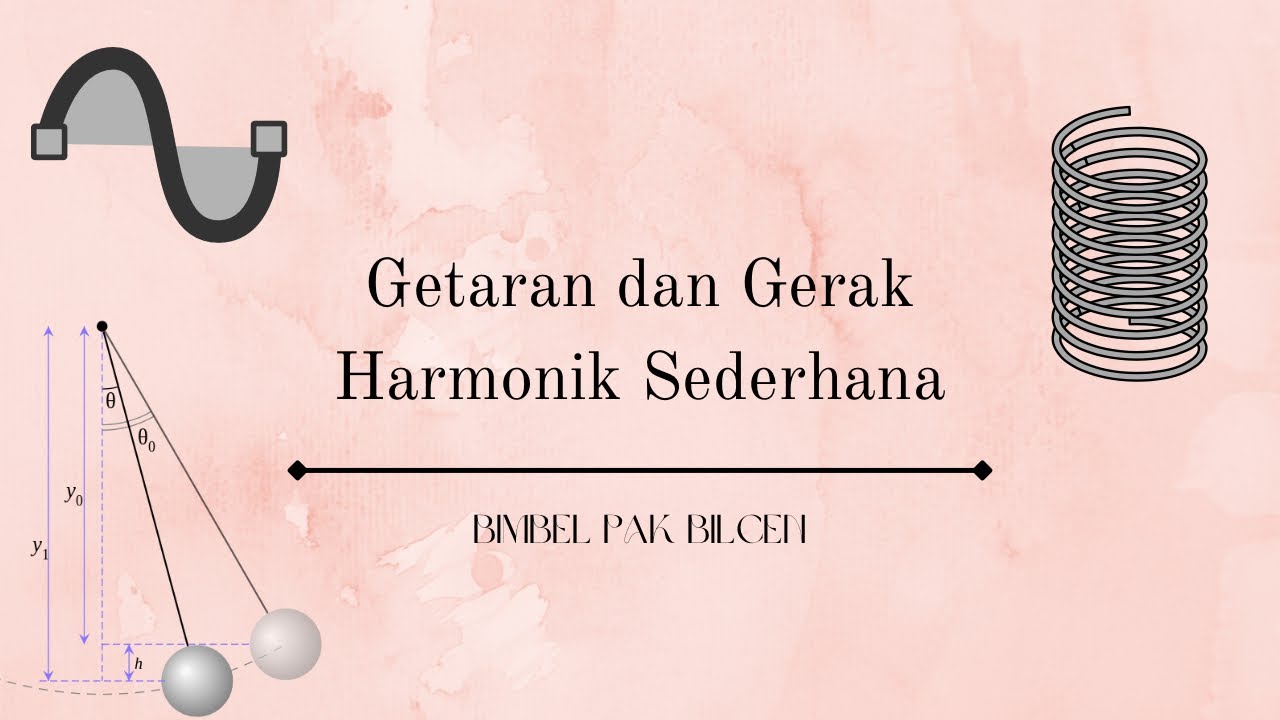
Getaran dan Gerak Harmonik Sederhana: Definisi, Titik Seimbang, Simpangan, Amplitudo, dan Periode

When is a Pendulum in Simple Harmonic Motion?(SHM)

GERAK HARMONIK SEDERHANA: MATERI FISIKA KELAS XI
5.0 / 5 (0 votes)

