Bentuk Umum Persamaan Lingkaran - Matematika SMA Kelas XI Kurikulum Merdeka
Summary
TLDRIn this educational video, the presenter discusses the general equation of a circle in mathematics, specifically for grade 11 students. The video explains how to derive the general equation of a circle from the center coordinates (a, b) and the radius, showcasing the method to convert a specific circle equation into the general form. It also includes step-by-step instructions for calculating the center and radius from a given general equation. The presenter provides an example, walks through the formulas, and demonstrates how to prove the derived equations, helping students understand the concept with clarity.
Takeaways
- 😀 The general equation of a circle is in the form: x² + y² + Ax + By + C = 0.
- 😀 The video explains how to derive the standard equation of a circle from its center and radius.
- 😀 The center of a circle in the general form can be found using the formula: (-A/2, -B/2).
- 😀 The radius of a circle in the general form is calculated using: √((A/2)² + (B/2)² - C).
- 😀 The video provides an example using the equation x² + y² + 6x - 4y - 3 = 0 to find the center and radius.
- 😀 The center of the circle in the example is calculated as (-3, 2).
- 😀 The radius of the circle in the example is determined to be 4.
- 😀 The process involves identifying the values of A, B, and C from the given equation before calculating the center and radius.
- 😀 The formula for the center involves dividing the coefficients of x and y by -2, with a negative sign for both.
- 😀 The formula for the radius combines the squared values of the divided coefficients of x and y, along with the constant C.
- 😀 At the end of the video, students are encouraged to practice with a similar equation to solidify their understanding of the concepts.
Q & A
What is the general form of the equation of a circle?
-The general form of the equation of a circle is x² + y² + Ax + By + C = 0, where A, B, and C are constants derived from the circle's center and radius.
How is the equation of a circle centered at (a, b) derived?
-The equation of a circle with center (a, b) and radius r is derived using the formula (x - a)² + (y - b)² = r², and when expanded, it results in the general form x² + y² + Ax + By + C = 0.
How do you find the center of a circle from its general equation?
-The center of a circle from the general equation x² + y² + Ax + By + C = 0 can be found using the formula: center = (-A/2, -B/2), where A and B are the coefficients of x and y, respectively.
What is the formula for finding the radius of a circle from the general equation?
-The radius of the circle can be found using the formula: radius = √((-A/2)² + (-B/2)² - C), where A, B, and C are the coefficients from the general equation.
Given the general equation x² + y² + 6x - 4y - 3 = 0, what is the center of the circle?
-The center of the circle is (-3, 2). This is calculated by taking -6/2 for the x-coordinate and -(-4)/2 for the y-coordinate.
How do you calculate the radius for the equation x² + y² + 6x - 4y - 3 = 0?
-The radius is calculated using the formula √((-6/2)² + (-(-4)/2)² - (-3)). After substituting the values, the radius is 4.
Why is the negative sign in the formula for the center important?
-The negative sign is essential because it ensures the correct positioning of the center based on the original terms of the equation. The formula for the center is always -A/2 and -B/2.
What is the role of the constant 'C' in the general equation of a circle?
-The constant 'C' in the general equation affects the calculation of the radius. It is subtracted after squaring the x and y coordinates of the center, helping to find the true radius.
How do you derive the standard form of the equation from the general form?
-To derive the standard form (x - a)² + (y - b)² = r² from the general form, you need to complete the square for both the x and y terms, which will give you the center (a, b) and the radius r.
Can you explain how the equation x² + y² + 6x - 4y - 3 = 0 proves the formula for the center and radius?
-Yes, by substituting the coefficients A = 6, B = -4, and C = -3 into the formulas for the center (-A/2, -B/2) and radius √((-A/2)² + (-B/2)² - C), we get the center (-3, 2) and radius 4. This confirms the formulas for both center and radius are correct.
Outlines

Cette section est réservée aux utilisateurs payants. Améliorez votre compte pour accéder à cette section.
Améliorer maintenantMindmap

Cette section est réservée aux utilisateurs payants. Améliorez votre compte pour accéder à cette section.
Améliorer maintenantKeywords

Cette section est réservée aux utilisateurs payants. Améliorez votre compte pour accéder à cette section.
Améliorer maintenantHighlights

Cette section est réservée aux utilisateurs payants. Améliorez votre compte pour accéder à cette section.
Améliorer maintenantTranscripts

Cette section est réservée aux utilisateurs payants. Améliorez votre compte pour accéder à cette section.
Améliorer maintenantVoir Plus de Vidéos Connexes
Review on Circles
HUBUNGAN ANTARA SUDUT PUSAT DAN SUDUT KELILING LINGKARAN ~ Materi Matematika Kelas 8 Semester 2
Grade 11 | Operations on Functions | General Mathematics
Persamaan Lingkaran : Konsep Dasar Persamaan Lingkaran Matematika Peminatan Kelas 11
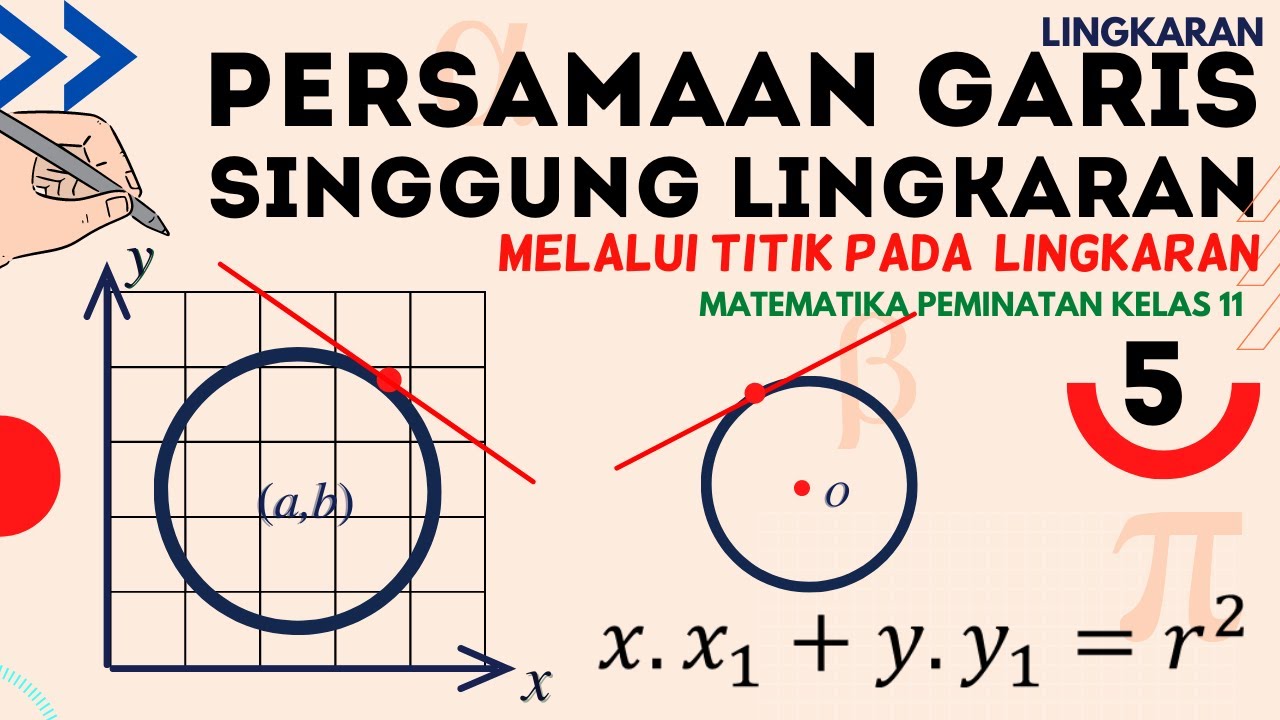
Persamaan Garis Singgung Lingkaran Yang Melalui Titik Pada Lingkaran : Matematika Peminatan Kelas 11
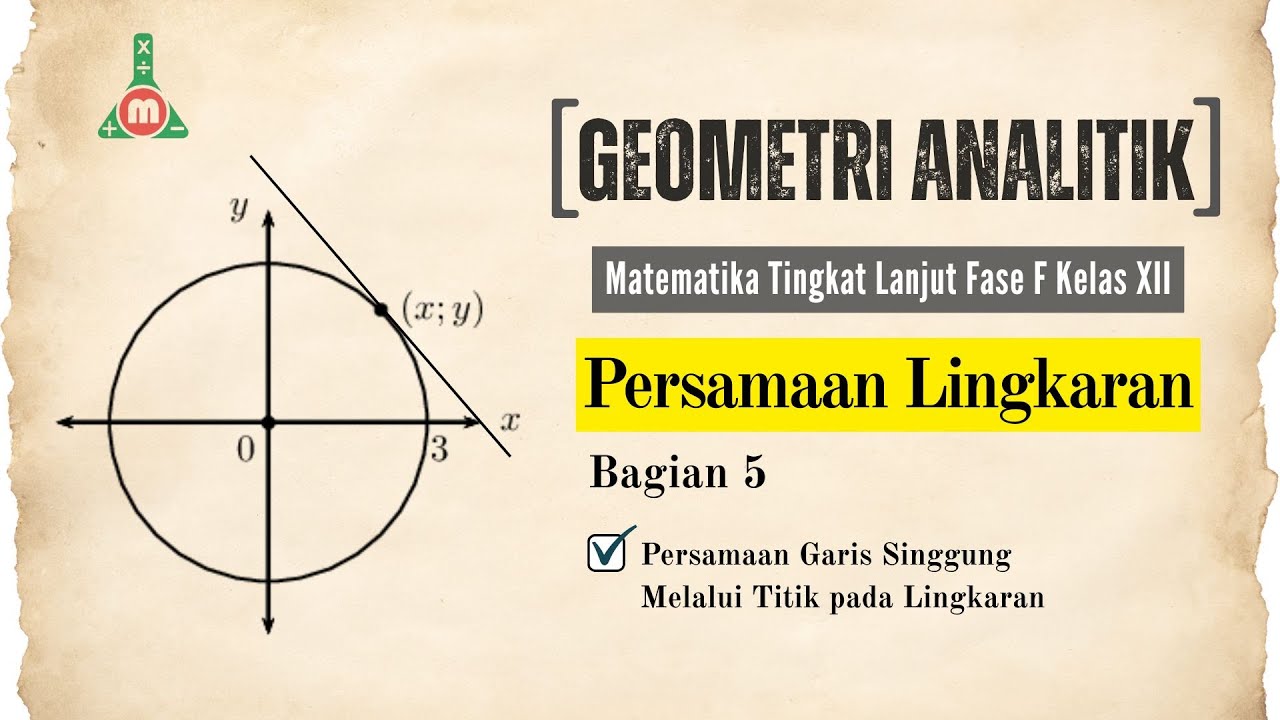
Lingkaran Bagian 5 - Persamaan Garis Singgung Melalui Titik Pada Lingkaran
5.0 / 5 (0 votes)

