How to Write Electron Configurations and Orbital Diagrams (General Chemistry I)
Summary
TLDRThis video provides a step-by-step guide on writing electron orbital diagrams using the periodic table efficiently. It explains orbital types (s, p, d, f), their capacities, and how to visualize them with box diagrams. The instructor demonstrates techniques for determining electron configurations for elements ranging from simple ones like nitrogen to complex ones like uranium. Tricks such as the diagonal line method, shorthand notation using noble gases, and handling ions are highlighted to simplify the process. By combining visual strategies and procedural steps, viewers learn to confidently construct orbital diagrams and electron configurations without excessive memorization, making even advanced elements manageable.
Takeaways
- 😀 The s orbital contains 2 electrons, the p orbital has 6, the d orbital contains 10, and the f orbital has 14 electrons.
- 😀 To write electron orbital diagrams, each orbital is represented by a box, and electrons are indicated with arrows pointing up or down.
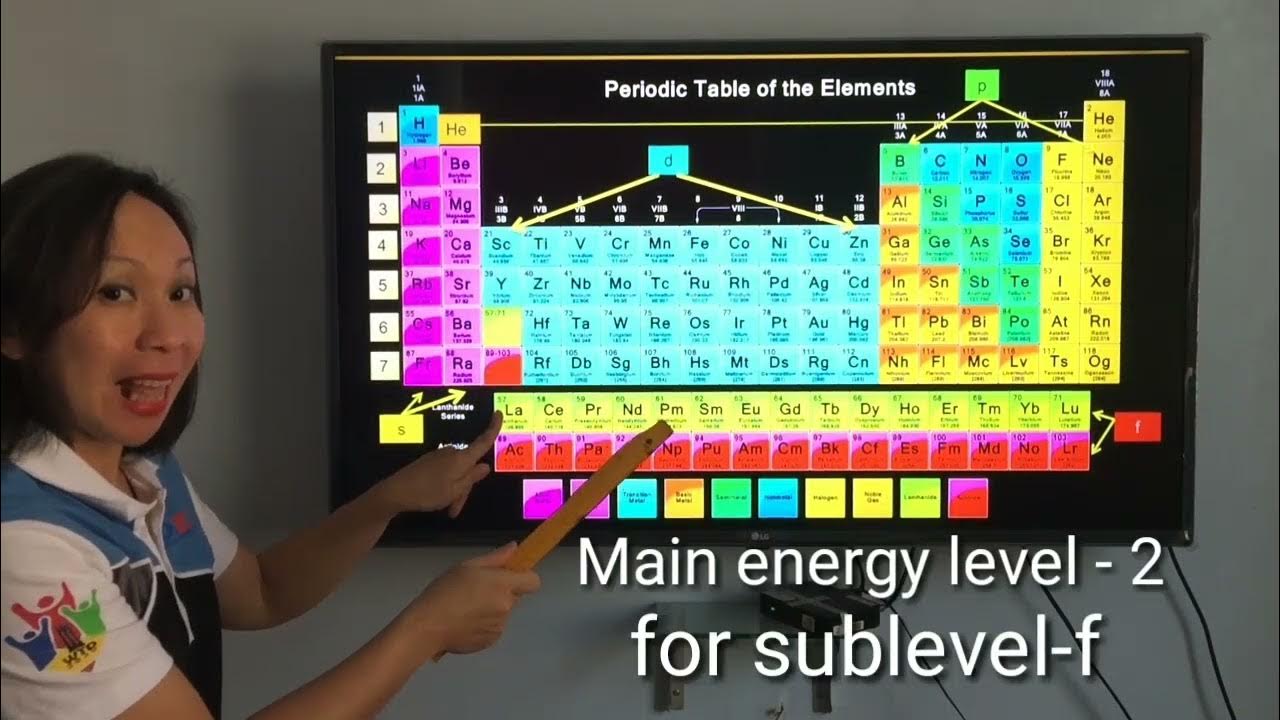
- 😀 The periodic table can be used to find electron configurations without memorizing orbital counts; each column corresponds to an orbital set.
- 😀 The 1s, 2s, 2p, 3s, 3p orbitals and beyond are represented by diagonal lines across the periodic table, simplifying the process of finding electron configurations.
- 😀 The electron configuration of nitrogen (atomic number 7) is 1s² 2s² 2p³, and its orbital diagram will have boxes for 1s, 2s, and 2p.
- 😀 For elements with higher atomic numbers, you can use the periodic table or the diagonal chart to easily find electron configurations, like for magnesium (atomic number 12).
- 😀 Shorthand notation is useful for large elements like silver and uranium; this method uses the nearest noble gas to simplify electron configurations.
- 😀 For ions, the electron configuration changes based on whether the atom gains or loses electrons. For example, Cl⁻ has the same configuration as Argon.
- 😀 The d and f orbitals require special attention, with 10 and 14 electrons respectively, and are located further down the periodic table.
- 😀 Writing orbital diagrams for elements far down the periodic table, like uranium, can be complex, but using the periodic table and diagonal charts makes it easier.
- 😀 The key to mastering orbital diagrams is practice—especially with elements in the middle and bottom rows of the periodic table, as their configurations involve multiple orbitals.
Q & A
What are the key orbital types and how many electrons do they hold?
-The key orbital types are: s (holds 2 electrons), p (holds 6 electrons), d (holds 10 electrons), and f (holds 14 electrons).
How can you use the periodic table to determine electron orbital configurations?
-You can use the periodic table to identify the element and count the number of electrons, following the order of orbitals. This helps you build the electron configuration without memorizing each element's setup.
How do you represent electrons in orbital diagrams?
-Electrons are represented by arrows in boxes. Each box represents an orbital, and the arrows indicate the spin of the electrons. For example, the s orbital has one box with two opposite arrows, while the p orbital has three boxes with two arrows in each box.
What is the diagonal method for simplifying orbital configurations?
-The diagonal method involves drawing diagonal lines on a chart of the periodic table. You follow these lines to fill orbitals in a simplified manner, making it easier to determine electron configurations, especially for elements far down the table.
Can you provide an example of using the diagonal method for an element?
-For magnesium (atomic number 12), you start at 1s², follow the diagonal line to 2s², then to 2p⁶, and finally to 3s², resulting in the electron configuration 1s² 2s² 2p⁶ 3s².
What is shorthand notation in electron configurations, and how is it used?
-Shorthand notation involves using the nearest noble gas as a reference point. For example, for silver (Ag), the shorthand is [Kr] 5s² 4d⁹, where [Kr] represents the electron configuration of Krypton.
What is the importance of using shorthand notation when writing electron configurations?
-Shorthand notation simplifies writing electron configurations, especially for elements with a high atomic number, by replacing part of the configuration with the electron configuration of the nearest noble gas.
How does the charge of an ion affect its electron configuration?
-For an anion (negative ion), electrons are added, while for a cation (positive ion), electrons are removed. For example, Cl⁻ has the same electron configuration as Argon, and Al²⁺ has the same configuration as Sodium.
How do you write the electron configuration for an anion like Cl⁻?
-For Cl⁻, the electron configuration is the same as Argon because the extra electron makes it a negative ion. The configuration would be 1s² 2s² 2p⁶ 3s² 3p⁶.
Can you walk me through the process of writing the electron configuration for an element like Uranium?
-For Uranium (atomic number 92), you would start by using the diagonal method and continue through the orbitals: 1s² 2s² 2p⁶ 3s² 3p⁶ 3d¹⁰ 4s² 4p⁶ 4d¹⁰ 5s² 4f¹⁴ 5d¹⁰ 6s² 4f¹⁴ 5d¹⁰ 6p⁶ 7s² 5f³, ending with 5f³.
Outlines

Cette section est réservée aux utilisateurs payants. Améliorez votre compte pour accéder à cette section.
Améliorer maintenantMindmap

Cette section est réservée aux utilisateurs payants. Améliorez votre compte pour accéder à cette section.
Améliorer maintenantKeywords

Cette section est réservée aux utilisateurs payants. Améliorez votre compte pour accéder à cette section.
Améliorer maintenantHighlights

Cette section est réservée aux utilisateurs payants. Améliorez votre compte pour accéder à cette section.
Améliorer maintenantTranscripts

Cette section est réservée aux utilisateurs payants. Améliorez votre compte pour accéder à cette section.
Améliorer maintenant



5.0 / 5 (0 votes)

