Cara Menghitung SWING CIRCLE Pada Saat Kapal Berlabuh Jangkar #mualimkapal
Summary
TLDRThis video provides a step-by-step guide on calculating a ship's swing circle when at anchor, explaining two different formulas to determine the safe rotation radius. It covers the simple formula using the ship's length and anchor chain segments, and a more advanced formula accounting for water depth and other factors. The tutorial includes detailed calculations, conversions between meters and nautical units, and a worked example showing both methods yielding similar results. The presenter emphasizes the simplicity of the first formula for practical use, while ensuring viewers understand how to calculate a safe anchoring radius for their vessel.
Takeaways
- 😀 The video explains how to determine the 'swing circle' or 'free swinging radius' of a ship when anchored.
- 😀 The swing circle is the area within which a ship can move freely while anchored.
- 😀 The first formula for calculating the swing circle radius involves adding the ship's length to the number of cables (segel) and multiplying by 27.5 meters.
- 😀 One cable (segel) is equivalent to 27.5 meters, and one nautical mile is 1852 meters.
- 😀 An example calculation is provided: the ship's length is 253.3 meters, and the anchor uses 8 segel, giving a swing radius of 2.5 cables.
- 😀 The second formula for the swing radius involves a more complex calculation using the ship's length, square roots, depth, and the 'reboot' distance.
- 😀 The second formula also results in a swing radius of 2.5 cables, which is consistent with the first formula in this example.
- 😀 The depth of water and the length of the anchor chain play an important role in the swing circle calculation.
- 😀 For simplicity, the first formula is recommended over the second, as it is easier to calculate without needing square roots and additional values.
- 😀 The video aims to provide useful calculations for mariners, particularly those dealing with anchoring and ship positioning at sea.
Q & A
What is the main topic discussed in the video?
-The video explains how to determine the swing circle (alphael) or the free rotation radius of a ship at anchor.
What does the term 'swing circle' refer to in this context?
-A swing circle refers to the safe circular area around an anchored ship within which the ship can rotate freely without risk of collision or grounding.
What is the first formula for calculating the swing circle radius?
-The first formula is: Ship length (LOA) plus the number of shackles (anchor chain length segments) multiplied by 27.5 meters.
How long is one shackle (segel) according to the video?
-One shackle is 27.5 meters, which is also equivalent to 0.1 cable, and one cable equals 185.2 meters.
How do you convert the swing circle radius from meters to cables?
-To convert from meters to cables, divide the total distance in meters by 185.2 (the length of one cable in meters).
What is the second formula for calculating the swing circle radius?
-The second formula is: LOA plus the square root of the squared total chain length minus the depth squared plus the square of the 'reboot' (distance from anchor position to ship).
Which formula does the presenter prefer, and why?
-The presenter prefers the first formula because it is simpler and avoids the need to calculate square roots.
What example values are used in the calculations?
-The ship length (LOA) is 253.5 meters, the anchor chain is 8 shackles (220 meters), the depth is 39 meters, and the 'reboot' distance is 6 meters.
What is the final calculated swing circle radius for both formulas in cables?
-For both formulas, the calculated swing circle radius is approximately 2.5 cables.
Why is it important to calculate a safe swing circle for an anchored ship?
-Calculating a safe swing circle ensures that the ship can rotate freely at anchor without hitting other vessels, structures, or running aground, maintaining safety in the anchorage area.
What is meant by 'reboot' in the second formula?
-'Reboot' refers to the distance from the anchor to the ship's position, used in the calculation of the swing radius in more precise scenarios involving depth.
What unit conversions are demonstrated in the video?
-The video demonstrates converting shackles to meters, meters to cables, and explaining the relation between shackles, cables, and nautical miles.
Outlines

Dieser Bereich ist nur für Premium-Benutzer verfügbar. Bitte führen Sie ein Upgrade durch, um auf diesen Abschnitt zuzugreifen.
Upgrade durchführenMindmap

Dieser Bereich ist nur für Premium-Benutzer verfügbar. Bitte führen Sie ein Upgrade durch, um auf diesen Abschnitt zuzugreifen.
Upgrade durchführenKeywords

Dieser Bereich ist nur für Premium-Benutzer verfügbar. Bitte führen Sie ein Upgrade durch, um auf diesen Abschnitt zuzugreifen.
Upgrade durchführenHighlights

Dieser Bereich ist nur für Premium-Benutzer verfügbar. Bitte führen Sie ein Upgrade durch, um auf diesen Abschnitt zuzugreifen.
Upgrade durchführenTranscripts

Dieser Bereich ist nur für Premium-Benutzer verfügbar. Bitte führen Sie ein Upgrade durch, um auf diesen Abschnitt zuzugreifen.
Upgrade durchführenWeitere ähnliche Videos ansehen

How to Calculate Circumference of a Circle (Step by Step) | Circumference Formula
PERSAMAAN STANDAR LINGKARAN | GEOMETRI ANALITIK

Cara Mencari Keliling dan Luas Lingkaran Jika Jari-jari dan Diameter Diketahui

Bentuk Umum Persamaan Lingkaran - Matematika SMA Kelas XI Kurikulum Merdeka

MATEMATIKA WAJIB KELAS XI MATERI LINGKARAN DARI BUKU PKS : SEGI-N BERATURAN
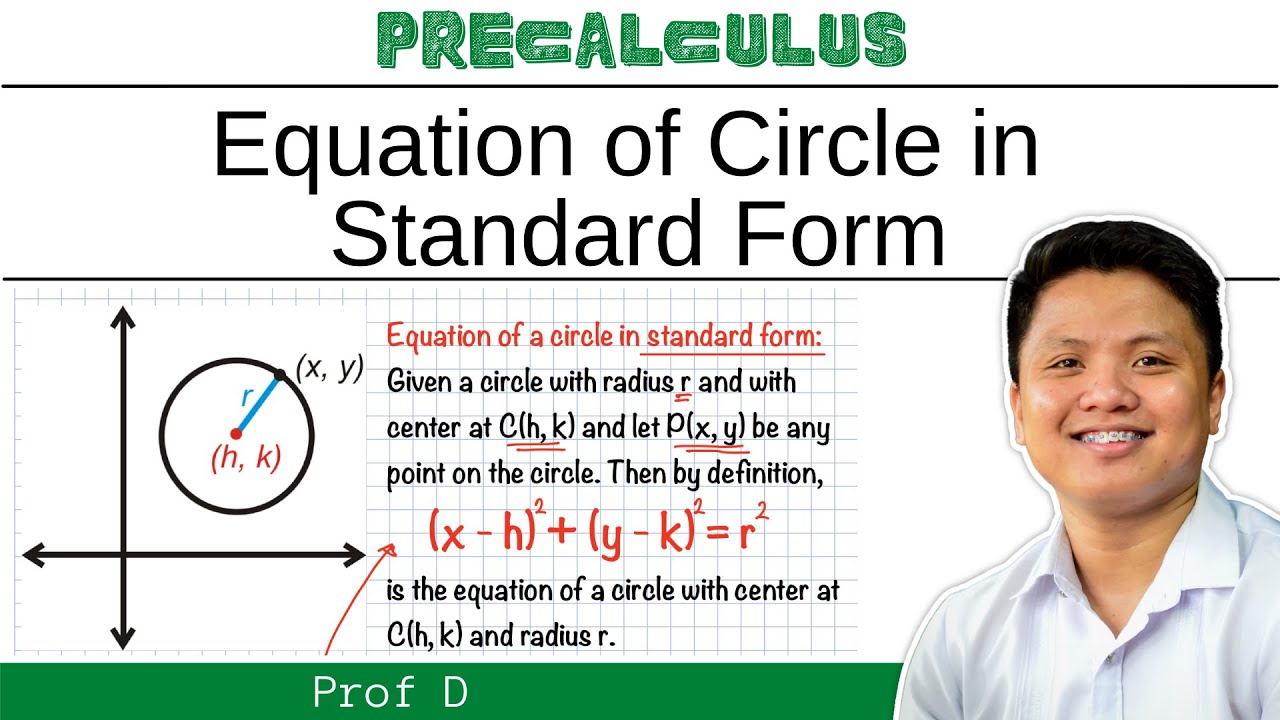
EQUATION OF CIRCLE IN STANDARD FORM | PROF D
5.0 / 5 (0 votes)

