Materi SKI Kelas 10 Bab 6 Semester 2 | Peradaban Islam Daulah Umayyah di Andalusia
Summary
TLDRThe video discusses the history of the Umayyad Caliphate in Andalusia, covering its rise, key figures, and significant achievements. Starting with the conquest of Andalusia by Islamic forces, the script highlights the governance of the Umayyads in Damascus and later in Andalusia, especially under Abd al-Rahman I. The video also explores the contributions of Muslim scholars in philosophy, medicine, and geography, including figures like Ibn Sina and Ibn Khaldun. It further examines the decline of the Umayyad rule due to internal fragmentation and external pressures, ultimately leading to the fall of Islamic power in Spain by 1492.
Takeaways
- 😀 Islam expanded through North Africa before reaching Andalusia, where the initial conquest was led by Musa bin Nusayr.
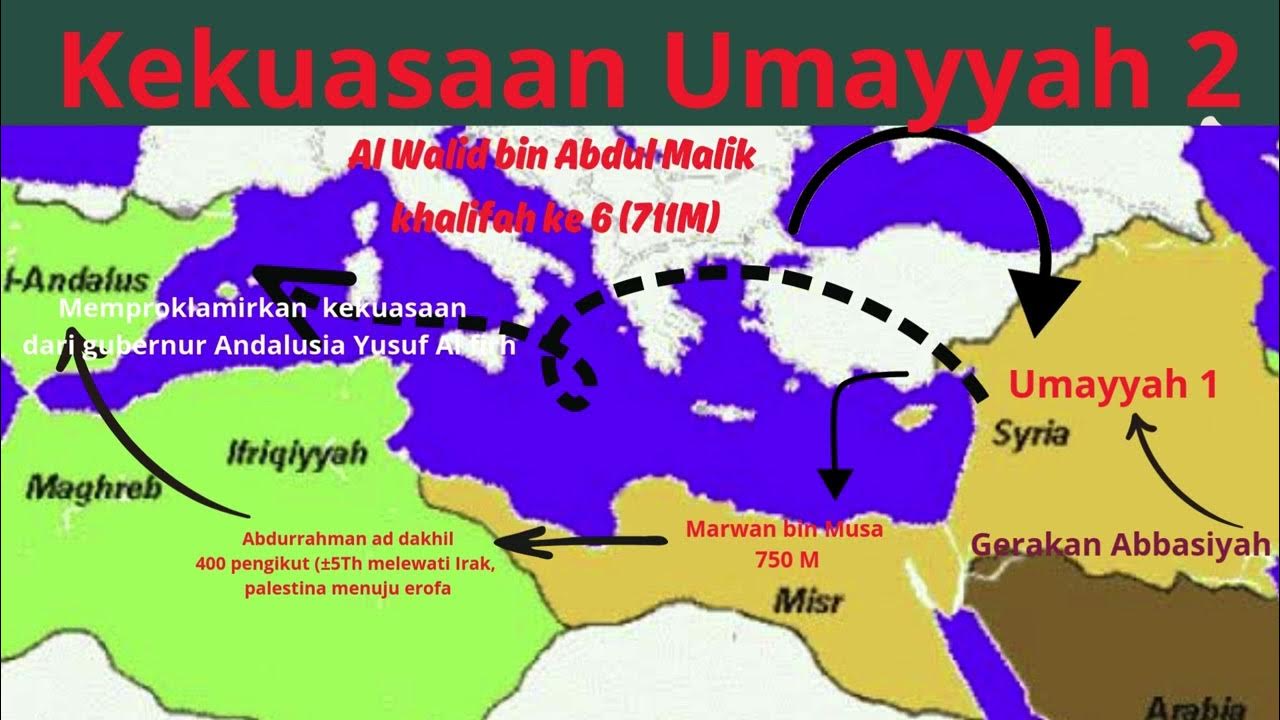
- 😀 The Umayyad Caliphate in Andalusia began with the leadership of Abdurrahman I, who escaped Abbasid persecution and founded the dynasty in 756.
- 😀 Abdurrahman I, also known as 'Addakhil', successfully established a strong Umayyad rule that lasted for over 30 years.
- 😀 The Umayyad rule in Andalusia was divided into several periods, each marked by political and social changes.
- 😀 The first period of Umayyad rule in Andalusia started with the conquest, with the capital in Damascus before shifting to Cordoba.
- 😀 Abdurrahman III, during the third period, began using the title 'Khalifah', marking a shift from 'Amir' (commander) used earlier.
- 😀 The weakening of the Umayyad Caliphate in Andalusia began in the fourth period (1030-1086), where the empire split into multiple small kingdoms.
- 😀 By the fifth period (1067-1248), the Morabitun dynasty from North Africa emerged as a dominant force to help defend against Christian attacks.
- 😀 The final period (1248-1492) saw the fall of Muslim rule to Christian forces, leaving only the kingdom of Granada under Muslim control.
- 😀 Scholars in Andalusia contributed significantly to philosophy, science, and medicine, with figures like Ibn Rushd, Ibn Sina, and Ibn Khaldun leading the way.
- 😀 The decline of the Umayyad Caliphate in Andalusia was due to several factors, including unclear succession, lack of unity, economic struggles, and external invasions.
Q & A
How did the Umayyad rule begin in Andalusia?
-The Umayyad rule in Andalusia began after the Muslim conquest of the region. Following the consolidation of Muslim control in North Africa under Musa ibn Nusayr, Tariq ibn Ziyad was sent to investigate and eventually conquer Andalusia. Initially, Andalusia was governed under the Umayyad Caliphate centered in Damascus.
What was the role of Musa ibn Nusayr in the conquest of Andalusia?
-Musa ibn Nusayr, as the governor of North Africa, organized and authorized the expedition into Andalusia. He sent Tariq ibn Ziyad to lead the mission, which resulted in the successful conquest of the region.
Who was Abd al-Rahman I, and why was he significant in Andalusian history?
-Abd al-Rahman I, also known as Abd al-Rahman al-Dakhil, was the only surviving member of the Umayyad family after the Abbasid revolution. He escaped to Andalusia and established an independent Umayyad emirate there, laying a strong political foundation that lasted for about 32 years under his leadership.
What title did Abd al-Rahman I receive due to his leadership?
-Due to his strength and resilience in rebuilding Umayyad power in Andalusia, Abd al-Rahman I was nicknamed the 'Falcon of Quraysh' (Raja Wali Quraisy in the script).
How was the Umayyad period in Andalusia divided historically?
-The Umayyad period in Andalusia was divided into six main periods: the initial governance under Damascus, a period of growth and stability, the declaration of the caliphate under Abd al-Rahman III, fragmentation into small kingdoms (Taifa states), the intervention of the Almoravids from North Africa, and finally the rule of Banu Ahmar in Granada until 1492.
What major political change occurred during the rule of Abd al-Rahman III?
-During the rule of Abd al-Rahman III, the rulers of Andalusia adopted the title of 'Caliph' instead of 'Amir,' marking the establishment of the Umayyad Caliphate of Cordoba and asserting political and religious independence.
What caused the fragmentation of Muslim rule in Andalusia?
-The fragmentation was caused by weak leadership, unclear systems of succession, lack of a unifying ideology, economic difficulties, and political isolation, leading to the division of the region into more than 30 small kingdoms known as Taifa states.
Which North African dynasty helped defend Andalusia from Christian attacks?
-The Almoravid dynasty (Daulah Murabitun) from North Africa emerged as a dominant force and helped defend Muslim territories in Andalusia from increasing Christian reconquest efforts.
What were some major contributions of Andalusian scholars in philosophy and science?
-Scholars in Andalusia made significant contributions in philosophy, medicine, chemistry, astronomy, and geography. Figures such as Ibn Bajjah (Avempace), Ibn Tufayl, Abbas ibn Firnas, Al-Razi, and Ibn Sina contributed to advancements in scientific and medical knowledge that influenced both the Islamic world and Europe.
How did Islamic legal thought develop in Andalusia?
-Islamic legal thought in Andalusia predominantly followed the Maliki school of jurisprudence, introduced by scholars such as Ziyad ibn Abd al-Rahman. This school became the dominant legal tradition in the region.
What was Ibn Khaldun’s contribution to historical studies?
-Ibn Khaldun introduced a theory of historical development in his famous work 'Muqaddimah.' He is regarded as a pioneer in the philosophy of history and sociology, and his work greatly influenced later Western and Islamic scholars.
When and how did Muslim rule in Andalusia finally end?
-Muslim rule in Andalusia ended in 1492 when the Kingdom of Granada, ruled by Banu Ahmar, fell to Christian forces. This marked the completion of the Reconquista and the end of Islamic political authority in the Iberian Peninsula.
Outlines

Dieser Bereich ist nur für Premium-Benutzer verfügbar. Bitte führen Sie ein Upgrade durch, um auf diesen Abschnitt zuzugreifen.
Upgrade durchführenMindmap

Dieser Bereich ist nur für Premium-Benutzer verfügbar. Bitte führen Sie ein Upgrade durch, um auf diesen Abschnitt zuzugreifen.
Upgrade durchführenKeywords

Dieser Bereich ist nur für Premium-Benutzer verfügbar. Bitte führen Sie ein Upgrade durch, um auf diesen Abschnitt zuzugreifen.
Upgrade durchführenHighlights

Dieser Bereich ist nur für Premium-Benutzer verfügbar. Bitte führen Sie ein Upgrade durch, um auf diesen Abschnitt zuzugreifen.
Upgrade durchführenTranscripts

Dieser Bereich ist nur für Premium-Benutzer verfügbar. Bitte führen Sie ein Upgrade durch, um auf diesen Abschnitt zuzugreifen.
Upgrade durchführenWeitere ähnliche Videos ansehen

Lahirnya Daulah Umayah di Andalusia

Dinasti Umayyah di Andalusia
Video Pembelajaran Sejarah Kebudayaan Islam (SKI). Roslina, S.Ag

Daulah Umayyah II Di Spanyol (Andalusia) || Awal mula Berdiri, Masa Keemasan, dan Berakhirnya Daulah
Dinasti Umayyah II di Spanyol/Andalusia

PAI Kelas 8 Bab 6 Daulah Umayyah di Andalusia
5.0 / 5 (0 votes)

