PHYSICAL SCIENCE Q1-Lesson 1:Exploring the Formation of Elements During Stellar Formation
Summary
TLDRThis lesson explores the formation of elements through stellar evolution and nucleosynthesis. Stars begin as protostars formed from collapsing molecular clouds, and through nuclear fusion, lighter elements like hydrogen fuse into heavier ones such as helium and carbon. Massive stars progress to fuse heavier elements until iron is formed. Once fuel is exhausted, stars expel their outer layers, leaving behindawhitedwarf.TheBigBangcreatedlightelements,withheavieronesforminglaterinstars.HenryMoseley’sorganizationofelementsbyatomicnumberledtothepredictionanddiscoveryofnewelements.Keyconceptsincludefusionreactionsandthecreationofelementsthroughstellarprocesses.
Takeaways
- 😀 Stars form from the collapse of molecular clouds, creating a protostar that heats up through gravitational contraction until nuclear fusion begins.
- 😀 Hydrogen fuses into helium in the core of stars, initiating nuclear fusion and creating energy, leading to the star's main-sequence phase.
- 😀 As fusion continues, stars produce heavier elements, starting with carbon, neon, and magnesium, culminating in the formation of iron.
- 😀 The fusion of lighter elements, such as helium fusing with carbon, results in the creation of heavier elements like oxygen and neon.
- 😀 Massive stars undergo successive fusion stages, forming increasingly heavier elements, but fusion stops once iron is produced.
- 😀 When a star's fuel is exhausted, its outer layers are expelled, and the remaining core can become a white dwarf, primarily composed of carbon.
- 😀 The Big Bang produced the lightest elements (hydrogen, helium, lithium), while heavier elements formed later through stellar nucleosynthesis within stars.
- 😀 Stellar nucleosynthesis is the process inside stars where elements are created through fusion reactions, forming elements heavier than hydrogen and helium.
- 😀 Henry Gwyn Jeffreys organized elements by atomic number rather than atomic mass, leading to predictions of new elements based on proton count.
- 😀 Nuclear reactions such as alpha, beta, and gamma emissions are crucial in transforming elements, with each emission type causing different changes in atomic structure.
- 😀 Alpha emission releases two protons and two neutrons, beta emission converts neutrons into protons, and gamma emission releases energy without changing the element.
Q & A
What is the process of star formation?
-Stars form when molecular clouds collapse under gravity, creating a protostar. The temperature increases due to gravitational contraction, and once nuclear fusion begins, the protostar becomes a main-sequence star.
How do stars generate energy through fusion?
-In a star's core, hydrogen fuses into helium through proton-proton chain reactions. This fusion process releases energy, and the balance between gravitational pressure and the energy produced by fusion keeps the star stable.
What elements are formed during the fusion process in stars?
-During fusion, lighter elements like hydrogen and helium combine to form heavier elements. For example, hydrogen fuses into helium, which can then transform into carbon. Massive stars can continue this process, producing elements like neon, magnesium, silicon, and eventually iron.
What happens when a star's core becomes iron?
-Iron marks the end of the energy-producing fusion reactions in a star. Fusion of elements beyond iron does not release energy, and when the star runs out of fuel, it can no longer sustain fusion, leading to the expulsion of outer layers and the formation of a white dwarf or, in the case of massive stars, a supernova.
What is stellar nucleosynthesis?
-Stellar nucleosynthesis is the process by which elements are created inside stars. Helium fuses with carbon to form oxygen, which can then react with helium to form neon, and so on, creating heavier elements like silicon and iron through nuclear fusion reactions.
How does the Big Bang contribute to the formation of elements?
-The Big Bang primarily produced the lightest elements—hydrogen, helium, and traces of lithium—during the first few minutes of the universe's existence. Heavier elements were formed later in stars through stellar nucleosynthesis.
What is the role of infrared radiation in star formation?
-Infrared radiation from forming stars provides evidence of ongoing star formation. This radiation can be detected from interstellar dust and gas, which are crucial for the process of star and element formation.
How does Henry Gwyn Jeffreys Moseley’s arrangement of elements impact atomic theory?
-Moseley arranged elements by their atomic number rather than atomic mass, which helped to resolve inconsistencies in the periodic table. This arrangement based on proton count enabled the prediction and discovery of new elements.
What are the different types of nuclear emissions and how do they affect elements?
-There are three main types of nuclear emissions: alpha, beta, and gamma. Alpha emission releases two protons and two neutrons, changing the element. Beta emission converts a neutron into a proton, ejecting an electron and changing the element. Gamma emission releases energy without changing the element, but it has high penetration.
What is the significance of the white dwarf stage in a star's life cycle?
-A white dwarf is the remnant core of a low-mass star after it expels its outer layers. The remaining core is mostly composed of carbon and represents the final stage of the star's evolution before it ceases fusion.
Outlines

Dieser Bereich ist nur für Premium-Benutzer verfügbar. Bitte führen Sie ein Upgrade durch, um auf diesen Abschnitt zuzugreifen.
Upgrade durchführenMindmap

Dieser Bereich ist nur für Premium-Benutzer verfügbar. Bitte führen Sie ein Upgrade durch, um auf diesen Abschnitt zuzugreifen.
Upgrade durchführenKeywords

Dieser Bereich ist nur für Premium-Benutzer verfügbar. Bitte führen Sie ein Upgrade durch, um auf diesen Abschnitt zuzugreifen.
Upgrade durchführenHighlights

Dieser Bereich ist nur für Premium-Benutzer verfügbar. Bitte führen Sie ein Upgrade durch, um auf diesen Abschnitt zuzugreifen.
Upgrade durchführenTranscripts

Dieser Bereich ist nur für Premium-Benutzer verfügbar. Bitte führen Sie ein Upgrade durch, um auf diesen Abschnitt zuzugreifen.
Upgrade durchführenWeitere ähnliche Videos ansehen

PS Lesson 1: Big Bang Theory & Formation of Light Elements
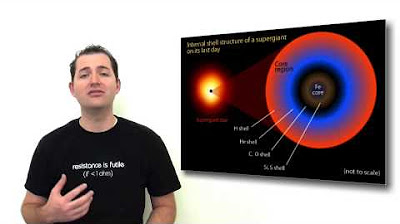
Nucleosynthesis: The Formation of Elements in the Universe
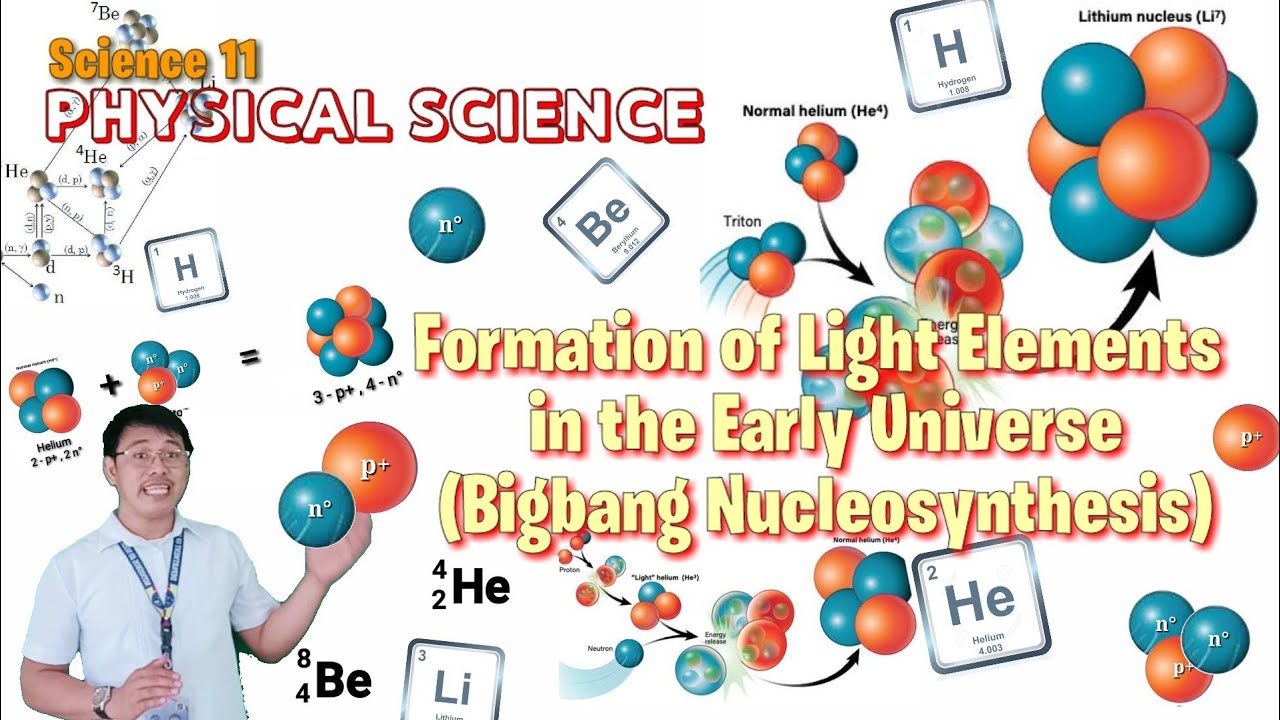
FORMATION OF LIGHT ELEMENTS | BIG BANG NUCLEOSYNTHESIS | SCIENCE 11 - PHYSICAL SCIENCE

The Epic Journey of Atoms: From Big Bang to Now!

SHS Physical Science Q1 Ep1: Formation of Heavy Elements (Part I)
UP TALKS | Nucleosynthesis: Formation of the Elements
5.0 / 5 (0 votes)

