Modul Osborne reynold
Summary
TLDRThis video provides a detailed walkthrough of a practical experiment using the Osborne apparatus to study fluid flow in pipes. It covers the setup of equipment, including a hydraulic table, ink, and measurement tools, and demonstrates how to measure flow rate, velocity, and Reynolds number for laminar, transitional, and turbulent flows. Step-by-step instructions guide viewers through data collection, calculations, and analysis, including determining friction factors and logarithmic values. The video also explains how to organize results into tables and plot graphs, making it an informative resource for understanding fluid mechanics principles and applying them in laboratory settings.
Takeaways
- 😀 The video demonstrates a practical session on the Osborne viscometer for fluid flow experiments, conducted by a civil engineering student from the 2019 batch.
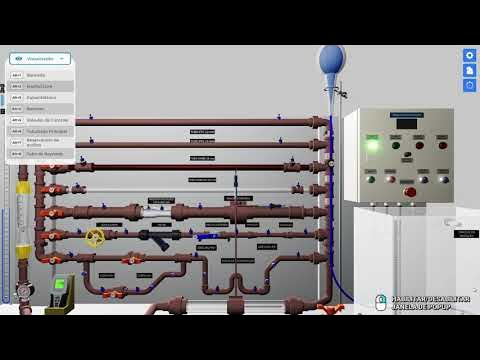
- 🧪 The required materials for the experiment include a graduated cylinder, ink, stopwatch, hydraulic table, and the Osborne apparatus.
- ⚡ The hydraulic table must be connected to a power source and turned on before starting the experiment, with the flow adjusted to a steady state.
- 💧 Ink is filled into the apparatus, and the fluid flow is observed to ensure it is laminar without any obstructions.
- 🌡️ Temperature of the fluid is measured as it affects the kinematic viscosity used in calculations.
- ⏱️ Flow rate (discharge) is measured by collecting fluid volumes at intervals of 100 mL and recording the time.
- 🔄 The experiment is repeated three times for each flow type: laminar, transitional, and turbulent, to ensure accuracy.
- 📊 Calculations include determining average flow rate (Q), average velocity (V), Reynolds number (Re), friction coefficient (f), and logarithmic values for plotting.
- 📈 Data results are tabulated and used to create graphs such as Reynolds number versus flow rate and logarithm of Reynolds number versus logarithm of friction coefficient.
- ✏️ Example calculations demonstrate converting measured volumes and times into flow rate, velocity, Reynolds number, friction factor, and logarithmic values for analysis.
- 📋 The experiment emphasizes understanding fluid behavior in different flow regimes and the relationship between flow parameters for engineering analysis.
Q & A
What is the purpose of the Osborne apparatus in this practical session?
-The Osborne apparatus is used to study fluid flow characteristics, specifically laminar, transitional, and turbulent flow, by measuring flow rate, velocity, Reynolds number, and friction factors.
Which equipment and materials are required for the Osborne practical?
-The materials include a measuring glass, ink, stopwatch, table, hydraulic setup, and a complete Osborne apparatus.
What is the first step in preparing the Osborne apparatus for the experiment?
-The first step is to ensure the hydraulic table is connected to a power source.
How is the flow of fluid stabilized before measurement?
-The flow is stabilized by filling the ink container, turning on the hydraulic table, and adjusting the flow until a steady flow is achieved by turning the valve counterclockwise.
How are measurements of fluid volume and time taken during the experiment?
-Measurements are taken by collecting the fluid in 100 mL increments, recording the time taken to collect each volume, and repeating this three times for each type of flow.
What key data is recorded from the experiment for further calculations?
-The key data recorded are the time (T) in seconds, fluid volume (V) in liters, and the type of flow observed (laminar, transitional, or turbulent).
Which formulas are used to calculate the average flow rate and velocity?
-The average flow rate Q is calculated as Q = V/t, and the average velocity V is calculated as V = Q/A, where A is the pipe cross-sectional area.
How is the Reynolds number determined in this experiment?
-The Reynolds number (Re) is calculated using the formula Re = V * D / ν, where V is the flow velocity, D is the pipe diameter, and ν is the kinematic viscosity of the fluid.
What method is used to calculate the average friction factor?
-The average friction factor (f) is calculated for laminar flow using f = 64 / Re, while for transitional and turbulent flow, the same principles apply but require empirical or software-assisted calculations.
What additional calculations are performed after obtaining basic flow parameters?
-Logarithmic values such as log(f) and log(Re) are calculated to help in plotting the Moody diagram or friction factor versus Reynolds number graphs.
How is the experiment concluded after data collection?
-The experiment is concluded by closing the ink container, shutting the hydraulic table, and recording all measured and calculated values in a data table for graphing.
Which graphs are suggested for analyzing the results?
-The recommended graphs are Reynolds number versus flow rate and log(Re) versus log(friction factor) for each type of flow (laminar, transitional, and turbulent).
Outlines

هذا القسم متوفر فقط للمشتركين. يرجى الترقية للوصول إلى هذه الميزة.
قم بالترقية الآنMindmap

هذا القسم متوفر فقط للمشتركين. يرجى الترقية للوصول إلى هذه الميزة.
قم بالترقية الآنKeywords

هذا القسم متوفر فقط للمشتركين. يرجى الترقية للوصول إلى هذه الميزة.
قم بالترقية الآنHighlights

هذا القسم متوفر فقط للمشتركين. يرجى الترقية للوصول إلى هذه الميزة.
قم بالترقية الآنTranscripts

هذا القسم متوفر فقط للمشتركين. يرجى الترقية للوصول إلى هذه الميزة.
قم بالترقية الآنتصفح المزيد من مقاطع الفيديو ذات الصلة




5.0 / 5 (0 votes)

