Invers Matriks 3x3 - Penjelasan Lengkap
Summary
TLDRThis video tutorial explains how to find the inverse of a 3×3 matrix using the determinant and the adjoint (transpose of the cofactor matrix). The instructor demonstrates step-by-step calculations, including using the Sarrus method to determine the determinant, finding minors and cofactors for each element, transposing the cofactor matrix to get the adjoint, and applying the inverse formula. Detailed examples and tips on handling signs, using horizontal and vertical line elimination for minors, and checking the final result make the process clear and practical. The video encourages viewers to follow along, practice, and revisit the material for better understanding.
Takeaways
- 😀 The inverse of a 3x3 matrix can be calculated using the Sarrus rule combined with minors and cofactors.
- 😀 The formula for the inverse of a matrix is: Inverse(A) = 1/det(A) * adj(A), where det(A) is the determinant of the matrix A and adj(A) is the adjoint of A.
- 😀 For a 2x2 matrix, the determinant is calculated differently from a 3x3 matrix, and similarly, the adjoint process differs.
- 😀 Determinants of 3x3 matrices can be computed using the Sarrus rule, which involves multiplying diagonals and subtracting certain products.
- 😀 In calculating the determinant of a 3x3 matrix, signs are important: use a plus or minus sign based on the position of each element.
- 😀 Cofactors are calculated by removing the row and column of the element in question, then calculating the determinant of the remaining 2x2 matrix.
- 😀 The minor of an element is the determinant of the smaller matrix obtained after eliminating the row and column containing the element.
- 😀 Adjoint of a matrix is found by transposing the matrix of cofactors, which involves switching rows and columns.
- 😀 To find the inverse of the matrix, first calculate the determinant, then calculate the adjoint, and finally apply the formula Inverse(A) = 1/det(A) * adj(A).
- 😀 The determinant of the given matrix in the example is 2, which is then used to compute the inverse matrix.
- 😀 The final inverse matrix is calculated by multiplying the adjoint matrix with the reciprocal of the determinant, resulting in a matrix with fractions.
Q & A
What is the general formula for the inverse of a 3x3 matrix?
-The inverse of a 3x3 matrix A is given by A⁻¹ = (1/det(A)) × adj(A), where det(A) is the determinant of A and adj(A) is the adjoint (transpose of the cofactor matrix).
How do you calculate the determinant of a 3x3 matrix using the Sarrus method?
-To calculate the determinant using Sarrus: 1) Repeat the first two columns of the matrix to the right. 2) Sum the products of the diagonals from top-left to bottom-right. 3) Sum the products of the diagonals from top-right to bottom-left. 4) Subtract the second sum from the first to get the determinant.
What is the difference between a minor and a cofactor?
-A minor of an element is the determinant of the submatrix formed by deleting the element's row and column. A cofactor is the minor multiplied by (-1)^(i+j), where i and j are the element's row and column indices.
How do you construct the cofactor matrix of a 3x3 matrix?
-To construct the cofactor matrix, calculate the cofactor for each element in the matrix by finding its minor and applying the appropriate sign (+ or -) based on its position, then place these values in a matrix of the same size.
What is the adjoin (adjoint) of a matrix and how is it related to the cofactor matrix?
-The adjoint of a matrix is the transpose of its cofactor matrix. This means the rows of the cofactor matrix become the columns in the adjoint.
Why is it important that the determinant of a matrix is not zero when finding its inverse?
-A matrix with a determinant of zero is singular and does not have an inverse, because division by zero is undefined in the formula A⁻¹ = (1/det(A)) × adj(A).
How do you calculate the minor M11 of a 3x3 matrix?
-To calculate M11, remove the first row and first column from the matrix. Then, compute the determinant of the resulting 2x2 submatrix.
What is the significance of the (+/-) signs when calculating cofactors?
-The signs determine the proper cofactor value using the formula (-1)^(i+j). This ensures the correct calculation of the cofactor matrix and, ultimately, the inverse of the matrix.
Once the adjoint is found, how is the final inverse of the matrix computed?
-The inverse is computed by multiplying each element of the adjoint matrix by 1 divided by the determinant of the original matrix.
What common mistakes should be avoided when calculating the inverse of a 3x3 matrix?
-Common mistakes include miscalculating the determinant, forgetting to apply the correct sign for cofactors, transposing incorrectly when forming the adjoint, and attempting to invert a matrix with determinant zero.
Why is calculating the inverse of a 3x3 matrix more complex than a 2x2 matrix?
-Because it requires calculating multiple 2x2 determinants for minors, applying correct signs for cofactors, forming the cofactor matrix, and then transposing it to get the adjoint, whereas a 2x2 matrix involves a much simpler formula.
Outlines

هذا القسم متوفر فقط للمشتركين. يرجى الترقية للوصول إلى هذه الميزة.
قم بالترقية الآنMindmap

هذا القسم متوفر فقط للمشتركين. يرجى الترقية للوصول إلى هذه الميزة.
قم بالترقية الآنKeywords

هذا القسم متوفر فقط للمشتركين. يرجى الترقية للوصول إلى هذه الميزة.
قم بالترقية الآنHighlights

هذا القسم متوفر فقط للمشتركين. يرجى الترقية للوصول إلى هذه الميزة.
قم بالترقية الآنTranscripts

هذا القسم متوفر فقط للمشتركين. يرجى الترقية للوصول إلى هذه الميزة.
قم بالترقية الآنتصفح المزيد من مقاطع الفيديو ذات الصلة
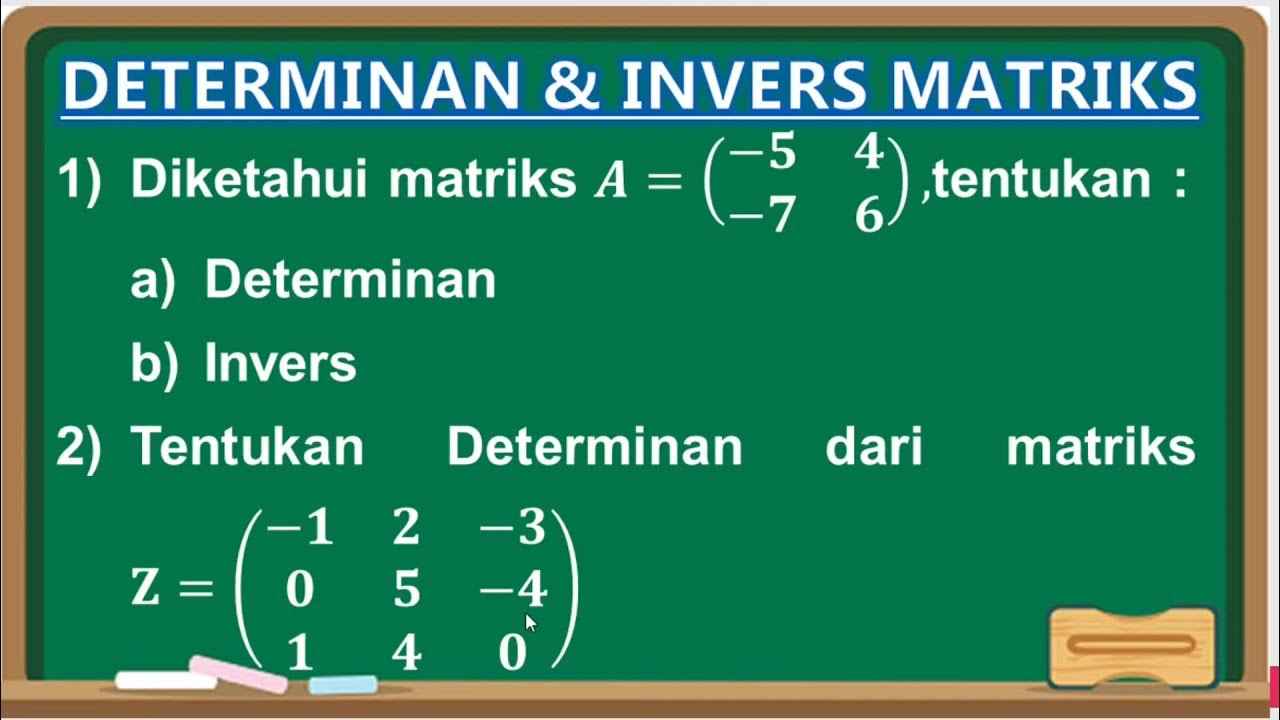
Cara Menentukan Determinan dan Invers Matriks

Matriks Matematika Wajib Kelas 11 - Invers Matriks Ordo 2x2 dan Ordo 3x3 dan Sifat-sifatnya

Matriks Matematika Wajib Kelas 11 - Minor, Kofaktor dan Adjoin Matriks Ordo 3x3

Cara Menentukan Invers Matriks

SM015: 4.3 INVERSE OF MATRICES - INTRO 2X2 ERO (EXAMPLE 1)
Matrik
5.0 / 5 (0 votes)

