Color Temperature Explained — The Cinematographer's Guide to White Balance & Color Temp Fundamentals
Summary
TLDRThis video explores the essential concept of color temperature in cinematography, explaining how it affects lighting and mood in film. Viewers will learn the science behind color temperature, its role in filmmaking, and how to use it to create the desired aesthetic. The video covers key light sources and their color temperatures, such as candlelight, daylight, and fluorescent lights. It also dives into white balance, gels, and other techniques filmmakers use to control color temperature, along with real-world examples from films. By the end, viewers are encouraged to download a color temperature reference chart to aid in their filmmaking.
Takeaways
- 😀 Color temperature is a fundamental concept in cinematography that helps create a compelling color palette and enhances the mood of a film.
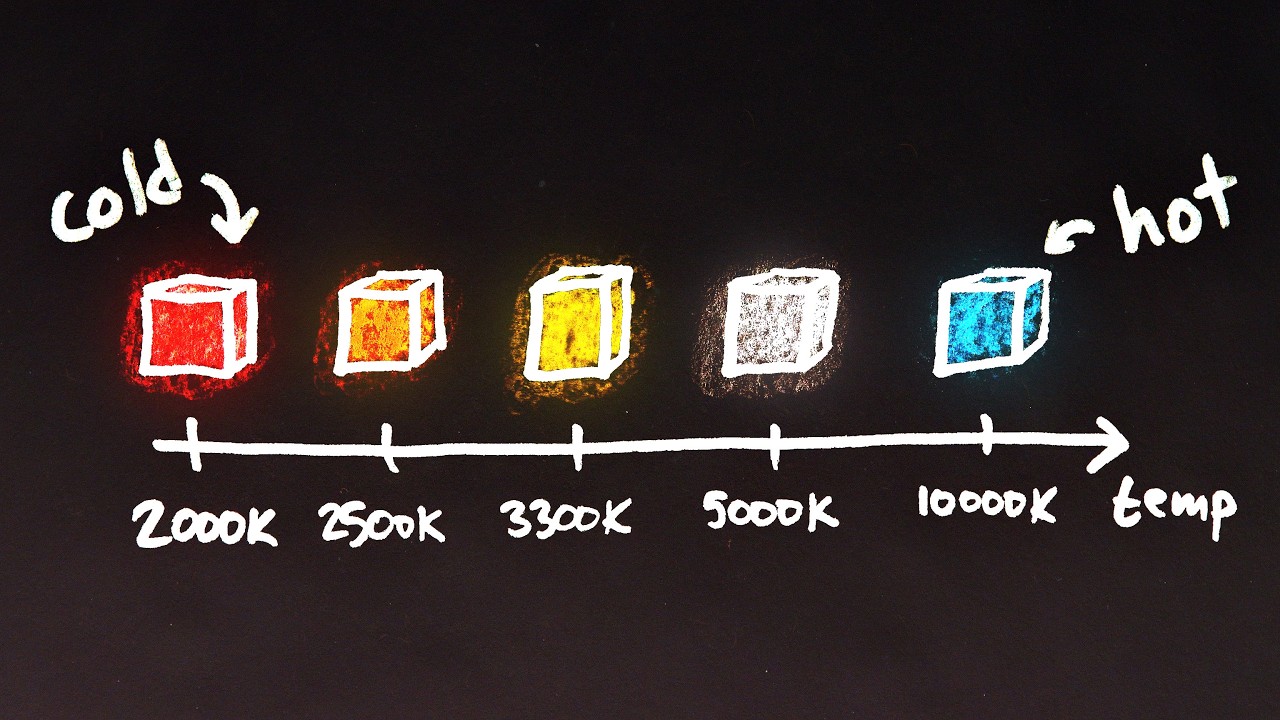
- 😀 Color temperature describes the color of a light source and is measured in Kelvins (K), not Celsius or Fahrenheit.
- 😀 The higher the Kelvin value, the cooler (bluer) the light, and the lower the Kelvin value, the warmer (more orange) the light.
- 😀 Some common color temperatures include candlelight (1900K), incandescent light/golden hour (3200K), and daylight (5500K).
- 😀 White balance in cameras adjusts the way light sources of different color temperatures are registered, ensuring accurate color representation.
- 😀 Correct white balancing ensures skin tones and other colors appear natural, while filmmakers may intentionally adjust color temperature for artistic effects.
- 😀 Filters and gels like CTO (color temperature orange), CTB (color temperature blue), and CTS (color temperature straw) can be used to modify a light source's temperature.
- 😀 Post-production tools like LUTs (Look-Up Tables) and color grading offer further flexibility in manipulating color temperature.
- 😀 Color temperature is not the same as color correction or grading, which are processes done during post-production.
- 😀 Cinematographers use color temperature creatively in films to indicate time periods, evoke emotions, and contrast different environments, as seen in films like *A Ghost Story*, *Palm Springs*, and *No Time to Die*.
Q & A
What is color temperature in cinematography?
-Color temperature refers to the color of a light source and is used to describe how light appears based on its temperature, measured in Kelvins. It plays a crucial role in setting the mood and tone of a scene in film and photography.
Who first defined the formula for color temperature?
-German physicist Max Planck defined the formula known as Planck's law in the early 1900s, which describes the electromagnetic radiation emitted by a theoretical black body at a given temperature.
How are color temperatures measured?
-Color temperatures are measured in Kelvins (K), which is the base unit of thermodynamic temperature. The higher the Kelvin value, the cooler (bluer) the light appears, while lower Kelvin values indicate warmer (more orange) light.
What are some common light sources and their color temperatures?
-Candlelight is around 1900K, incandescent light and golden hour light are around 3200K, fluorescent lights are typically 4200K, daylight is 5500K, and overcast skies can be around 6500K.
What is white balance and how does it relate to color temperature?
-White balance is a camera setting that adjusts how different light sources are perceived in terms of their color temperature. It ensures that light sources of the same color temperature appear white in your footage, and adjusts for cooler or warmer light accordingly.
Why is white balancing important for cinematography?
-White balancing ensures accurate color representation in footage, including skin tones, and allows filmmakers to manipulate color temperature to create specific moods or time-of-day effects.
What are gels and how do they affect color temperature?
-Gels are transparent materials used to modify the color of a light source. Common gels include CTB (Color Temperature Blue) to add blue, CTO (Color Temperature Orange) to add orange, and CTS (Color Temperature Straw) to add a yellow or golden tint.
How can filmmakers use color temperature creatively in films?
-Cinematographers use color temperature to visually represent different times of day, enhance emotional tone, or highlight character states. For example, in 'A Ghost Story', color temperature shifts in lighting represent different time periods in the house, and in 'Palm Springs', the color orange was used symbolically in the love story.
How is color temperature used in the movie 'No Time to Die'?
-In 'No Time to Die', color temperature is used to create depth and contrast. For example, in the cold Norway opening, contrasting cyan and yellow lighting was used to enhance the visual beauty and romantic tension of the sequence.
How did the cinematography of 'The Hangover 2' utilize color temperature?
-In 'The Hangover 2', color temperature was used to emphasize heat, with a mixture of cool daylight, warm tungsten light, and uncorrected fluorescent light to create a gritty, sweaty atmosphere in the Bangkok hotel room.
Outlines

هذا القسم متوفر فقط للمشتركين. يرجى الترقية للوصول إلى هذه الميزة.
قم بالترقية الآنMindmap

هذا القسم متوفر فقط للمشتركين. يرجى الترقية للوصول إلى هذه الميزة.
قم بالترقية الآنKeywords

هذا القسم متوفر فقط للمشتركين. يرجى الترقية للوصول إلى هذه الميزة.
قم بالترقية الآنHighlights

هذا القسم متوفر فقط للمشتركين. يرجى الترقية للوصول إلى هذه الميزة.
قم بالترقية الآنTranscripts

هذا القسم متوفر فقط للمشتركين. يرجى الترقية للوصول إلى هذه الميزة.
قم بالترقية الآنتصفح المزيد من مقاطع الفيديو ذات الصلة

PENTING BANGET! Penjelasan TATA CAHAYA atau LIGHTING yang BISA KAMU TERAPKAN UNTUK FILM KAMU
The Color Temperature Paradox

Elements of Art: Color | KQED Arts
Elements and Principles of Design in Film
Filmmaking 101 - Three Point Lighting Tutorial

Colour Grading: Trik Ubah Mood Film Cuma Pakai Warna | Siasat Sinema S4 #6
5.0 / 5 (0 votes)

