Fisika - "DINAMIKA ROTASI" (momen gaya, momen inersia, momen sudut)
Summary
TLDRIn this educational video, Fina Agustiana introduces the topic of rotational dynamics for 11th-grade physics. She explains key concepts such as torque (momen gaya), moment of inertia (momen inersia), and angular momentum (momentum sudut), offering clear definitions and formulas for each. Through detailed examples, including problem-solving on the calculation of torques and moments of inertia for various objects, Fina makes complex ideas more accessible. The video encourages students to understand how forces, angles, and rotational motion interact, providing a strong foundation in the mechanics of rotating bodies.
Takeaways
- 🔄 Rotational dynamics studies the motion of rotating objects such as spinning tops and seesaws.
- 📏 Torque (moment of force) is a measure of rotational effect and its SI unit is Newton-meter (Nm).
- 🧮 The main torque formulas are τ = r × F, τ = r × F × sinθ (for angled forces), and τ = I × α.
- 📐 The direction of torque depends on rotation: clockwise is defined as positive and counterclockwise as negative (based on the chosen convention).
- 🧲 To calculate net torque, identify the pivot point, determine force directions, calculate lever arms, and sum all torques with correct signs.
- 📊 Moment of inertia (I) represents an object's resistance to rotational motion and has units of kg·m².
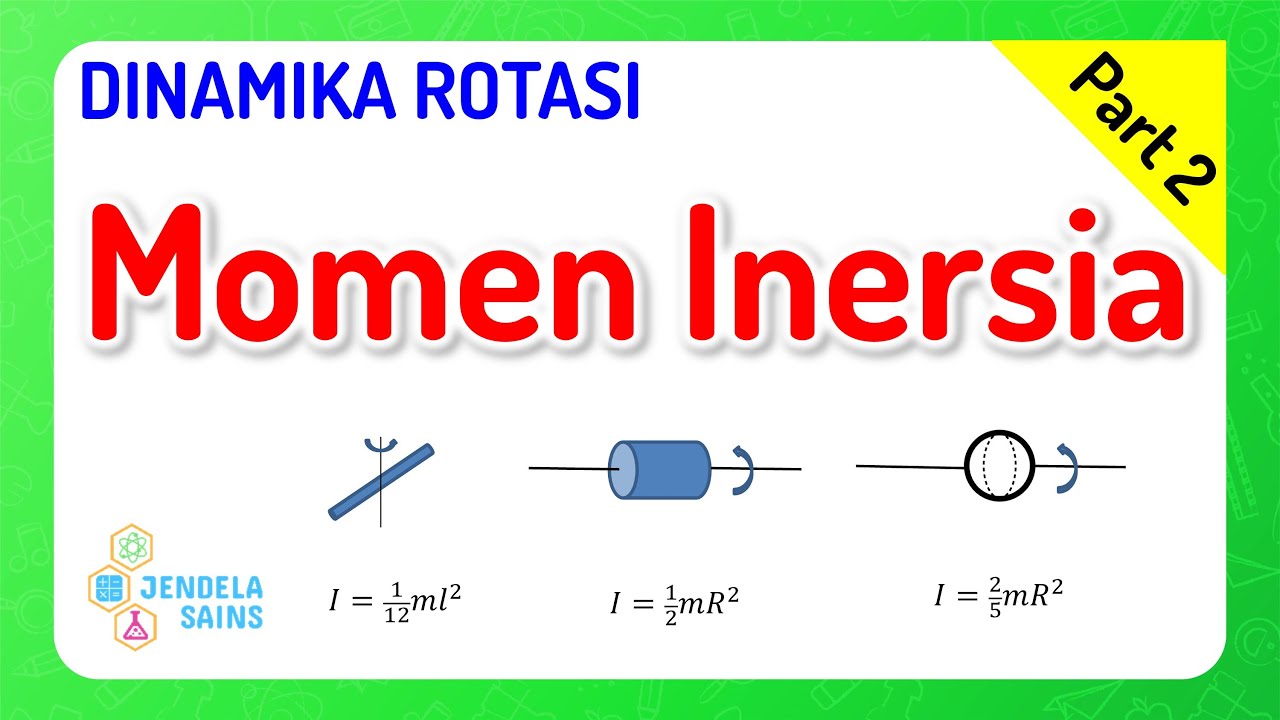
- ⚙️ The formula for moment of inertia depends on the object’s shape, such as solid sphere (2/5 MR²), hollow sphere (2/3 MR²), rod (1/12 ML² at center or 1/3 ML² at end), solid cylinder (1/2 MR²), ring (MR²), and particle (MR²).
- 📎 For a particle, moment of inertia is calculated using I = MR², where R is the distance from the axis of rotation.
- 🪵 The position of the rotation axis significantly affects the moment of inertia, especially for objects like rods.
- 🌪️ Angular momentum (L) is defined as the product of moment of inertia and angular velocity: L = I × ω.
- 📦 The unit of angular momentum is kg·m²/s, combining moment of inertia and angular velocity units.
- 🧠 Problem-solving in rotational dynamics involves identifying known values, selecting the correct formula based on object type, and carefully applying substitution steps.
Q & A
What is torque (moment of force) and how is it calculated?
-Torque (or moment of force) is a measure of the rotational force applied to an object. It is calculated using the formula: torque (τ) = r × F, where 'r' is the distance from the axis of rotation to the point of force application, and 'F' is the magnitude of the applied force. The unit of torque is Newton-meters (N·m).
What happens when the force applied creates an angle with the lever arm?
-When the force applied forms an angle with the lever arm, the formula for torque becomes τ = r × F × sin(θ), where 'θ' is the angle between the force vector and the lever arm. This accounts for the component of the force that contributes to rotational motion.
What is the significance of the moment of inertia in rotational dynamics?
-The moment of inertia (I) is a property of a rotating object that determines how much torque is required to achieve a given angular acceleration. It depends on both the mass of the object and how the mass is distributed relative to the axis of rotation. Its unit is kg·m².
How do you calculate the moment of inertia for different objects?
-The moment of inertia depends on the shape and mass distribution of the object. For example, for a solid sphere, the formula is I = (2/5)mr², where 'm' is the mass and 'r' is the radius. For a thin rod rotating around its center, I = (1/12)ml², where 'l' is the length of the rod.
What does a negative value for torque indicate?
-A negative value for torque indicates that the rotational direction is opposite to the chosen positive direction. Typically, counterclockwise rotation is considered positive, while clockwise rotation is negative.
What is angular momentum and how is it related to moment of inertia?
-Angular momentum (L) is the rotational equivalent of linear momentum. It is given by the product of the moment of inertia (I) and the angular velocity (ω), expressed as L = I × ω. The unit of angular momentum is kg·m²/s.
How is the total torque on an object calculated when multiple forces are applied?
-The total torque on an object is the sum of the individual torques from all applied forces. Each torque is calculated as τ = r × F for each force, considering the direction and distance from the axis of rotation.
What does the torque calculation in the example involving a rotating rod teach us?
-The example demonstrates how to calculate the net torque by considering the forces applied at different points on the rod, their distances from the axis of rotation, and the direction of rotation. It also shows how to consider the signs for clockwise and counterclockwise torques.
How does the concept of the moment of inertia apply to everyday objects?
-The moment of inertia is a key factor in understanding how objects rotate. For instance, a wheel or a rotating fan has a moment of inertia that determines how much force is needed to spin it. The larger the moment of inertia, the harder it is to rotate the object.
What are some practical examples of rotational dynamics that use the principles discussed?
-Examples include the motion of a bicycle wheel, the spinning of a top, or the operation of a ceiling fan. In each of these cases, the forces applied and the moment of inertia affect how easily the object spins or accelerates.
Outlines

هذا القسم متوفر فقط للمشتركين. يرجى الترقية للوصول إلى هذه الميزة.
قم بالترقية الآنMindmap

هذا القسم متوفر فقط للمشتركين. يرجى الترقية للوصول إلى هذه الميزة.
قم بالترقية الآنKeywords

هذا القسم متوفر فقط للمشتركين. يرجى الترقية للوصول إلى هذه الميزة.
قم بالترقية الآنHighlights

هذا القسم متوفر فقط للمشتركين. يرجى الترقية للوصول إلى هذه الميزة.
قم بالترقية الآنTranscripts

هذا القسم متوفر فقط للمشتركين. يرجى الترقية للوصول إلى هذه الميزة.
قم بالترقية الآنتصفح المزيد من مقاطع الفيديو ذات الصلة
Fisika kelas 11 | Dinamika rotasi dan kesetimbangan benda tegar (part 1)
Dinamika Rotasi • Part 2: Momen Inersia

FISIKA KELAS XI || Momen Gaya dan Momen Inersia || DINAMIKA ROTASI DAN KESETIMBANGAN BENDA TEGAR

FISIKA KELAS XI | TEORI KINETIK GAS (PART 2) - Persamaan Gas Ideal

FISIKA KELAS XI: FLUIDA STATIS (PART 1) Tekanan dan Hukum Pascal

How to Study Physics for Class 11th🔥| Most Practical Strategy| Prashant Kirad
5.0 / 5 (0 votes)

