Delay Off Timer Circuit Explained – Control Lights, Fans & More Without a Microcontroller!
Summary
TLDRThis video demonstrates how to build a smart delay-off timer circuit using the LM393 comparator IC. Pressing a button turns on a light, which remains on for about a minute after release, automatically switching off. The tutorial explains the role of comparators, resistors, and capacitors in controlling timing, and shows how to safely drive LEDs or high-power AC loads using a transistor and relay with a flyback diode for protection. It also covers calculating resistor values for desired delays and making the delay adjustable with a potentiometer. Ideal for DIY electronics enthusiasts seeking a reliable, low-power timer solution.
Takeaways
- 💡 The video demonstrates how to build a delay-off timer circuit that keeps a light on for a set period after a button press.
- 🔌 The LM393 IC is the core component, featuring dual comparators, and operates from 3V to 38V, with 5V used in this project.
- ⚡ Comparators compare two voltages: if the non-inverting input exceeds the reference, the output goes high; otherwise, it stays low.
- 📏 Pin 2 of the LM393 is set as a reference voltage using a voltage divider, typically around 0.877V in this circuit.
- 🔋 A capacitor connected to pin 3 charges quickly when the button is pressed, then discharges slowly to create the timing delay.
- ⏱️ The RC time constant (resistance × capacitance) determines how long the output stays high after releasing the button.
- 💡 The LM393 output is open-collector, so a pull-up resistor is required to produce a true high signal for LEDs or transistors.
- 🔧 To control high-current devices like relays, use a transistor (e.g., 2N2222) as a switch between the LM393 output and the load.
- 🛡️ A flyback diode across the relay coil protects components from voltage spikes caused by collapsing magnetic fields.
- 🔄 Using a potentiometer instead of a fixed resistor allows the delay time to be adjustable, up to about 2 minutes with a 1 MΩ pot.
- 💵 Higher resistor values in the voltage divider reduce power consumption, though smaller values also work but draw more current.
- ✅ The circuit is fully analog, requires no microcontroller, and can control LEDs, fans, motors, and even high-power AC appliances via relays.
Q & A
What is the main function of the delay-off timer circuit described in the video?
-The delay-off timer circuit allows a light or device to stay on for a set period after a button is pressed and released, automatically turning off after the delay time elapses.
Which IC is used as the 'brain' of the circuit, and why is it chosen?
-The LM393 IC is used because it contains two built-in voltage comparators, works with a wide voltage range (3V to 38V), is affordable, and can handle timing without needing a microcontroller.
How does a comparator in the LM393 work?
-A comparator compares two voltages, A and B. If voltage A is higher than B, the output goes high (5V). If A is lower than B, the output goes low (0V). This produces a clean, digital on/off signal.
How is the timing delay implemented in this circuit?
-Timing is controlled by a capacitor that charges quickly when the button is pressed and discharges slowly afterward. The capacitor voltage at pin 3 is compared to a reference voltage at pin 2. The output stays high while pin 3 is above the reference, creating the delay.
What is the role of the voltage divider in the circuit?
-The voltage divider sets a stable reference voltage at pin 2 of the comparator. This ensures the comparator can reliably detect when the capacitor voltage drops below the reference and turn the output off.
Why are high-value resistors preferred in the voltage divider?
-High-value resistors reduce current draw, lowering power consumption. For example, using 47kΩ and 10kΩ resistors draws only 0.088 mA, compared to higher current if smaller resistors were used.
Why is a pull-up resistor needed on the LM393 output?
-The LM393 output is open-collector, meaning it can only pull low but not provide a high voltage. A pull-up resistor connects the output to the positive supply, ensuring a proper high signal when the output is floating.
How can the circuit drive high-current devices like relays?
-A transistor, such as a 2N2222 NPN, is used as a switch between the LM393 output and the relay. The LM393 sends a small signal to the transistor base, which then switches the larger current needed for the relay.
What is the purpose of a flyback diode across a relay coil?
-The flyback diode protects the circuit from high-voltage spikes generated when the relay coil is turned off. It provides a safe path for the current to dissipate, preventing damage to the transistor or IC.
How can the delay time be adjusted in this circuit?
-The delay can be adjusted by changing the resistor in the capacitor’s discharge path. Replacing the fixed resistor with a potentiometer allows manual tuning of the delay, for example, up to about 2 minutes with a 1 MΩ potentiometer.
Why does the capacitor need separate charge and discharge paths?
-The capacitor charges quickly through a low-resistance path for a fast response when the button is pressed, and discharges slowly through a higher-resistance path to create the desired delay before turning the output off.
Can this circuit control devices other than LEDs and relays?
-Yes, the circuit can control various 5V devices like fans, motors, or, with a relay, high-power AC appliances, as long as the transistor handles the required current.
Outlines

此内容仅限付费用户访问。 请升级后访问。
立即升级Mindmap

此内容仅限付费用户访问。 请升级后访问。
立即升级Keywords

此内容仅限付费用户访问。 请升级后访问。
立即升级Highlights

此内容仅限付费用户访问。 请升级后访问。
立即升级Transcripts

此内容仅限付费用户访问。 请升级后访问。
立即升级浏览更多相关视频
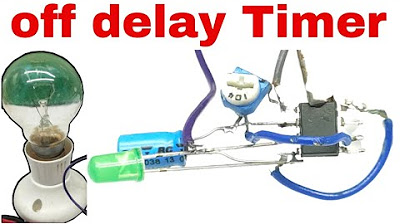
Off Delay Timer | how to make off delay timer | how to make delay timer | delay timer

Práctica 9: Circuito integrado 555

Como Fazer um Sequencial de Leds (muito simples)
How to Make a Digital Stopwatch | DLD Project | Engineering 7.0 |

Cara Membuat Rangkaian Lampu Menggunakan Sensor Cahaya di Proteus | Tutorial skematik
⚡ Proyecto con temporizador biestable con el NE555 y arranque de motor electrico SR con SET y RESET
5.0 / 5 (0 votes)

