GERAK PARABOLA
Summary
TLDRThis educational video explains the concept of projectile motion in a clear and engaging way. It covers how an object, like a thrown or kicked ball, follows a parabolic trajectory due to the combination of horizontal uniform motion and vertical accelerated motion influenced by gravity. The video details calculating initial velocities along both axes, determining positions over time, and finding maximum height, total flight time, and range. It also introduces key formulas such as V0x = V0 cos α and V0y = V0 sin α, while demonstrating practical examples to help students understand the physics behind parabolic motion and its real-life applications.
Takeaways
- 😀 Projectile motion is a two-dimensional motion combining horizontal uniform motion (constant velocity) and vertical accelerated motion (due to gravity).
- 😀 The trajectory of a thrown or kicked ball forms a parabola.
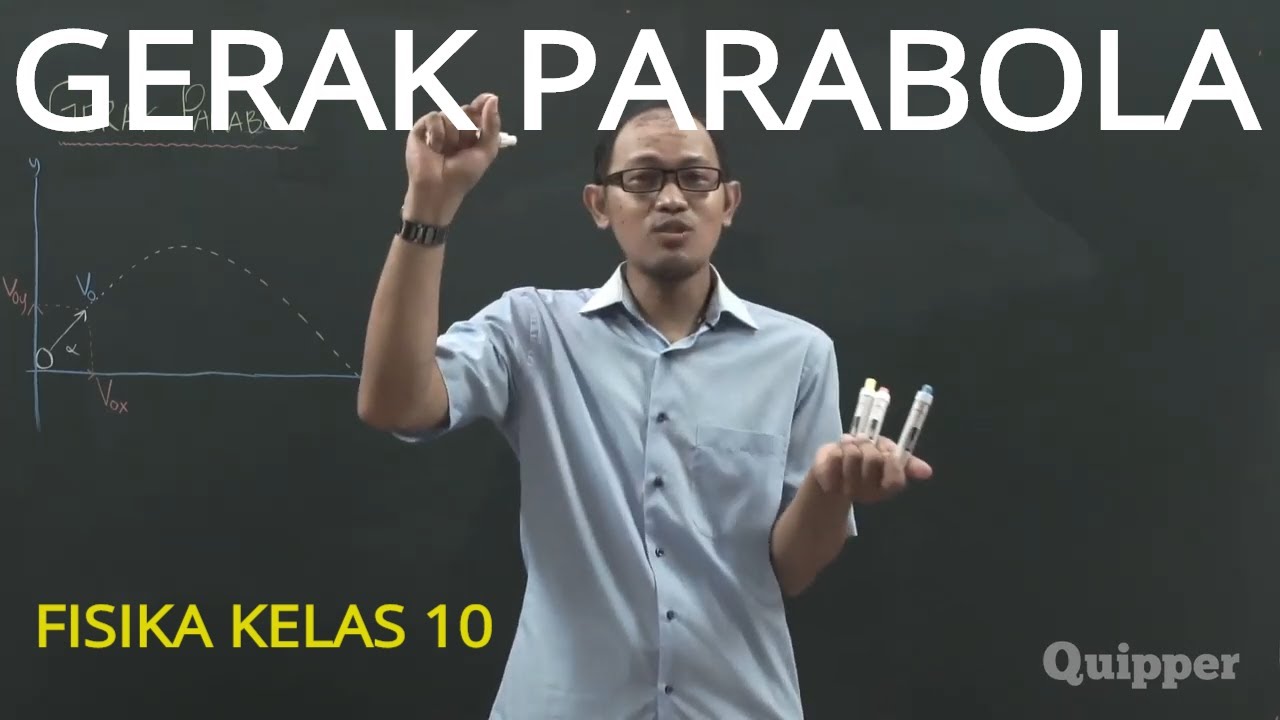
- 😀 The initial velocity can be broken into horizontal (V₀x = V₀ cos α) and vertical components (V₀y = V₀ sin α) based on the angle of elevation α.
- 😀 Horizontal motion has constant velocity: x = V₀x * t.
- 😀 Vertical motion is uniformly accelerated due to gravity: y = V₀y * t - ½ g t² and V_y = V₀y - g t.
- 😀 At the maximum height, the vertical velocity V_y = 0 while horizontal velocity V_x remains constant.
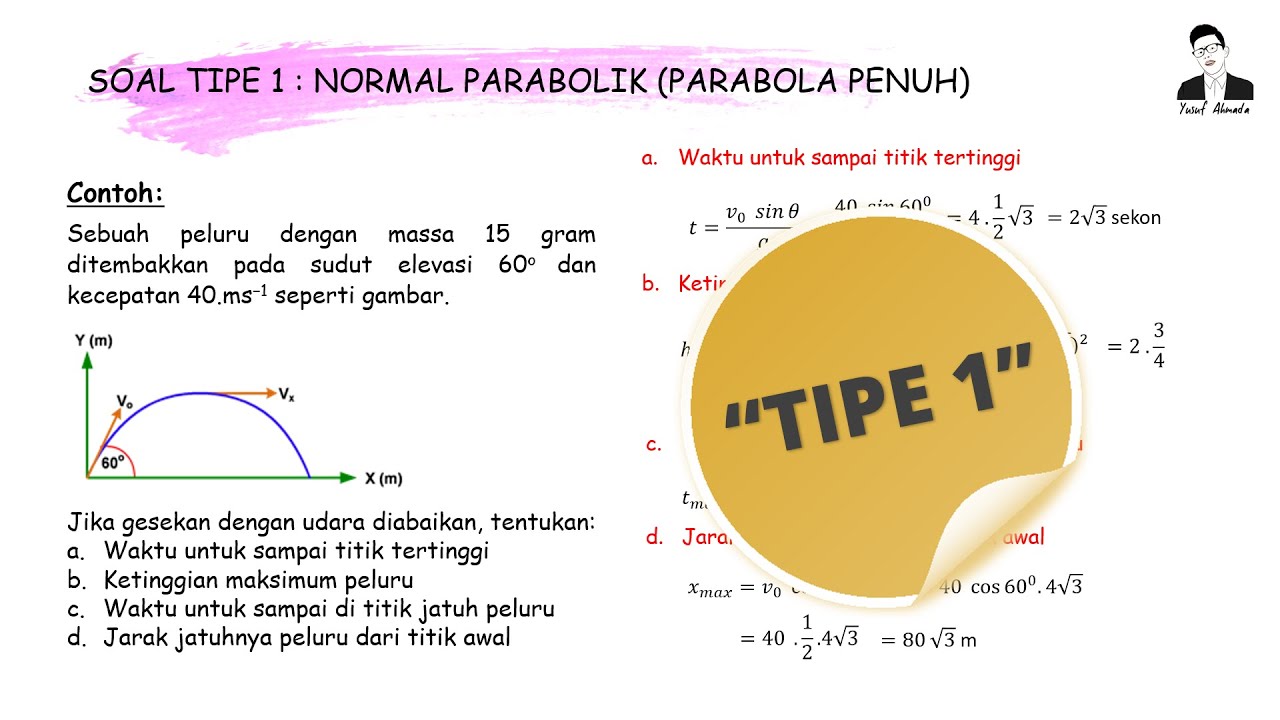
- 😀 Maximum height is calculated as y_max = V₀y² / (2g); if launched from height y₀, y_max = y₀ + V₀y² / (2g).
- 😀 Time to reach maximum height is t_max = V₀y / g.
- 😀 The horizontal range of a projectile launched from the ground is x_max = V₀² sin 2α / g, and total flight time is t_total = 2 V₀ sin α / g.
- 😀 The total velocity at any point can be found using the Pythagorean theorem: V = √(V_x² + V_y²).
- 😀 Gravity (g) affects the vertical motion, reducing upward velocity and increasing downward velocity.
- 😀 Understanding projectile motion requires analyzing both horizontal and vertical components separately and then combining them for the full trajectory.
Q & A
What is projectile motion or gerak parabola?
-Projectile motion, or gerak parabola, is a two-dimensional motion combining uniform motion along the horizontal axis (X-axis) and uniformly accelerated motion along the vertical axis (Y-axis), resulting in a curved, parabolic trajectory.
How does the horizontal and vertical motion differ in a projectile?
-In projectile motion, horizontal motion is uniform (constant velocity), whereas vertical motion is uniformly accelerated due to gravity, causing the vertical speed to decrease when rising and increase when falling.
What is the definition of the angle of elevation?
-The angle of elevation is the angle formed between the projectile's initial velocity and the horizontal axis (X-axis). It determines the initial horizontal and vertical velocity components.
How do you calculate the horizontal and vertical components of initial velocity?
-The horizontal component is V0x = V0 * cos(α), and the vertical component is V0y = V0 * sin(α), where V0 is the initial speed and α is the angle of elevation.
What formulas are used to find the position of a projectile?
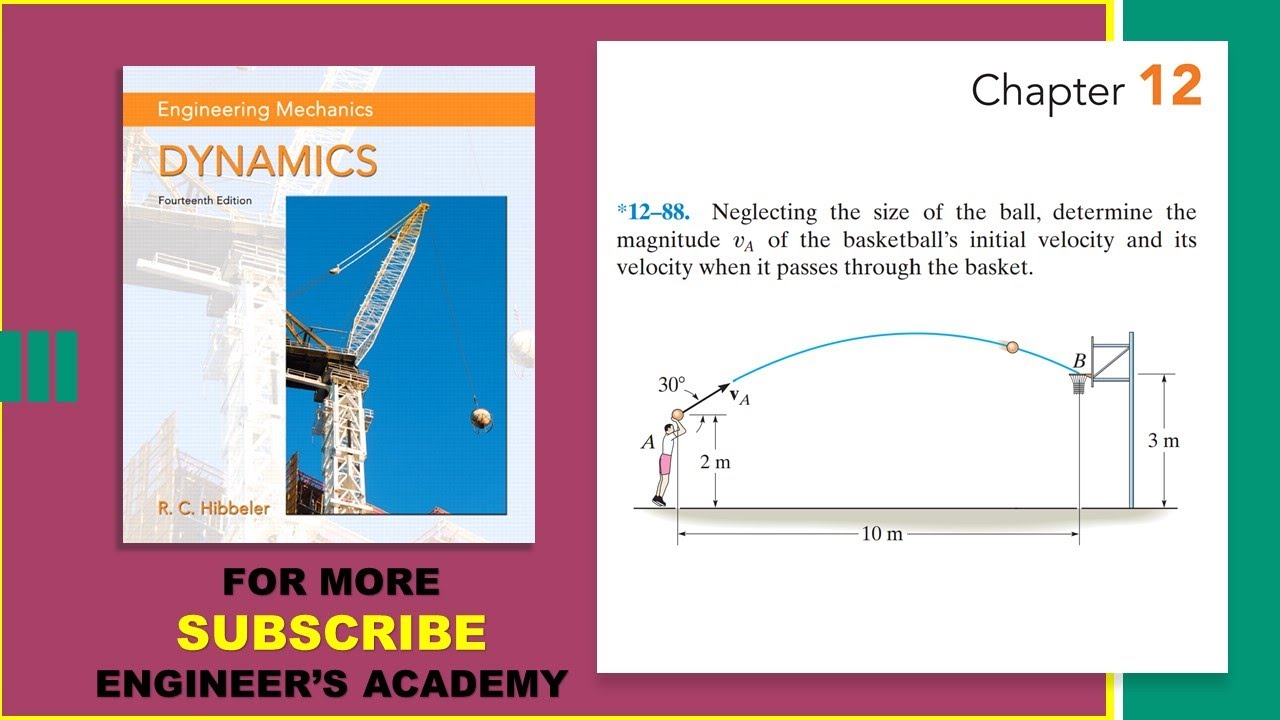
-For horizontal position: x = Vx * t (GLB). For vertical position: y = y0 + V0y * t - 1/2 * g * t^2 (GLBB).
How is the maximum height of a projectile determined?
-Maximum height occurs when Vy = 0. The formula is y_max = y0 + V0y^2 / (2g). If launched from the ground, y0 = 0, so y_max = V0^2 * sin^2(α) / (2g).
How do you calculate the time it takes to reach maximum height?
-The time to reach maximum height is t_max = V0y / g = (V0 * sin(α)) / g.
What is the formula for the horizontal range of a projectile launched from the ground?
-The horizontal range is x_max = V0^2 * sin(2α) / g.
How do you calculate the total velocity at any point during the projectile's motion?
-The total or resultant velocity is V = √(Vx^2 + Vy^2), combining the constant horizontal velocity and the vertical velocity at that instant.
How does gravity affect the vertical motion of a projectile?
-Gravity causes a constant downward acceleration of g m/s², which slows the upward motion until the vertical velocity reaches zero at the peak, then accelerates the projectile downward.
If a projectile is thrown from a height y0 above the ground, how is the maximum height formula adjusted?
-The maximum height becomes y_max = y0 + V0^2 * sin^2(α) / (2g), where y0 is the initial height from which the projectile is launched.
Why is the horizontal velocity considered constant in projectile motion?
-Horizontal velocity is constant because there is no horizontal acceleration (assuming air resistance is negligible), so the motion along the X-axis is uniform.
Outlines

此内容仅限付费用户访问。 请升级后访问。
立即升级Mindmap

此内容仅限付费用户访问。 请升级后访问。
立即升级Keywords

此内容仅限付费用户访问。 请升级后访问。
立即升级Highlights

此内容仅限付费用户访问。 请升级后访问。
立即升级Transcripts

此内容仅限付费用户访问。 请升级后访问。
立即升级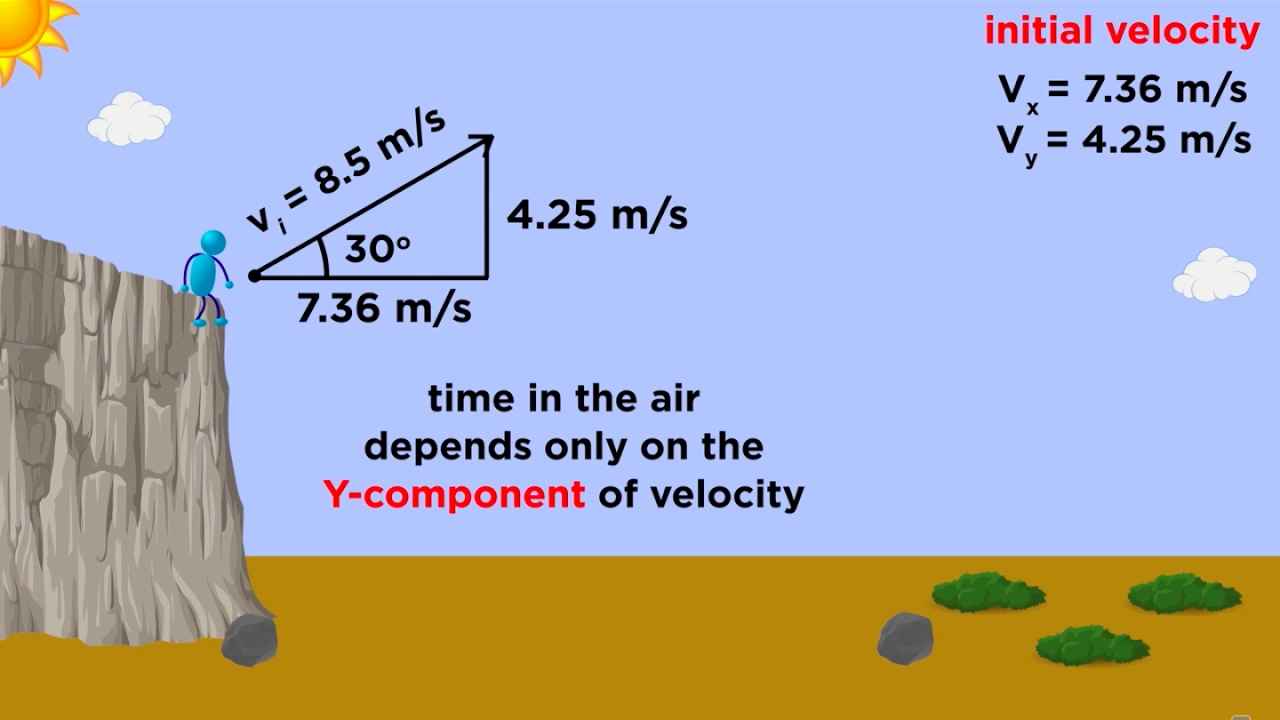


5.0 / 5 (0 votes)

