Hubungan Garis dan Sudut
Summary
TLDRThis video tutorial introduces key concepts in geometry, focusing on the relationships between lines and angles. It explains several angle types, including adjacent angles, vertical angles, alternate interior angles, and supplementary angles. Through clear examples, the video demonstrates how to solve problems involving these angle relationships, helping viewers understand how to find unknown angles using basic algebraic equations. The tutorial emphasizes the importance of recognizing angle relationships in geometric figures, making it accessible for students looking to improve their understanding of angles and lines in mathematics.
Takeaways
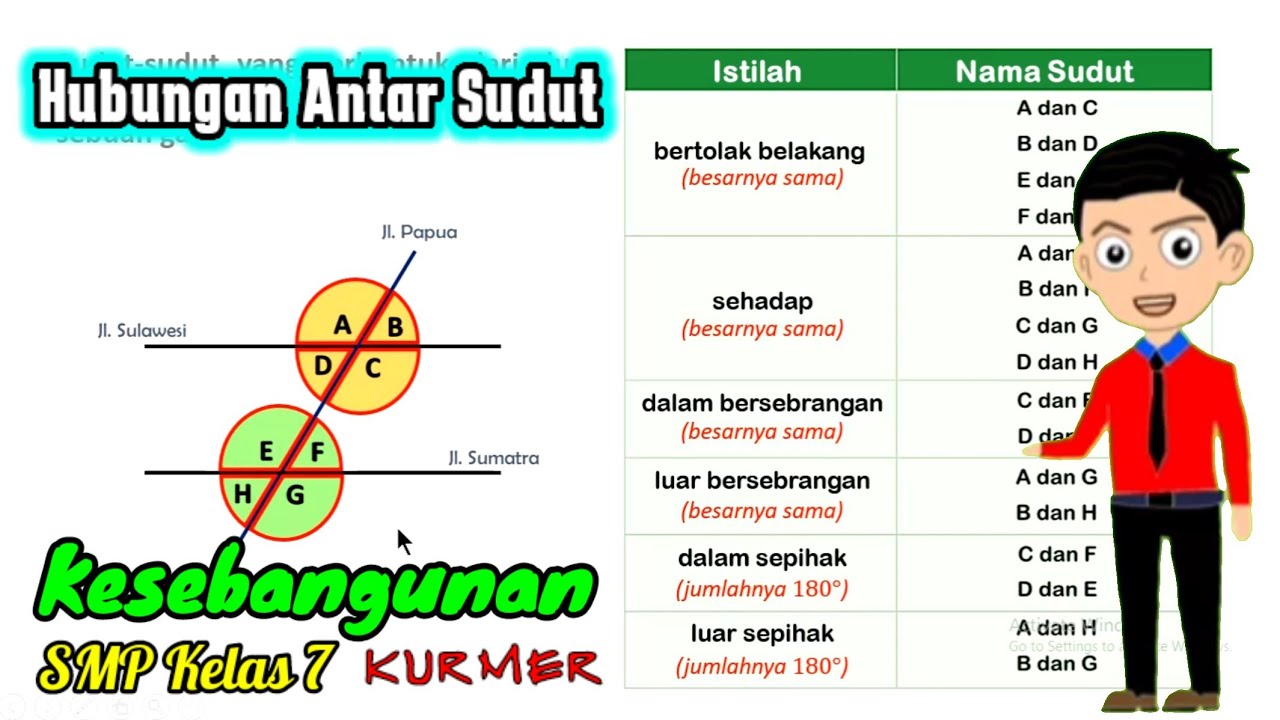
- 😀 Sudut-sudut sehadap are angles located opposite each other when two lines intersect and have equal measures.
- 😀 Sudut-sudut dalam berseberangan occur between two parallel lines and are formed by a transversal, and these angles are also equal.
- 😀 Sudut-sudut luar berseberangan are angles located outside two parallel lines formed by a transversal, and they are congruent.
- 😀 Sudut-sudut dalam sepihak are angles on the same side of the transversal inside parallel lines and add up to 180°.
- 😀 Sudut-sudut luar sepihak are angles on the same side of the transversal outside parallel lines and also add up to 180°.
- 😀 Understanding angle relationships is essential for solving problems related to lines and angles formed by parallel lines and transversals.
- 😀 The concept of 'sehadap' (opposite angles) is fundamental for calculating angle measures when two lines intersect.
- 😀 When solving for unknown angles, always identify their relationships to other angles (e.g., opposite, alternate, same side).
- 😀 Example 1 shows how two 'sehadap' angles lead to an equation to solve for the unknown angle (x).
- 😀 Example 2 demonstrates how 'outside opposite angles' can be used to set up and solve equations to find the value of an unknown angle.
- 😀 Example 3 highlights the process of solving for an unknown angle by recognizing the relationship between two 'inside opposite' angles in parallel lines.
Q & A
What is the main topic of the video?
-The main topic of the video is the relationship between lines and angles in geometry, including types of angles such as vertical, adjacent, and supplementary angles, along with examples and problem-solving methods.
What is meant by 'angles opposite to each other' as mentioned in the video?
-'Angles opposite to each other' refers to 'vertical angles,' which are formed when two lines intersect. These angles are always equal in measure.
Can you explain the concept of 'angles on the same side'?
-Angles on the same side, or 'consecutive interior angles,' refer to two angles that are on the same side of the transversal and inside the parallel lines. These angles always add up to 180 degrees.
What is the relationship between alternate interior angles?
-Alternate interior angles are formed when a transversal cuts through two parallel lines. These angles are congruent, meaning they have equal measures.
How does the script describe the relationship between angles formed outside two parallel lines?
-The video discusses 'exterior angles' formed outside two parallel lines, where the angles opposite each other are also congruent, meaning they are equal in measure.
What is the significance of supplementary angles in this context?
-Supplementary angles are two angles that add up to 180 degrees. In the video, the concept of supplementary angles is applied to angles formed on the same side of a transversal cutting through parallel lines.
How does the video guide viewers to solve angle-related problems?
-The video provides step-by-step instructions on solving angle-related problems by recognizing the types of angle relationships (such as opposite, adjacent, and supplementary angles) and applying them to find the unknown angle values.
What type of angle relationship is demonstrated in the first example problem?
-In the first example problem, the angle relationship is between two angles that are 'opposite to each other' (vertical angles), which are congruent. The problem shows how to set up an equation to solve for the unknown variable.
What does the video emphasize about angles formed by parallel lines and transversals?
-The video emphasizes that angles formed by parallel lines and transversals have specific properties, such as congruent alternate interior angles and supplementary consecutive interior angles, which are crucial for solving geometry problems.
How are 'interior opposite angles' used in the problem-solving process?
-'Interior opposite angles' (alternate interior angles) are used in problem-solving by equating them to each other because they are congruent when formed by parallel lines and a transversal. This helps in setting up equations to solve for unknown angles.
Outlines

此内容仅限付费用户访问。 请升级后访问。
立即升级Mindmap

此内容仅限付费用户访问。 请升级后访问。
立即升级Keywords

此内容仅限付费用户访问。 请升级后访问。
立即升级Highlights

此内容仅限付费用户访问。 请升级后访问。
立即升级Transcripts

此内容仅限付费用户访问。 请升级后访问。
立即升级



5.0 / 5 (0 votes)

