MATERI UTBK SNBT PENALARAN KUANTITATIF - BILANGAN BERPANGKAT
Summary
TLDRIn this educational video, Yunis guides viewers through the concepts of exponentiation, or powers, commonly encountered in math exams like UTBK. The tutorial covers key exponent properties such as negative exponents, zero exponents, and rules for multiplying, dividing, and simplifying exponential expressions. Yunis also walks through several examples, showing how to apply these properties to solve problems effectively. This comprehensive lesson ensures a strong foundation in working with exponents, making it a valuable resource for students preparing for standardized tests.
Takeaways
- 😀 Exponentiation (bilangan berpangkat) simplifies repeated multiplication of the same number.
- 😀 An exponent indicates how many times the base number is multiplied by itself (e.g., a^n means a multiplied by itself n times).
- 😀 Negative exponents represent the reciprocal of the base raised to the positive exponent (e.g., a^-n = 1/a^n).
- 😀 Any number raised to the power of 0 equals 1 (e.g., a^0 = 1). This holds true for all numbers except 0.
- 😀 Fractional exponents represent roots, with the numerator being the power and the denominator being the root (e.g., a^(m/n) = n√a^m).
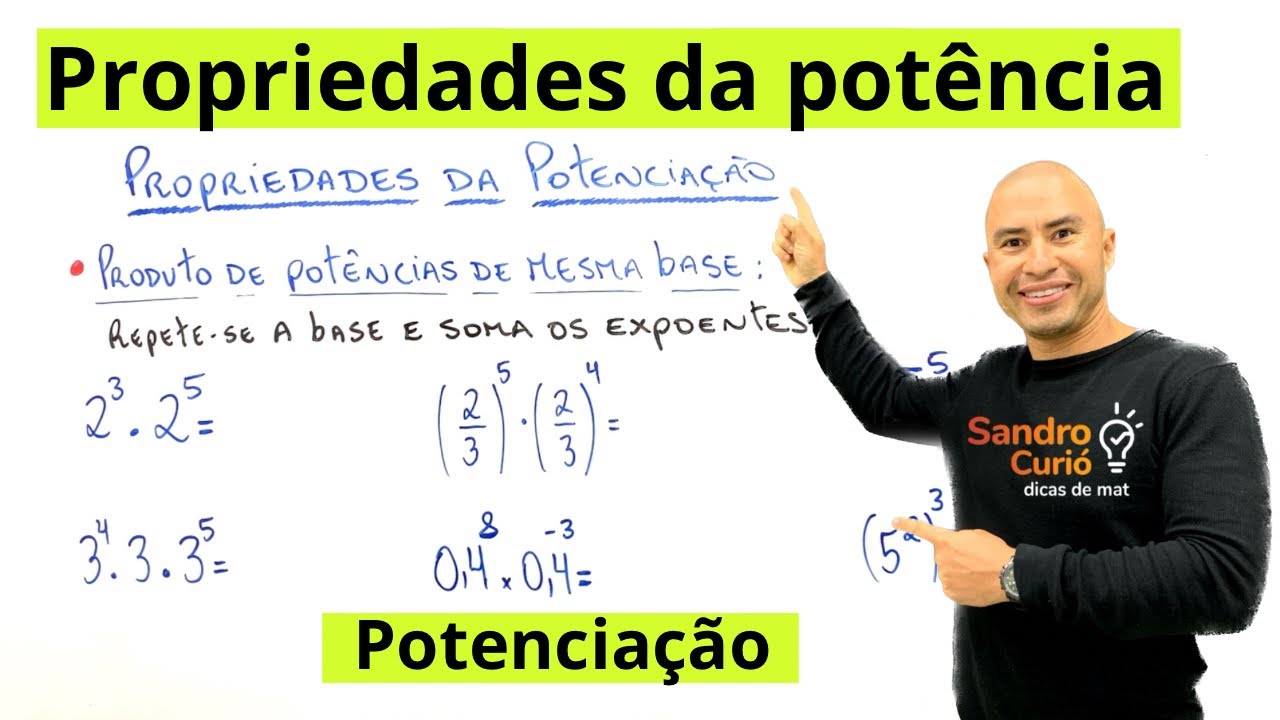
- 😀 Multiplying numbers with the same base means adding their exponents (e.g., a^m * a^n = a^(m+n)).
- 😀 Dividing numbers with the same base means subtracting their exponents (e.g., a^m / a^n = a^(m-n)).
- 😀 Power of a product: (a * b)^n = a^n * b^n. The exponent applies to both numbers in the multiplication.
- 😀 Power of a quotient: (a / b)^n = a^n / b^n. The exponent applies to both the numerator and the denominator.
- 😀 In algebraic expressions involving exponents, like simplifying or adding terms with the same base and exponent, one can combine like terms (e.g., 5√3 + 2√3 = 7√3).
Q & A
What is an exponent?
-An exponent is a number that represents the number of times a base is multiplied by itself. For example, in a^n, 'a' is the base and 'n' is the exponent, indicating how many times 'a' is multiplied by itself.
What does a^(-m) equal?
-a^(-m) equals 1/a^m. This property shows how negative exponents transform into the reciprocal of the base raised to the positive exponent.
What is the result of any number raised to the power of 0?
-Any non-zero number raised to the power of 0 equals 1. For instance, 1000^0 = 1 and 2020^0 = 1.
How do you calculate a^(m/n)?
-a^(m/n) can be rewritten as (a^(1/n))^m. This means the nth root of 'a' raised to the power of 'm'.
What is the rule for multiplying two numbers with the same base and exponents?
-The rule is a^m * a^n = a^(m+n). When multiplying numbers with the same base, you add their exponents.
What happens when you divide two numbers with the same base and exponents?
-When dividing numbers with the same base, the rule is a^m / a^n = a^(m-n). You subtract the exponents.
What is the rule for distributing exponents over a product of numbers?
-The rule is (a * b)^n = a^n * b^n. When raising a product of two numbers to a power, each number is raised to the same power individually.
How do you handle exponents in fractions?
-For a fraction raised to a power, the rule is (a/b)^n = a^n / b^n. Both the numerator and denominator are raised to the power separately.
What does 1/a^n equal?
-1/a^n equals a^(-n). This is the same as the reciprocal of 'a' raised to the positive exponent.
How do you simplify the expression √75 + √1?
-To simplify √75 + √1, first simplify √75 into 5√3 (since √25 = 5). The final result is 7√3, as you combine like terms.
Outlines

此内容仅限付费用户访问。 请升级后访问。
立即升级Mindmap

此内容仅限付费用户访问。 请升级后访问。
立即升级Keywords

此内容仅限付费用户访问。 请升级后访问。
立即升级Highlights

此内容仅限付费用户访问。 请升级后访问。
立即升级Transcripts

此内容仅限付费用户访问。 请升级后访问。
立即升级浏览更多相关视频

POTÊNCIA - Dica RÁPIDA| COMO CALCULAR POTÊNCIA | | POTENCIAÇÃO 6 ANO | Matemática Básica \Prof. Gis/

EXAME PSICOTÉCNICO DO DETRAN 2025. TESTE PSICOTÉCNICO DETRAN 2025. PSICOTESTE DETRAN 2025.
PROPRIEDADES DA POTENCIAÇÃO | RÁPIDO E FÁCIL

POTENCIAÇÃO EM 10 MINUTOS

MATERI UTBK SNBT PENGETAHUAN KUANTITATIF - OPERASI BENTUK ALJABAR

Perpangkatan dan Bentuk Akar [Part 2] - Perkalian pada Perpangkatan
5.0 / 5 (0 votes)

