Integral Fungsi Aljabar • Part 5: Contoh Soal Integral Tak Tentu Fungsi Aljabar Sederhana (3)
Summary
TLDRThis educational video explains how to find original functions using indefinite integrals, focusing on algebraic functions and practical applications. Through step-by-step examples, it demonstrates integrating derivatives, handling constants of integration, and determining their values using known points on a graph. The lesson also connects calculus to real-world physics by deriving a height function from a velocity equation of a thrown ball. Viewers learn how integration reverses differentiation, how to solve for unknown constants, and how these concepts apply to both mathematical problems and motion scenarios, making the topic clear, practical, and engaging.
Takeaways
- 😀 Indefinite integrals are used to find the original function when its derivative is known.
- 😀 The general formula applied is f(x) = ∫f'(x) dx.
- 😀 When integrating polynomial terms, each term can be integrated separately.
- 😀 Every indefinite integral must include a constant of integration (+C).
- 😀 The value of the constant C can be determined using a known point on the graph (initial condition).
- 😀 Substituting a known (x, y) point into the function helps solve for the constant C.
- 😀 The resulting function becomes complete and specific after finding the value of C.
- 😀 In curve-related problems, the final answer is often written as y = f(x).
- 😀 In physics applications, velocity is the derivative of position (or height), so position is found by integrating velocity.
- 😀 Initial conditions (like starting height or position) are crucial to determining the constant in real-world problems.
- 😀 Integration can be applied to motion problems such as determining the height of a thrown object over time.
- 😀 Substituting specific time values into the position function allows calculation of height at a given moment.
Q & A
What is the main topic of the video?
-The main topic of the video is about indefinite integrals of algebraic functions, specifically focusing on how to find the original function using integration, along with practical examples.
What is the integral of the function F'(x) = 3x² - 4x + 1?
-The integral of F'(x) = 3x² - 4x + 1 is F(x) = x³ - 2x² + x - 9. This is obtained by integrating each term of the function separately.
How do you determine the constant 'C' in an indefinite integral?
-The constant 'C' is determined by using a known point on the function. For example, if the function passes through the point (2, -7), you substitute x = 2 and F(x) = -7 into the equation, solving for 'C'.
What role does the constant of integration play in indefinite integrals?
-The constant of integration (denoted as +C) accounts for the fact that there are infinitely many antiderivatives of a function, all differing by a constant value.
In the second example, what is the relationship between the gradient of the tangent and the first derivative?
-The gradient of the tangent line at any point on the curve is given by the first derivative of the function at that point. In the example, the gradient is 2x - 1, which is the derivative of the function F(x).
What is the final equation for the curve after integrating F'(x) = 2x - 1?
-The final equation of the curve is y = x² - x + 3. This is obtained by integrating the first derivative and solving for the constant using the given point (2, 5).
How do you find the height of a ball thrown upwards based on its velocity function?
-To find the height of the ball, you integrate the velocity function with respect to time. In the example, the velocity function is V(t) = 18 - 6t, and its integral gives the height function H(t) = -3t² + 18t + 12.
What does the equation H(t) = -3t² + 18t + 12 represent in the context of the problem?
-The equation H(t) = -3t² + 18t + 12 represents the height of the ball at any given time 't' after it is thrown upwards from a height of 12 meters. The negative coefficient in front of the t² term indicates that the ball is accelerating downwards due to gravity after reaching its peak height.
Why is it important to use the initial condition H(0) = 12 in the height equation?
-Using the initial condition H(0) = 12 allows us to find the constant 'C' in the height equation. This ensures that the function accurately models the scenario, where the ball starts at a height of 12 meters when t = 0.
What is the height of the ball at t = 5 seconds?
-At t = 5 seconds, the height of the ball is 27 meters, which is calculated by substituting t = 5 into the height function H(t) = -3t² + 18t + 12.
Outlines

This section is available to paid users only. Please upgrade to access this part.
Upgrade NowMindmap

This section is available to paid users only. Please upgrade to access this part.
Upgrade NowKeywords

This section is available to paid users only. Please upgrade to access this part.
Upgrade NowHighlights

This section is available to paid users only. Please upgrade to access this part.
Upgrade NowTranscripts

This section is available to paid users only. Please upgrade to access this part.
Upgrade NowBrowse More Related Video

Integral Fungsi Aljabar • Part 2: Integral Fungsi Operasi dan Integral Tak Tentu

Integral Fungsi Aljabar • Part 3: Contoh Soal Integral Tak Tentu Fungsi Aljabar Sederhana (1)

MATEMATIKA Kelas 11 - Integral Tak Tentu | GIA Academy
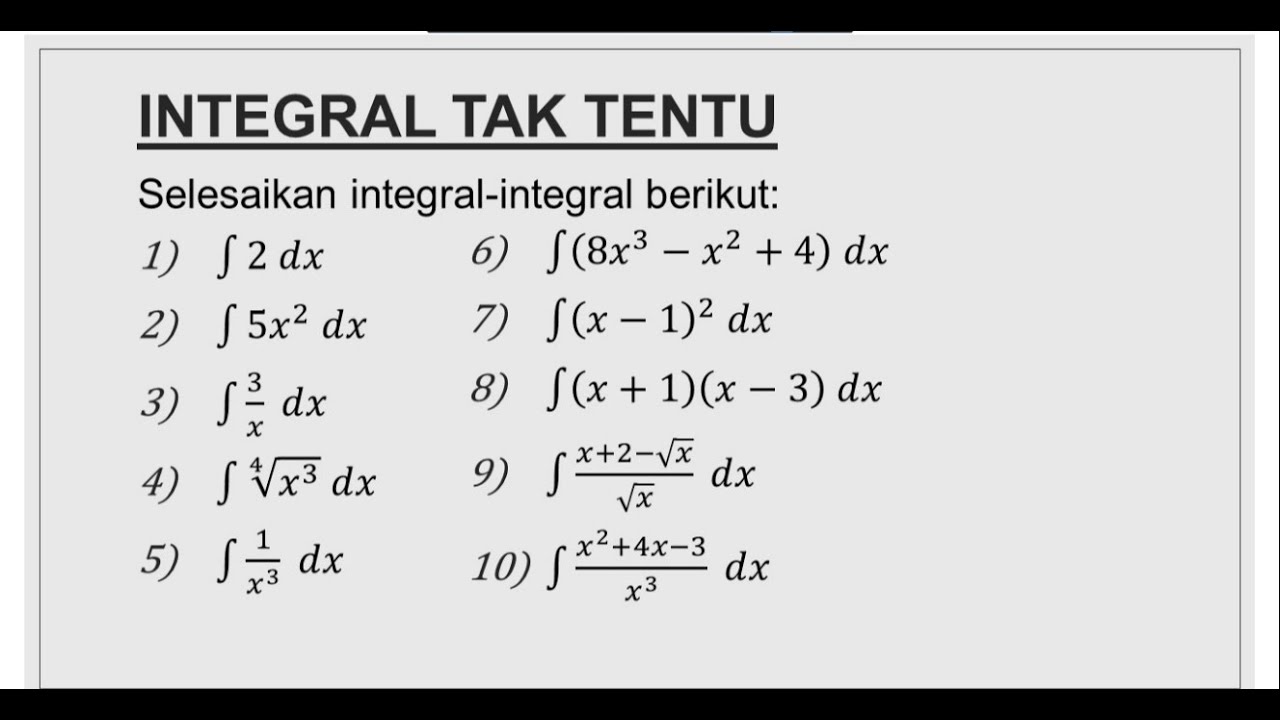
INTEGRAL TAK TENTU

KALKULUS | INTEGRAL | INTEGRAL TAK TENTU (ANTI TURUNAN)

Integral Fungsi Aljabar • Part 4: Contoh Soal Integral Tak Tentu Fungsi Aljabar Sederhana (2)
5.0 / 5 (0 votes)
