Momentum dan Impuls • Part 2: Tumbukan & Hukum Kekekalan Momentum
Summary
TLDRThis video explains the concepts of momentum and impulse, focusing on collisions. It covers real-life examples such as car crashes, billiard, and bowling, and illustrates collisions between two moving objects on a flat surface. Key topics include Newton's third law, conservation of momentum, and the calculation of momentum using mass and velocity. The video also introduces the coefficient of restitution, distinguishing perfectly elastic, partially elastic, and inelastic collisions, and explains how kinetic energy is conserved or lost in each case. Viewers gain a clear understanding of collision types, energy changes, and practical applications in everyday scenarios.
Takeaways
- 😀 Collisions (tumbukan) are common in daily life, such as car crashes, billiard balls hitting each other, and bowling balls striking pins.
- 😀 During a collision, objects exert forces on each other following Newton’s action-reaction principle.
- 😀 After a collision, the direction and speed of objects can change depending on their masses and initial velocities.
- 😀 The Law of Conservation of Momentum states that total momentum before a collision equals total momentum after the collision.
- 😀 Momentum is defined as mass multiplied by velocity, and changes in momentum are caused by changes in velocity, not mass.
- 😀 The coefficient of restitution (e) measures how elastic a collision is and determines how objects bounce after impact.
- 😀 The value of the coefficient of restitution always lies between 0 and 1.
- 😀 There are three types of collisions: perfectly elastic (e = 1), partially elastic (0 < e < 1), and perfectly inelastic (e = 0).
- 😀 In a perfectly elastic collision, no kinetic energy is lost and objects bounce back with full energy.
- 😀 In a partially elastic collision, some kinetic energy is lost, resulting in lower rebound heights or speeds.
- 😀 In a perfectly inelastic collision, objects stick together and move as one after the collision.
- 😀 Momentum is conserved in all types of collisions, regardless of energy loss.
- 😀 Mechanical (kinetic) energy is only conserved in perfectly elastic collisions.
- 😀 The loss of kinetic energy in collisions can be calculated as the difference between total initial and final kinetic energy.
- 😀 Energy lost during collisions is typically transformed into other forms such as heat, sound, or deformation.
Q & A
What is an example of a collision in everyday life?
-Examples include a car collision, billiard balls hitting each other, a volleyball hitting another ball, and bowling balls hitting pins.
What happens to two objects when they collide on a flat surface?
-When two objects collide, they exert equal and opposite forces on each other (action-reaction), which may cause them to bounce back, move together, or stop, depending on their masses and velocities.
What is the principle of conservation of momentum in collisions?
-The total momentum of a system before a collision is equal to the total momentum after the collision, expressed as P1 + P2 = P1' + P2', where P = mass × velocity.
What is the formula for momentum of an object?
-Momentum (P) is calculated as the product of mass and velocity: P = m × v.
What is the coefficient of restitution and how is it calculated?
-The coefficient of restitution (e) measures the elasticity of a collision, calculated as e = (V2' - V1') / (V1 - V2), where V1 and V2 are velocities before collision, and V1' and V2' are velocities after.
What are the three types of collisions?
-1. Perfectly elastic (no energy loss, e = 1), 2. Partially elastic (some energy loss, 0 < e < 1), 3. Perfectly inelastic (objects stick together, e = 0).
What happens in a perfectly inelastic collision?
-The two colliding objects stick together and move as a single unit after the collision, with a common velocity calculated using momentum conservation.
Does kinetic energy always conserve in collisions?
-No, kinetic energy is conserved only in perfectly elastic collisions. In partially elastic or inelastic collisions, some kinetic energy is converted to other forms like heat or deformation.
How can the loss of kinetic energy in a collision be calculated?
-The lost kinetic energy ΔEk = (Ek1 + Ek2) before collision − (Ek1' + Ek2') after collision, where Ek = ½ m v² for each object.
Is momentum conserved in all types of collisions?
-Yes, momentum is conserved in all collisions, regardless of whether they are elastic, partially elastic, or inelastic.
What is the typical range of the coefficient of restitution?
-The coefficient of restitution ranges from 0 to 1, where 0 represents a perfectly inelastic collision, values between 0 and 1 represent partially elastic collisions, and 1 represents a perfectly elastic collision.
Outlines

This section is available to paid users only. Please upgrade to access this part.
Upgrade NowMindmap

This section is available to paid users only. Please upgrade to access this part.
Upgrade NowKeywords

This section is available to paid users only. Please upgrade to access this part.
Upgrade NowHighlights

This section is available to paid users only. Please upgrade to access this part.
Upgrade NowTranscripts

This section is available to paid users only. Please upgrade to access this part.
Upgrade NowBrowse More Related Video

Fisika SMA - Impuls & Momentum (3) - Hukum Kekekalan Momentum (I)

FISIKA Kelas 10 - Momentum & Impuls | GIA Academy

08 01 Fisika Dasar 1- Momentum Dan Impuls
FISIKA KELAS X | MOMENTUM, IMPULS, dan TUMBUKAN (PART 1) - Konsep Dasar Momentum dan Impuls
Momentum and Impulse | Grade 9 Science Quarter 4 Week 3 Lesson
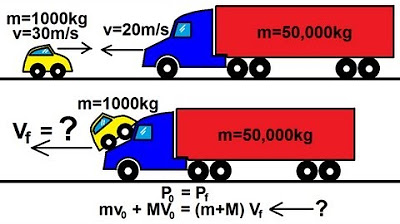
Physics 10 Momentum and Impulse (5 of 30) Why you Don't Want to Collide with a Semi Truck
5.0 / 5 (0 votes)
