Quem é o homem? | Eis o homem #1
Summary
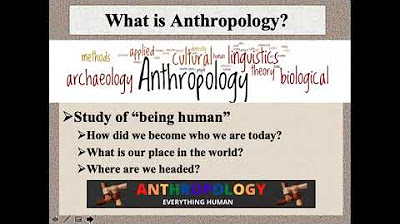
TLDRThe video explores the broad and multifaceted field of anthropology, examining humans from evolutionary, biological, historical, cultural, and linguistic perspectives. It highlights anthropology's holistic approach to understanding humanity, connecting past and present, and human diversity. The discussion then shifts to a theological perspective, reflecting on the biblical concept of humans as the 'image of God.' This notion is presented not as mere identity, but as a responsibility to act ethically and reflect divine principles. Through historical, literary, and personal anecdotes, the speaker emphasizes the uniqueness of humanity and challenges viewers to consider the implications of being created in God's image.
Takeaways
- 😀 Anthropology is a broad and multidisciplinary field that encompasses evolution, biology, history, cultural anthropology, and linguistics.
- 😀 The human species can be studied from various perspectives, such as evolutionary biology, archaeology, cultural anthropology, and linguistics.
- 😀 Anthropology aims to understand both the commonalities and differences among human societies and how they have evolved over time.
- 😀 The Bible suggests that humans were created in the image of God, which is central to understanding human nature in both religious and philosophical contexts.
- 😀 The concept of humans being made in the image of God is connected to the responsibility given to humans, similar to how kings placed images to represent their authority.
- 😀 Humans, as God’s representatives, are entrusted with the responsibility to act according to God's ethics and demonstrate His image in the world.
- 😀 There are two accounts of human creation in Genesis, where the second account emphasizes the physical and unique creation of humans by God.
- 😀 The uniqueness of humans is seen as one of the strongest evidence for the existence of a Creator, highlighting the miracle of human creation.
- 😀 The individuality and uniqueness of each human are considered miraculous, and according to probability laws, it’s almost impossible for such uniqueness to occur naturally.
- 😀 The Jewish tradition frequently refers to humans as the image of God, and the key question is not whether we are made in God's image, but how we should behave and represent God in our lives.
Q & A
What is anthropology and why is it considered conceptually broad?
-Anthropology is the study of the human species, and it is conceptually broad because it encompasses multiple perspectives: biological, historical, cultural, and linguistic. It aims to provide a holistic understanding of humans.
How does anthropology approach the study of human evolution?
-Anthropology looks at human evolution through the lens of biology, exploring how our species emerged, how biological factors shaped our lives, and how we are connected to our ancestors.
What is the role of archaeology in anthropology?
-Archaeology, a subfield of anthropology, studies historical human activity through material remains, such as the first stone tools created by our ancestors, to understand human history.
How do cultural anthropologists study human societies?
-Cultural anthropologists study contemporary human societies, aiming to understand both the similarities and differences in human behavior, social structures, and traditions across cultures.
Why is language important in anthropology?
-Language is a fundamental part of being human, shaping thought, communication, and culture. Linguistic anthropology examines how language emerges, evolves, and continues to influence human life.
What does the phrase 'made in the image of God' mean according to the transcript?
-In the transcript, 'made in the image of God' is interpreted as humans being given responsibility and stewardship over creation. It reflects both uniqueness and accountability in human life.
How does the biblical concept of humans as God's image relate to authority?
-The text suggests that humans act as God's representatives on Earth, similar to how kings and emperors used images to signify their authority. Humans are meant to govern responsibly according to divine ethics.
What is the contrast between the first and second creation accounts in Genesis?
-The first creation account depicts God as all-powerful and humans as small in comparison, while the second creation account emphasizes a close, personal connection between God and humans, highlighting their singularity and special role.
Why is human uniqueness seen as evidence of divine creation?
-Each human is created uniquely, which the transcript presents as improbable by chance alone. This uniqueness is considered a powerful and convincing sign of a deliberate, miraculous creation by God.
What practical implications arise from humans being the image of God?
-Being the image of God implies moral and ethical responsibility. Humans should live in ways that reflect divine qualities, and their actions should remind others of God, demonstrating stewardship and ethical conduct.
How does the speaker use humor to illustrate theological points?
-The speaker recounts a humorous anecdote about his father questioning when God broke the Ten Commandments, highlighting the tension between making images of God and humans being God’s image. Humor is used to make theological ideas more relatable.
Outlines

This section is available to paid users only. Please upgrade to access this part.
Upgrade NowMindmap

This section is available to paid users only. Please upgrade to access this part.
Upgrade NowKeywords

This section is available to paid users only. Please upgrade to access this part.
Upgrade NowHighlights

This section is available to paid users only. Please upgrade to access this part.
Upgrade NowTranscripts

This section is available to paid users only. Please upgrade to access this part.
Upgrade NowBrowse More Related Video

Introduction to Anthropology
Lesson 1 Introduction to Anthropology

What is Anthropology? | College Majors | College Degrees | Study Hall

What is Anthropology | Sociocultural | Linguistic & Biological Anthropology | What is Archaeology

Pengertian Ilmu Antropologi

Cognitive Science Rescues the Deconstructed Mind | John Vervaeke | TEDxUofT
5.0 / 5 (0 votes)
