Abstract Factory Pattern: Easy Guide for Beginners
Summary
TLDRThis video explains the Abstract Factory design pattern, a powerful tool in software development for creating families of related or dependent objects without specifying their concrete classes. Using a door and installer example, it demonstrates how abstract factories decouple client code from specific implementations, ensuring consistent object creation and reducing code complexity. The video covers key concepts, UML components, and a Java implementation, showing how wooden and iron doors along with their respective installers can be produced through separate factories. It concludes by highlighting practical applications, emphasizing improved maintainability, flexibility, and clean, organized code structure.
Takeaways
- 😀 The Abstract Factory design pattern provides a solution for creating related or dependent objects through an interface, decoupling clients from specific class implementations.
- 😀 The pattern is useful when you need to create a series of related objects that share a consistent style or theme.
- 😀 An example of the Abstract Factory pattern is the creation of doors (wooden, iron, PVC) and their corresponding installers (carpenter, welder).
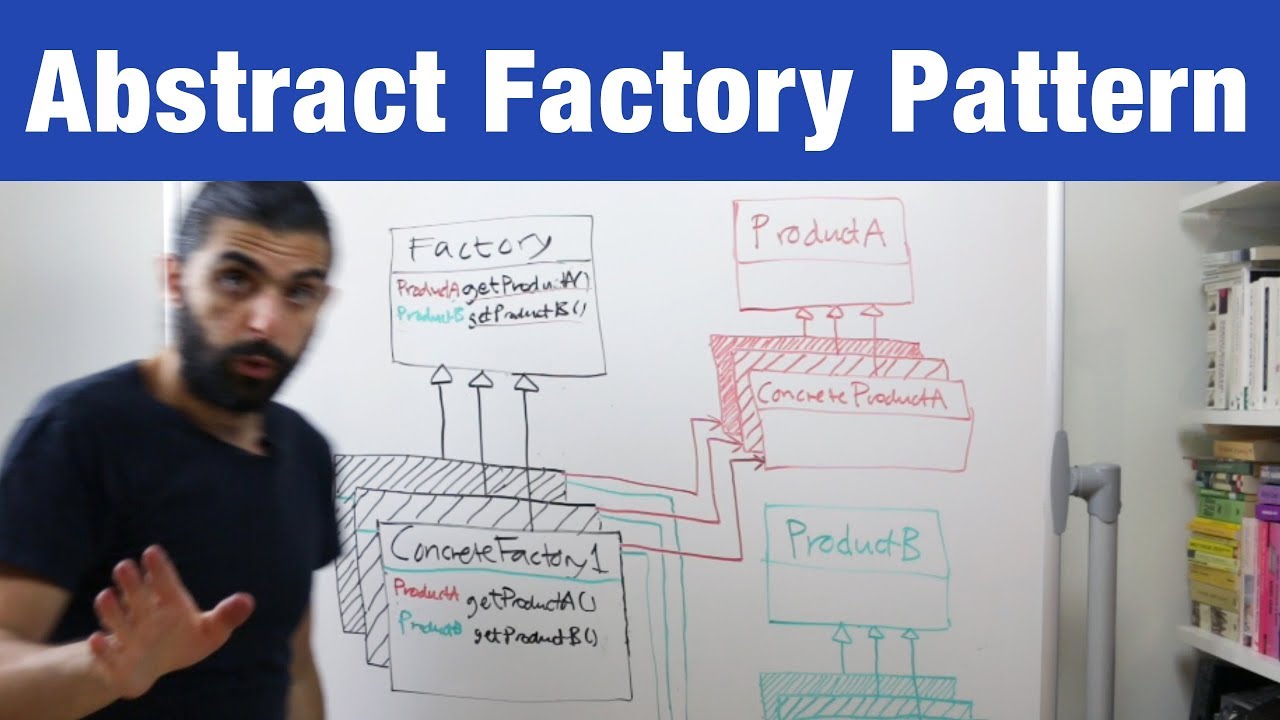
- 😀 The Abstract Factory defines an interface for creating a set of related product objects, without specifying their concrete classes.
- 😀 Concrete Factory classes implement the Abstract Factory interface and create specific product objects, encapsulating the creation logic.
- 😀 The Abstract Product defines an interface for product objects, ensuring that different product types can be created with a common interface.
- 😀 The Client class uses the Abstract Factory to create and interact with product objects, without worrying about specific product implementations.
- 😀 The pattern helps improve flexibility and maintainability by decoupling the client code from the concrete classes of the products and factories.
- 😀 The Abstract Factory pattern is particularly useful when managing complex object creation processes, making the code easier to extend or modify.
- 😀 By using this pattern, the client code operates on interfaces, which promotes decoupling and reduces dependency on specific implementations.
- 😀 The Abstract Factory design pattern is a key strategy to implement in scenarios where related objects are frequently created together, ensuring consistency and flexibility in the system design.
Q & A
What problem does the Abstract Factory design pattern solve?
-The Abstract Factory design pattern helps in creating a set of related or dependent objects without tightly coupling the code. It allows for a unified interface to create objects, ensuring consistency while making the code easier to maintain and extend.
How does the Abstract Factory pattern improve code maintainability?
-By using the Abstract Factory pattern, the client code is decoupled from the specific concrete classes of objects. This decoupling makes it easier to replace or add new object creation logic in the future, improving maintainability.
What is an abstract factory?
-An abstract factory is a factory of factories. It defines an interface for creating related or dependent objects, but without specifying their concrete classes. Concrete factories implement this interface to create specific product objects.
Can you explain the roles of the concrete factories in the Abstract Factory pattern?
-Concrete factories implement the abstract factory interface and provide specific implementations for creating concrete product objects. Each concrete factory is responsible for creating a set of related product objects.
What is the role of the abstract product in the Abstract Factory pattern?
-The abstract product defines a common interface for a type of product object. Concrete product classes implement this interface, ensuring that clients can work with products through a unified interface without needing to know the specific implementations.
How does the client use the Abstract Factory pattern?
-The client interacts with the abstract factory interface to create and use product objects. It relies on the interfaces defined by the abstract factory and product classes, which decouples the client from the concrete classes of both factories and products.
How does the Abstract Factory pattern differ from the Simple Factory pattern?
-While the Simple Factory pattern creates a single type of object based on input, the Abstract Factory pattern creates a set of related objects, ensuring they work together and conform to a certain theme or style. The Abstract Factory also decouples the client from specific implementations of the objects.
Can you give an example of when to use the Abstract Factory pattern?
-The Abstract Factory pattern is useful when you need to create a set of related or dependent objects that must be designed or styled consistently. For instance, if you're building a graphical user interface with buttons, text boxes, and menus that need to follow a specific theme, the Abstract Factory pattern would be helpful.
What are the components of the UML diagram for the Abstract Factory pattern?
-The UML diagram for the Abstract Factory pattern includes: the Abstract Factory (defines the interface for creating products), Concrete Factories (implement the interface and create concrete products), Abstract Products (define common operations for products), Concrete Products (implement product operations), and the Client (uses the abstract factory to create and use products).
How does the Abstract Factory pattern help in managing complex object creation?
-The Abstract Factory pattern allows you to centralize the object creation logic within the factory classes. This makes it easier to manage and modify the creation process without affecting the client code, which interacts only with interfaces, making complex creation processes more manageable and flexible.
Outlines

This section is available to paid users only. Please upgrade to access this part.
Upgrade NowMindmap

This section is available to paid users only. Please upgrade to access this part.
Upgrade NowKeywords

This section is available to paid users only. Please upgrade to access this part.
Upgrade NowHighlights

This section is available to paid users only. Please upgrade to access this part.
Upgrade NowTranscripts

This section is available to paid users only. Please upgrade to access this part.
Upgrade NowBrowse More Related Video
Abstract Factory Pattern – Design Patterns (ep 5)

#65 Need of Interface in Java

Factory Pattern

Curso POO Teoria #02a - O que é um Objeto?

The Factory Method Pattern Explained and Implemented in Java | Creational Design Patterns | Geekific

36. OCR A Level (H446) SLR7 - 1.2 Object-oriented languages part 1
5.0 / 5 (0 votes)
