FUNÇÕES DO SISTEMA IMUNE - SISTEMA IMUNOLÓGICO - AULA 1
Summary
TLDRIn this video, Kleberson explains the basics of immunology, focusing on the immune system’s role in defending the body against foreign invaders like bacteria, viruses, and cancer. He introduces the concept of innate and adaptive immunity, comparing immune cells to soldiers on a battlefield. Kleberson explains how innate immunity acts as a first-line defense, while adaptive immunity is more specialized and memory-driven. He also discusses the origin of immune cells, their differentiation in the bone marrow and thymus, and the functions of primary and secondary lymphoid organs. The video is an accessible introduction to immunological principles for beginners.
Takeaways
- 🧬 Immunology is the study of the immune system, which defends the body against foreign substances like viruses, bacteria, cancer, and other antigens.
- ⚔️ The immune system can be compared to an army, with front-line soldiers representing innate immunity and specialized troops representing adaptive immunity.
- 🛡️ Innate immunity is the body's first line of defense, responding generally to invaders without prior exposure.
- 🧪 Components of innate immunity include physical and chemical barriers, macrophages, neutrophils, natural killer (NK) cells, cytokines, and the complement system.
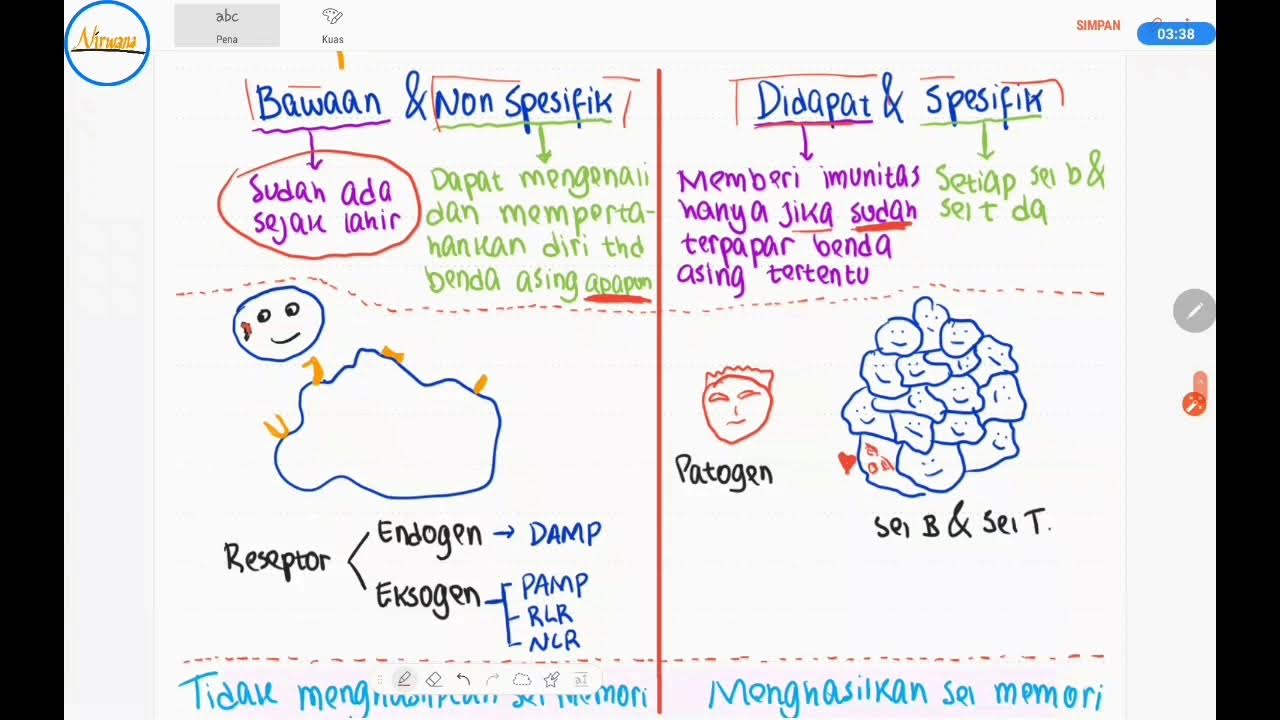
- 🎯 Adaptive immunity is specialized and has memory, allowing the body to respond more effectively upon re-exposure to a specific pathogen.
- 💉 Adaptive immunity involves T cells (CD4 and CD8) and B cells, which mature into plasma cells to produce antibodies.
- 🔬 Adaptive immunity can be divided into humoral immunity (B cells targeting extracellular microbes) and cellular immunity (T cells targeting intracellular microbes).
- 💪 Immunity can be active, induced by the body through exposure or vaccination, or passive, provided externally, such as through serum in emergencies.
- 🌱 Immune cells originate from hematopoietic stem cells, which differentiate into myeloid and lymphoid progenitors, giving rise to various immune cells like granulocytes, macrophages, and lymphocytes.
- 🏛️ Lymphoid organs are central (bone marrow and thymus) where cells mature, and peripheral (lymph nodes, spleen, and MALT) where immune cells encounter antigens and become effector cells.
Q & A
What is immunology?
-Immunology is the study of the immune system, which includes all cells and substances that defend the body against foreign substances such as viruses, bacteria, cancer cells, and antigens.
What are antigens?
-Antigens are substances recognized by the body as foreign or abnormal, which trigger an immune response. They can include microorganisms, cancer cells, or any other substance not naturally part of the body.
How does the transcript compare the immune system to a battle?
-The transcript uses a war analogy: cells in the immune system are compared to soldiers. Some are frontline fighters (innate immunity) that act immediately and generally, while others are specialized soldiers (adaptive immunity) that recognize specific invaders and have memory for future responses.
What is the difference between innate and adaptive immunity?
-Innate immunity acts as the first line of defense with general, non-specific attacks against invaders, whereas adaptive immunity is specific, has memory, and targets particular microorganisms or antigens with a more strategic response.
Which cells are part of innate immunity?
-Innate immunity includes physical and chemical barriers, phagocytic cells like macrophages and neutrophils, natural killer (NK) cells, cytokines, and the complement system.
Which cells are part of adaptive immunity?
-Adaptive immunity includes T lymphocytes (T cells) and B lymphocytes (B cells). T cells can be further divided into CD4+ helper T cells and CD8+ cytotoxic T cells, while B cells can differentiate into plasma cells that produce antibodies.
What is the difference between humoral and cellular adaptive immunity?
-Humoral immunity involves B cells and antibodies that target extracellular microorganisms, whereas cellular immunity involves T cells that target intracellular microorganisms.
What is the difference between active and passive immunity?
-Active immunity is induced in the body, generating memory cells, as seen with vaccinations. Passive immunity involves the transfer of pre-formed antibodies for immediate protection, such as with antivenom or immune sera.
What is the origin of immune cells?
-All immune cells originate from hematopoietic stem cells in the bone marrow, which differentiate into myeloid progenitors (producing granulocytes, mast cells, monocytes/macrophages) and lymphoid progenitors (producing T and B lymphocytes).
What are central and peripheral lymphoid organs and their roles?
-Central lymphoid organs (bone marrow and thymus) are where immune cells mature: B cells mature in the bone marrow, T cells in the thymus. Peripheral lymphoid organs (lymph nodes, spleen, and MALT) are where mature immune cells encounter antigens and become effector cells.
Why is memory important in adaptive immunity?
-Memory allows adaptive immune cells to recognize previously encountered pathogens quickly and efficiently, resulting in a faster and stronger immune response upon re-exposure.
What is the role of cytokines in the immune system?
-Cytokines are signaling molecules that regulate immune responses by activating and coordinating the activity of various immune cells to effectively combat pathogens.
Outlines

This section is available to paid users only. Please upgrade to access this part.
Upgrade NowMindmap

This section is available to paid users only. Please upgrade to access this part.
Upgrade NowKeywords

This section is available to paid users only. Please upgrade to access this part.
Upgrade NowHighlights

This section is available to paid users only. Please upgrade to access this part.
Upgrade NowTranscripts

This section is available to paid users only. Please upgrade to access this part.
Upgrade NowBrowse More Related Video
Konsep umum : Dasar sistem imun, sistem pertahanan tubuh, imunologi

Imunologia: conceitos básicos (Aula 1)

Como funciona o sistema imunológico? - Universo Explicado [ANIMAÇÃO]

Video 9 White Blood Cells Types and Functions

Vaccines 101: How Vaccines Work

How immunotherapy could help us beat cancer | Deepta Bhattacharya | TEDxUArizona
5.0 / 5 (0 votes)
