EQUAÇÃO DO 2° GRAU EM 6 MINUTOS
Summary
TLDRIn this tutorial, the process of solving quadratic equations using the Bhaskara formula is explained with clear examples. The video walks through complete and incomplete quadratic equations, breaking down the steps for calculating discriminants and finding roots. Special cases, such as equations where the constant term is zero, are also addressed with tips for factoring and simplifying. The tutorial emphasizes understanding the discriminant to determine the number and nature of the solutions, providing viewers with a solid grasp of how to solve quadratic equations confidently.
Takeaways
- 😀 The equation x² - 3x - 10 = 0 is a quadratic equation, as the unknown is squared.
- 😀 To solve this quadratic equation, we will use the Bhaskara formula (quadratic formula).
- 😀 The coefficients of the equation are: A = 1, B = -3, and C = -10.
- 😀 The discriminant (Δ) is calculated using the formula: Δ = B² - 4AC.
- 😀 In this case, the discriminant (Δ) is 49, which has an exact square root (7).
- 😀 Using the quadratic formula, we find the roots of the equation to be x = 5 and x = -2.
- 😀 For equations where C = 0 (incomplete quadratic equations), factor out the common x term.
- 😀 For example, x² + 5x = 0 can be factored as x(x + 5) = 0, giving the roots x = 0 and x = -5.
- 😀 For equations where B = 0 (e.g., x² - 16 = 0), isolate the x² term and solve for x by taking the square root.
- 😀 When solving x² = 16, the solution is x = ±4, because both 4² and (-4)² equal 16.
Q & A
What is the general form of a quadratic equation?
-A quadratic equation is in the form ax² + bx + c = 0, where 'a', 'b', and 'c' are constants, and 'x' is the variable raised to the second power.
What is the purpose of the Bhaskara formula in solving quadratic equations?
-The Bhaskara formula is used to find the roots (solutions) of a quadratic equation. It is given by x = (-b ± √(b² - 4ac)) / 2a, where 'a', 'b', and 'c' are the coefficients of the equation.
How do you identify the values of a, b, and c in a quadratic equation?
-In a quadratic equation of the form ax² + bx + c = 0, 'a' is the coefficient of x², 'b' is the coefficient of x, and 'c' is the constant term. For example, in x² - 3x - 10 = 0, a = 1, b = -3, and c = -10.
What is the significance of the 'delta' (Δ) in solving quadratic equations?
-Delta (Δ) is the discriminant of the quadratic equation, given by Δ = b² - 4ac. It determines the nature of the roots: if Δ > 0, there are two real roots; if Δ = 0, there is one real root; and if Δ < 0, the roots are complex.
How do you calculate the delta for the equation x² - 3x - 10 = 0?
-For the equation x² - 3x - 10 = 0, the delta (Δ) is calculated as Δ = (-3)² - 4(1)(-10) = 9 + 40 = 49.
What does the square root of delta tell us in solving quadratic equations?
-The square root of delta (√Δ) helps to find the roots of the quadratic equation. If Δ = 49, then √Δ = 7, and the roots are calculated by adding or subtracting 7 from -b and dividing by 2a.
What is the solution to the equation x² - 3x - 10 = 0 using Bhaskara?
-Using the Bhaskara formula for x² - 3x - 10 = 0, we get the solutions x = (-(-3) ± √49) / 2(1) = (3 ± 7) / 2, which results in x = 5 and x = -2.
How do you solve an incomplete quadratic equation like x² + 5x = 0?
-For an incomplete quadratic equation like x² + 5x = 0, you can factor out 'x' as a common factor: x(x + 5) = 0. Then, solve for x = 0 or x + 5 = 0, which gives x = 0 or x = -5.
What happens when the coefficient 'b' in a quadratic equation is 0?
-When the coefficient 'b' is 0, the quadratic equation simplifies. For example, in x² - 16 = 0, you isolate x² to get x² = 16, and then solve for x by taking the square root, resulting in x = ±4.
What is the final solution for the equation x² = 16?
-For the equation x² = 16, the solution is x = ±4, meaning x can be either 4 or -4, as both values satisfy the equation.
Outlines

This section is available to paid users only. Please upgrade to access this part.
Upgrade NowMindmap

This section is available to paid users only. Please upgrade to access this part.
Upgrade NowKeywords

This section is available to paid users only. Please upgrade to access this part.
Upgrade NowHighlights

This section is available to paid users only. Please upgrade to access this part.
Upgrade NowTranscripts

This section is available to paid users only. Please upgrade to access this part.
Upgrade NowBrowse More Related Video
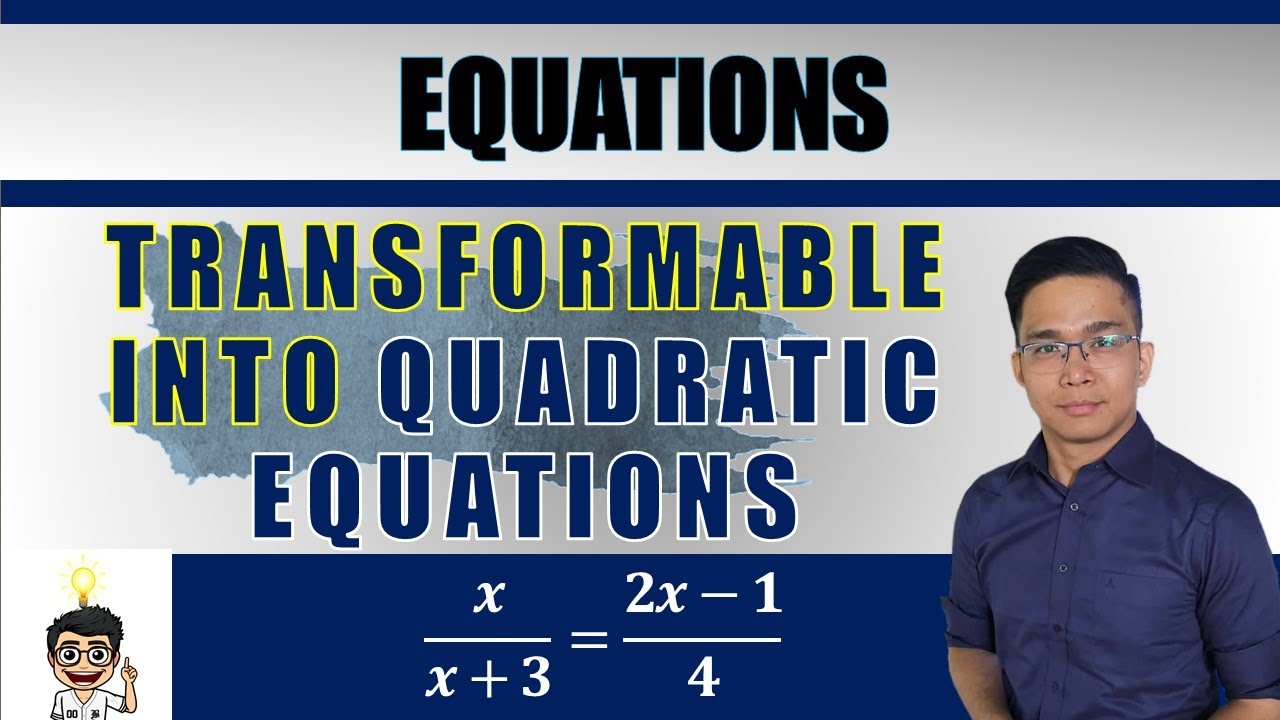
Solving Equations Transformable into Quadratic Equations
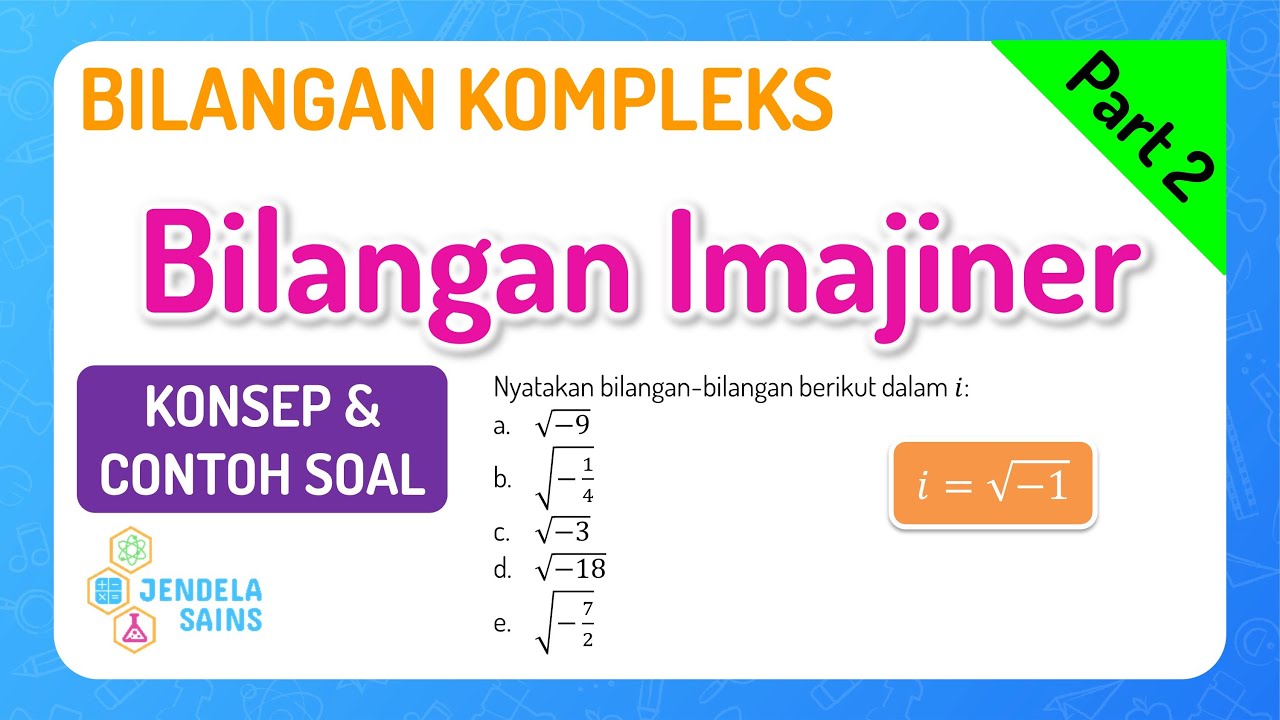
Bilangan Kompleks • Part 2: Bilangan Imajiner

Persamaan kuadrat dengan cara pemfaktoral melengkapi kuadrat sempurna dan menggunakan rumus
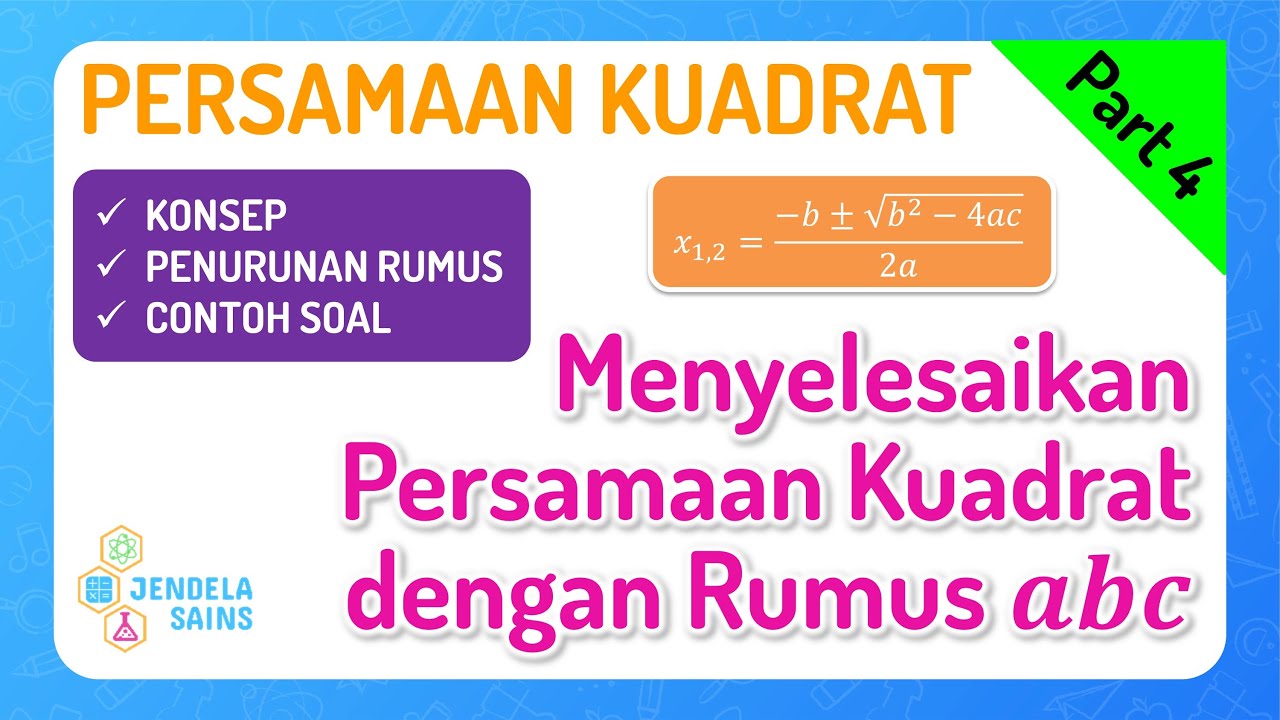
Persamaan Kuadrat • Part 4: Menyelesaikan Persamaan Kuadrat dengan Rumus abc
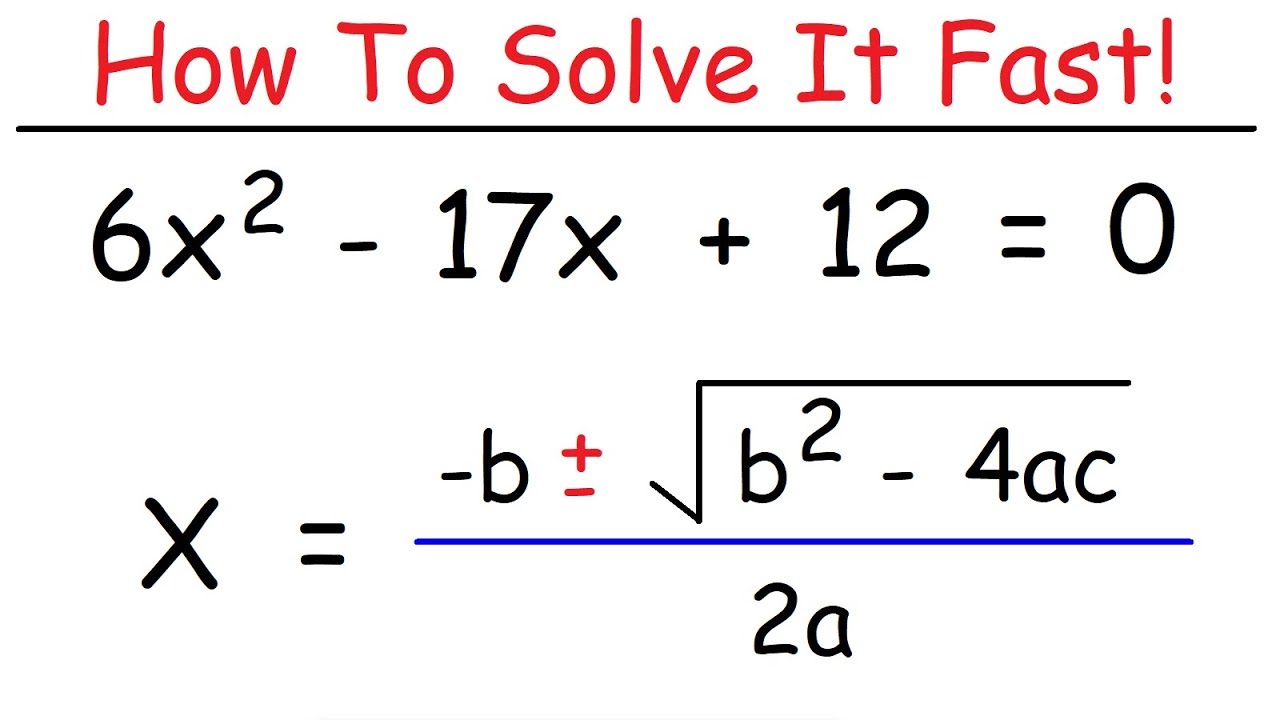
How To Solve Quadratic Equations Using The Quadratic Formula
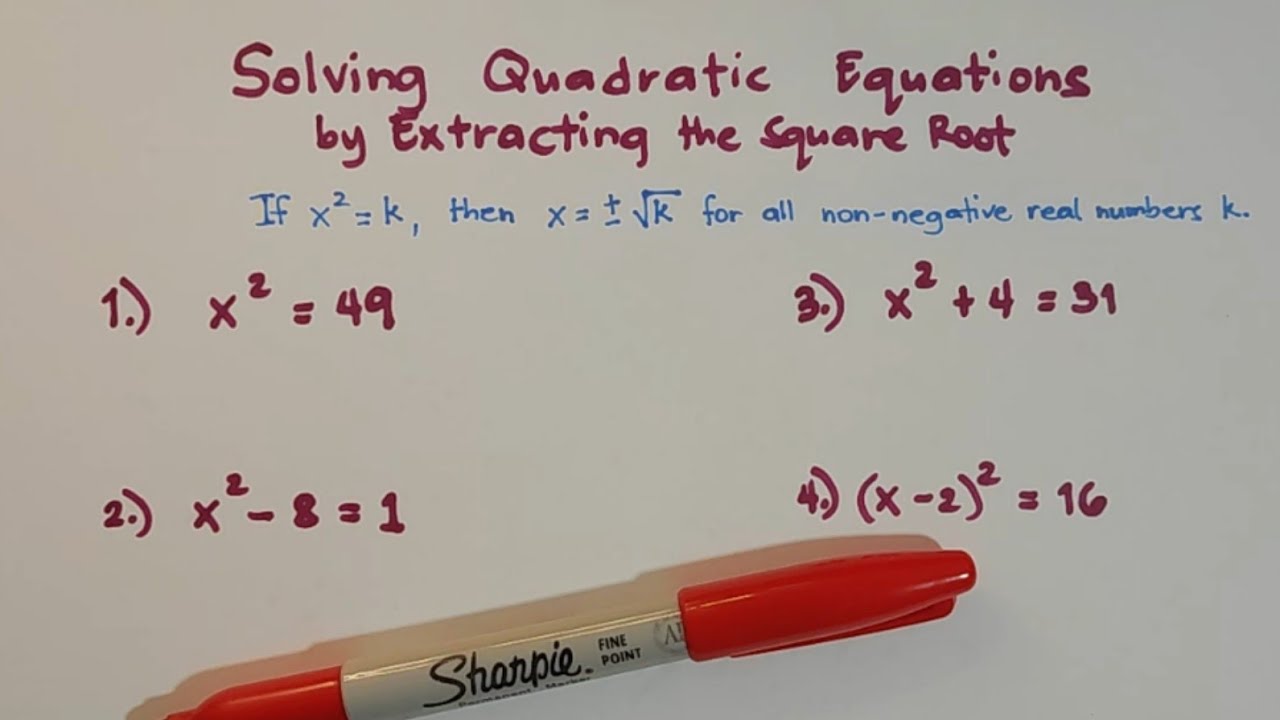
How to Solve Quadratic Equations by Extracting the Square Root? @MathTeacherGon
5.0 / 5 (0 votes)
