Is Matter around us Pure in 20 Minutes🔥| Class 9th | Rapid Revision | Prashant Kirad
Summary
TLDRThis educational video provides a comprehensive overview of solutions, colloidal systems, suspensions, and the differences between physical and chemical changes. It explains key concepts like the Tyndall Effect, particle size distinctions, and methods like filtration to separate mixtures. The video also contrasts physical changes, such as melting ice, with chemical changes, such as burning paper, highlighting their distinct characteristics. It serves as a helpful revision guide for students, emphasizing practical examples and clear differences to enhance understanding of these scientific concepts.
Takeaways
- 😀 Solutions are homogeneous mixtures where particles are smaller than 1 nanometer and cannot scatter light.
- 😀 Colloids are heterogeneous mixtures with particles between 1 to 1000 nanometers that scatter light due to the Tyndall effect.
- 😀 Suspensions are heterogeneous mixtures where large particles settle over time and can be separated by filtration.
- 😀 The Tyndall effect occurs in colloids and suspensions, where light is scattered by the particles, making the light path visible.
- 😀 In a true solution, light does not scatter, and the path of light is not visible.
- 😀 Physical changes involve a change in physical properties (shape, size, state) but do not create new substances, such as melting ice.
- 😀 Chemical changes involve a chemical reaction that produces new substances, such as burning paper or rusting iron.
- 😀 Physical changes are reversible, meaning the original substance can be recovered, like freezing water back into ice.
- 😀 Chemical changes are usually irreversible, like the burning of wood or the digestion of food, which cannot return to their original form.
- 😀 Suspensions, unlike colloids, can be separated by filtration due to the larger size of their particles.
- 😀 The distinction between solutions, colloids, and suspensions is important in understanding their behavior and the Tyndall effect, which helps differentiate colloids from true solutions.
Q & A
What is the definition of matter?
-Matter is anything that has mass and occupies space. It can exist in different forms and is composed of various particles.
What are the two types of pure substances discussed in the script?
-The two types of pure substances are elements and compounds. Elements consist of only one type of atom, while compounds are made of two or more elements combined chemically in a fixed ratio.
What is the definition of a pure substance?
-A pure substance consists of only one type of particle throughout. It has consistent physical and chemical properties, and cannot be separated into other substances by physical means.
What are the three main properties of pure substances as highlighted in the script?
-The three properties are: Consistent properties (both physical and chemical), Inseparability by physical means, and a definite, uniform composition.
What is the difference between homogeneous and heterogeneous mixtures?
-A homogeneous mixture has a uniform composition throughout, where individual components are not visible, like sugar dissolved in water. A heterogeneous mixture has a non-uniform composition with distinct, visible components, like sand in water.
What is an element and how is it different from a compound?
-An element consists of only one type of atom and cannot be broken down further into simpler substances. A compound is formed when two or more elements chemically combine in a fixed mass ratio.
What are the properties of metals discussed in the script?
-Metals are shiny (lustrous), good conductors of heat and electricity, malleable (can be hammered into thin sheets), ductile (can be drawn into wires), and sonorous (produce sound when struck).
What is the key difference between a physical change and a chemical change?
-A physical change only alters the physical properties of a substance (e.g., state, shape, size) without forming a new substance. In contrast, a chemical change results in the formation of new substances, with a change in both physical and chemical properties.
What is the Tyndall Effect and how can it help differentiate between solutions, colloids, and suspensions?
-The Tyndall Effect occurs when light scatters off particles in a colloid or suspension, making the path of light visible. This effect helps differentiate colloidal mixtures and suspensions from true solutions, where the particles are too small to scatter light.
What is a solution, and what are its two components?
-A solution is a homogeneous mixture of two or more substances with uniform composition. It consists of a solvent (the substance that dissolves the other) and a solute (the substance being dissolved).
Outlines

This section is available to paid users only. Please upgrade to access this part.
Upgrade NowMindmap

This section is available to paid users only. Please upgrade to access this part.
Upgrade NowKeywords

This section is available to paid users only. Please upgrade to access this part.
Upgrade NowHighlights

This section is available to paid users only. Please upgrade to access this part.
Upgrade NowTranscripts

This section is available to paid users only. Please upgrade to access this part.
Upgrade NowBrowse More Related Video
Sistem Koloid (1) | Jenis-jenis Koloid | Kimia kelas 11
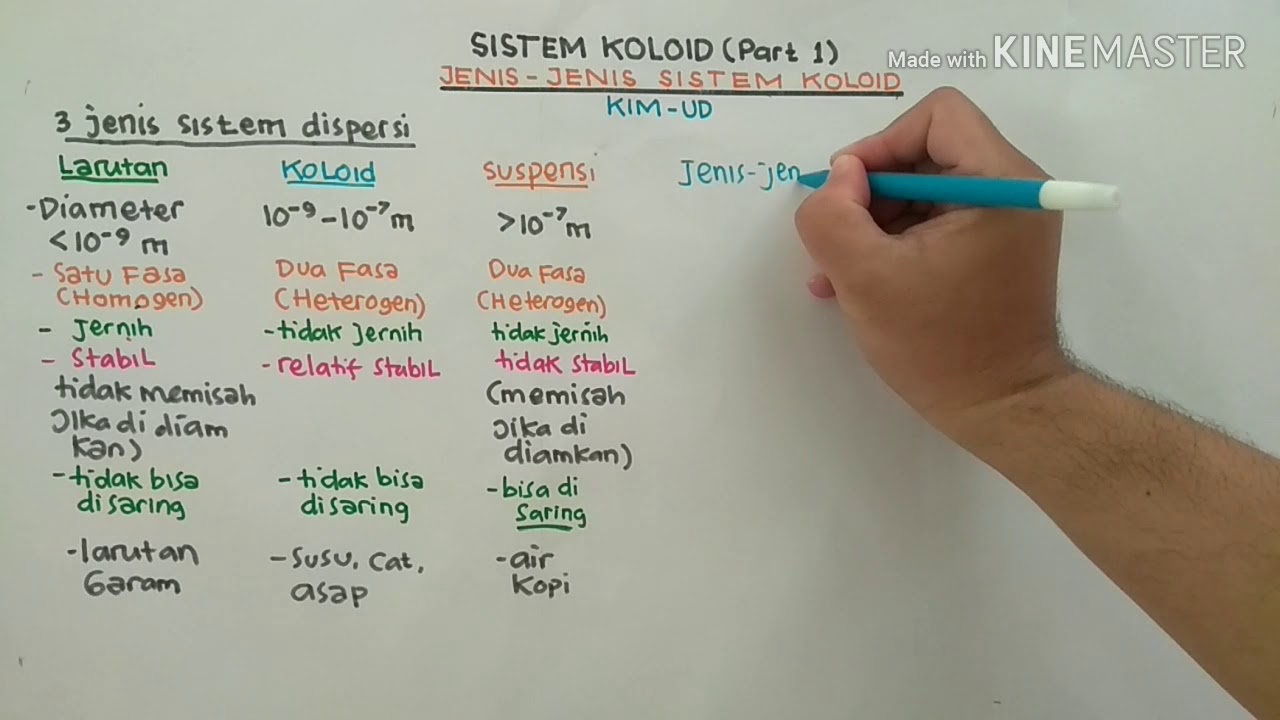
SISTEM KOLOID (Part 1), Jenis Sistem Koloid
Sistem Koloid • Part 1: Perbedaan Larutan, Koloid, dan Suspensi; Jenis-Jenis Koloid

SISTEM KOLOID (Part 2), Sifat-sifat Sistem Koloid
Hukum Termodinamika, Bagian 1: Energi Dalam dan Hukum Pertama

VIDEO PPT USUR, SENYAWA DAN CAMPURAN CP
5.0 / 5 (0 votes)
