Tides Explained
Summary
TLDRThis video explains the phenomenon of tides, which are caused by the gravitational forces of the moon and the sun, along with the Earth's rotation. The moon's gravitational pull causes ocean bulges, resulting in high and low tides, with the Earth’s rotation shifting these bulges. Tidal ranges vary globally, with the Bay of Fundy having the largest at 16.3 meters. The video also covers spring and neap tides, which occur during the full moon and new moon phases, and when the moon is in its first and third quarters. For a more detailed understanding, the video suggests exploring a related playlist.
Takeaways
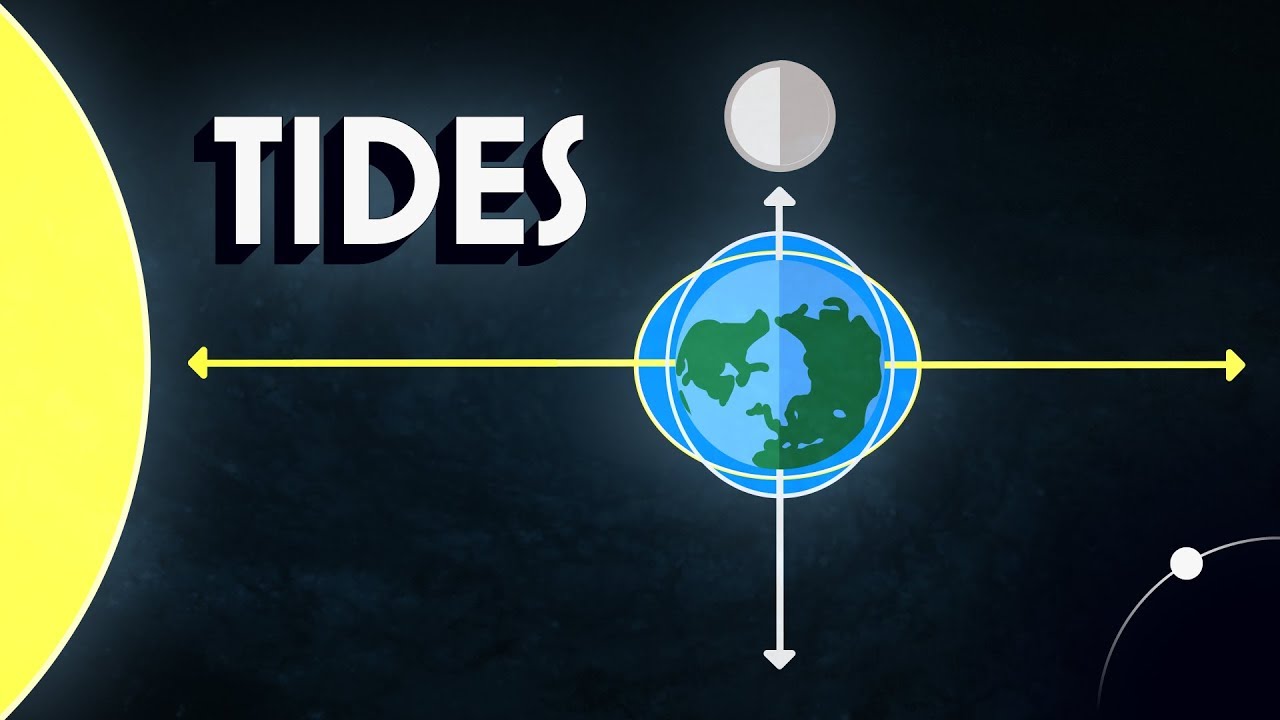
- 🌕 Tides are the rise and fall of sea levels caused by the gravitational forces of the moon and the sun, along with the Earth's rotation.
- 🌍 Gravity is the force of attraction between two objects, and the closer they are, the stronger the gravitational pull.
- 🌑 The moon has a greater effect on Earth's tides than the sun due to its proximity to Earth.
- 🌊 On the side of Earth facing the moon, gravity causes the ocean to bulge outward, creating high tide.
- 🌎 The Earth’s rotation causes the tidal bulge to shift, leading to alternating high and low tides.
- 🔄 The tidal bulge changes direction as the moon orbits Earth and Earth rotates on its axis.
- 📏 Tidal range is the difference in height between high tide and low tide, and can vary greatly across locations.
- 🌊 The Bay of Fundy in Canada has the world's largest tidal range, measuring 16.3 meters (53.5 feet).
- ⏳ Most places experience two high tides and two low tides each day, with a six-hour cycle between them.
- 🌞 During new and full moons, when the Earth, moon, and sun align, the tidal range is at its maximum, called spring tides.
- 🌗 When the moon is at its first or third quarter, the sun and moon are 90 degrees apart, resulting in the lowest tidal range, known as neap tides.
Q & A
What are the three main factors that cause tides on Earth?
-Tides are caused by the gravitational force of the moon, the gravitational force of the sun, and the rotation of the Earth.
How does gravity affect tides?
-Gravity is the force of attraction between two objects. The closer an object is to another, the stronger the gravitational pull. This causes the ocean's water to bulge out, creating high and low tides.
Why does the moon have a stronger effect on tides than the sun?
-Despite being much smaller than the sun, the moon has a greater effect on Earth's tides because it is much closer to Earth, making its gravitational pull stronger.
What is a tidal bulge?
-A tidal bulge is the outward bulging of the ocean's water on the side of Earth facing the moon due to the moon's gravitational pull. There is also a smaller bulge on the opposite side of Earth.
How does the Earth's rotation affect tides?
-The Earth's rotation causes the tidal bulge to change direction constantly. As the Earth rotates on its axis, areas experience high tide when they are under the bulge and low tide when they are not.
What is the tidal range?
-The tidal range is the height difference between high tide and low tide. It indicates the extent of the water level change between these two points.
Where is the world's largest tidal range, and how big is it?
-The world's largest tidal range is 16.3 meters (53.5 feet), and it occurs in the Bay of Fundy in Canada.
How often do high and low tides occur on most parts of Earth?
-Most places experience two high tides and two low tides each day. The cycle of high and low tides happens approximately every 12 hours and 25 minutes.
What are spring tides, and when do they occur?
-Spring tides occur when the sun, moon, and Earth form a straight line, typically around new moon and full moon. This alignment causes the tidal forces to be at their maximum, resulting in the largest tidal range.
What are neap tides, and when do they occur?
-Neap tides occur when the moon is at the first and third quarter, with the sun and moon separated by 90 degrees. In this position, the solar tidal force cancels out the moon's tidal force, resulting in the smallest tidal range.
Outlines

This section is available to paid users only. Please upgrade to access this part.
Upgrade NowMindmap

This section is available to paid users only. Please upgrade to access this part.
Upgrade NowKeywords

This section is available to paid users only. Please upgrade to access this part.
Upgrade NowHighlights

This section is available to paid users only. Please upgrade to access this part.
Upgrade NowTranscripts

This section is available to paid users only. Please upgrade to access this part.
Upgrade Now



5.0 / 5 (0 votes)
