Matrices - Minors and Cofactors | Don't Memorise
Summary
TLDRThis video delves into the formula for the determinant of a matrix, explaining how the first row serves as the reference. It explores the process of calculating the determinant by multiplying each element by a minor and cofactor, with signs adjusted by raising -1 to the sum of the row and column numbers. The video introduces key concepts like minor and cofactor, explaining their relationship and providing examples of how to calculate these for matrix elements. A clear, step-by-step breakdown makes it easier to understand the determinant calculation method.
Takeaways
- 😀 The determinant of a matrix can be derived by expanding along any row or column.
- 😀 When expanding along the first row, each element is multiplied by a cofactor, which includes a sign factor and a smaller determinant.
- 😀 The sign factor for each element is determined by raising -1 to the power of (row number + column number).
- 😀 The minor of an element is the determinant of the smaller matrix obtained by removing its row and column.
- 😀 The cofactor of an element is the product of its minor and the sign factor.
- 😀 The formula for the first element 'a11' includes multiplying it by the determinant of the remaining 2x2 matrix after excluding its row and column.
- 😀 The cofactor formula applies to all elements in a matrix, with each element contributing to the overall determinant through its minor and sign factor.
- 😀 The minor of an element is referred to as the 'smaller part', while the cofactor is the 'larger part' that includes the sign factor.
- 😀 For any element 'Aij' in a matrix, the cofactor is the minor multiplied by (-1)^(i + j), where 'i' is the row number and 'j' is the column number.
- 😀 The minor and cofactor are essential concepts for calculating the determinant and understanding matrix properties.
- 😀 In the next part of the lesson, an example will be used to apply these concepts and demonstrate the process in action.
Q & A
What is the formula for calculating the determinant of a matrix when using the first row as a reference?
-The formula is based on expanding the determinant along the first row. Each element in the first row is multiplied by a cofactor. The cofactor of each element is determined by multiplying its minor by '(-1)^(i+j)', where 'i' is the row number and 'j' is the column number of the element.
What does '(-1)^(i+j)' signify in the cofactor calculation?
-'(-1)^(i+j)' is a factor used to alternate the sign of each cofactor. It is based on the sum of the row and column indices ('i' and 'j'). If the sum is even, the sign is positive, and if the sum is odd, the sign is negative.
What is the meaning of the 'minor' of an element in a matrix?
-The minor of an element 'Aij' in a matrix is the determinant of the smaller matrix obtained by excluding the row and column of the element 'Aij'.
What is the cofactor of an element in a matrix?
-The cofactor of an element 'Aij' is calculated by multiplying its minor by '(-1)^(i+j)', where 'i' is the row number and 'j' is the column number of the element.
How do you calculate the minor for element 'a11' in a matrix?
-To calculate the minor for 'a11', exclude the first row and first column of the matrix, and then calculate the determinant of the remaining 2x2 matrix. In this case, the minor is the determinant of the matrix formed by elements 'a22', 'a23', 'a32', and 'a33'.
What are the steps to calculate the cofactor of element 'a11'?
-To calculate the cofactor of 'a11', first calculate the minor, which is the determinant of the smaller matrix after removing the first row and column. Then multiply the minor by '(-1)^(1+1)' to get the cofactor.
What is the relationship between the cofactor and the minor of an element in a matrix?
-The cofactor of an element is equal to '(-1)^(i+j)' multiplied by its minor. The minor is the determinant of the submatrix formed by removing the element's row and column, and the cofactor is the signed version of this minor.
Can the cofactor of an element be calculated without using the minor?
-No, the cofactor calculation always involves first calculating the minor of the element, followed by applying the sign factor '(-1)^(i+j)' to get the cofactor.
What does the term 'minor' mean in the context of matrix determinants?
-In the context of matrix determinants, the term 'minor' refers to the determinant of the smaller matrix obtained by removing the row and column of the element in question.
How can we remember the difference between a minor and a cofactor?
-A good way to remember the difference is by understanding that a minor is a 'smaller' determinant (the submatrix determinant), while the cofactor is the 'larger' term that includes the sign change factor '(-1)^(i+j)'.
Outlines

This section is available to paid users only. Please upgrade to access this part.
Upgrade NowMindmap

This section is available to paid users only. Please upgrade to access this part.
Upgrade NowKeywords

This section is available to paid users only. Please upgrade to access this part.
Upgrade NowHighlights

This section is available to paid users only. Please upgrade to access this part.
Upgrade NowTranscripts

This section is available to paid users only. Please upgrade to access this part.
Upgrade NowBrowse More Related Video

MATRIKS RUANG VEKTOR | MENCARI DETERMINAN DENGAN METODE OBE
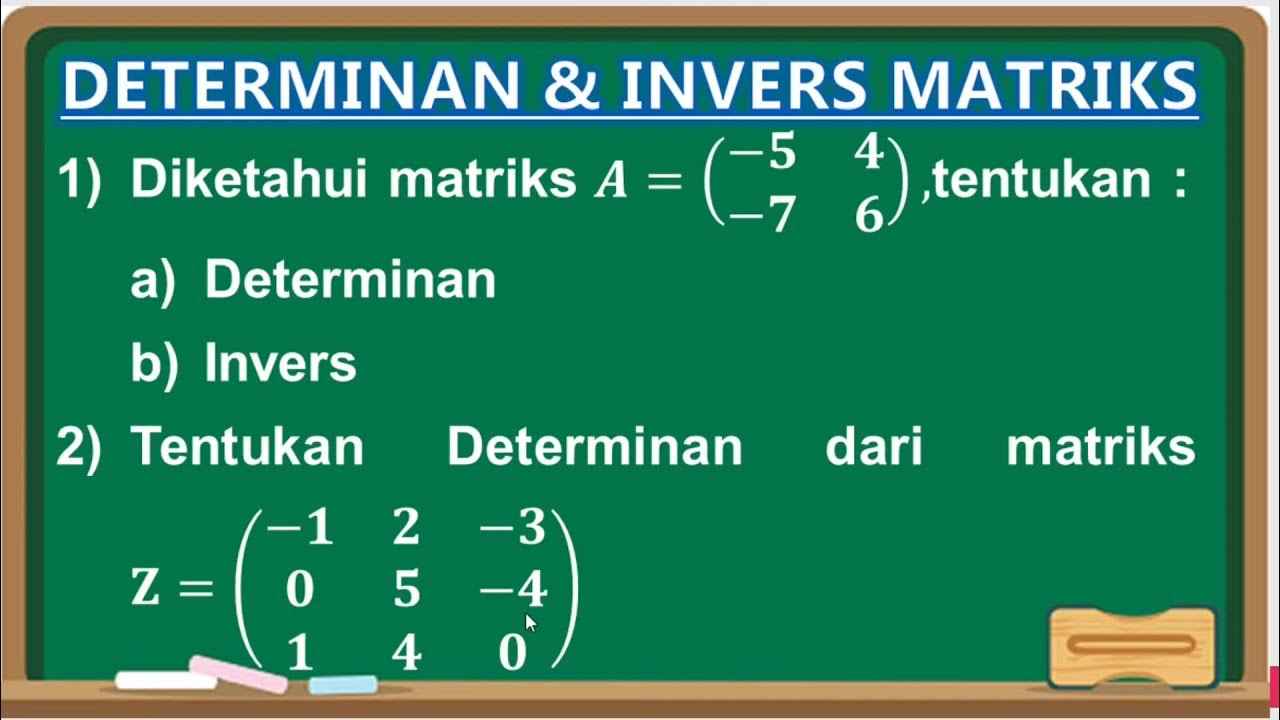
Cara Menentukan Determinan dan Invers Matriks

Matriks Matematika Wajib Kelas 11 - Invers Matriks Ordo 2x2 dan Ordo 3x3 dan Sifat-sifatnya
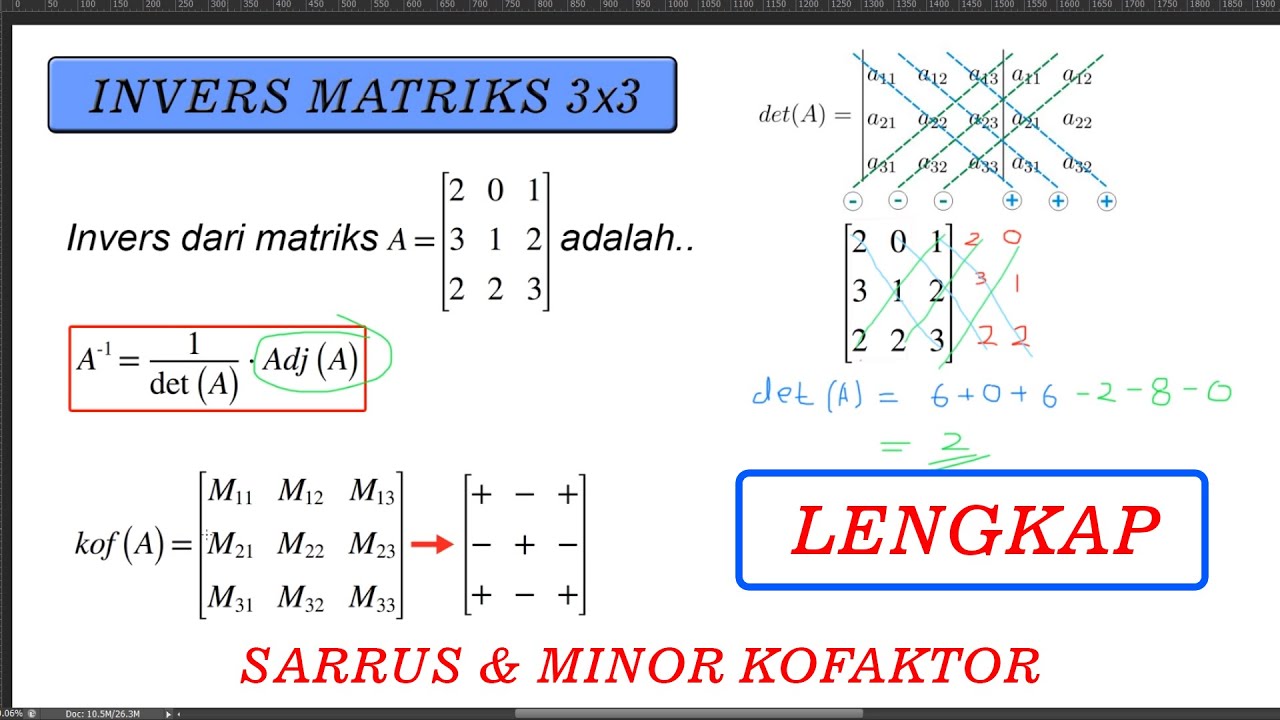
Invers Matriks 3x3 - Penjelasan Lengkap
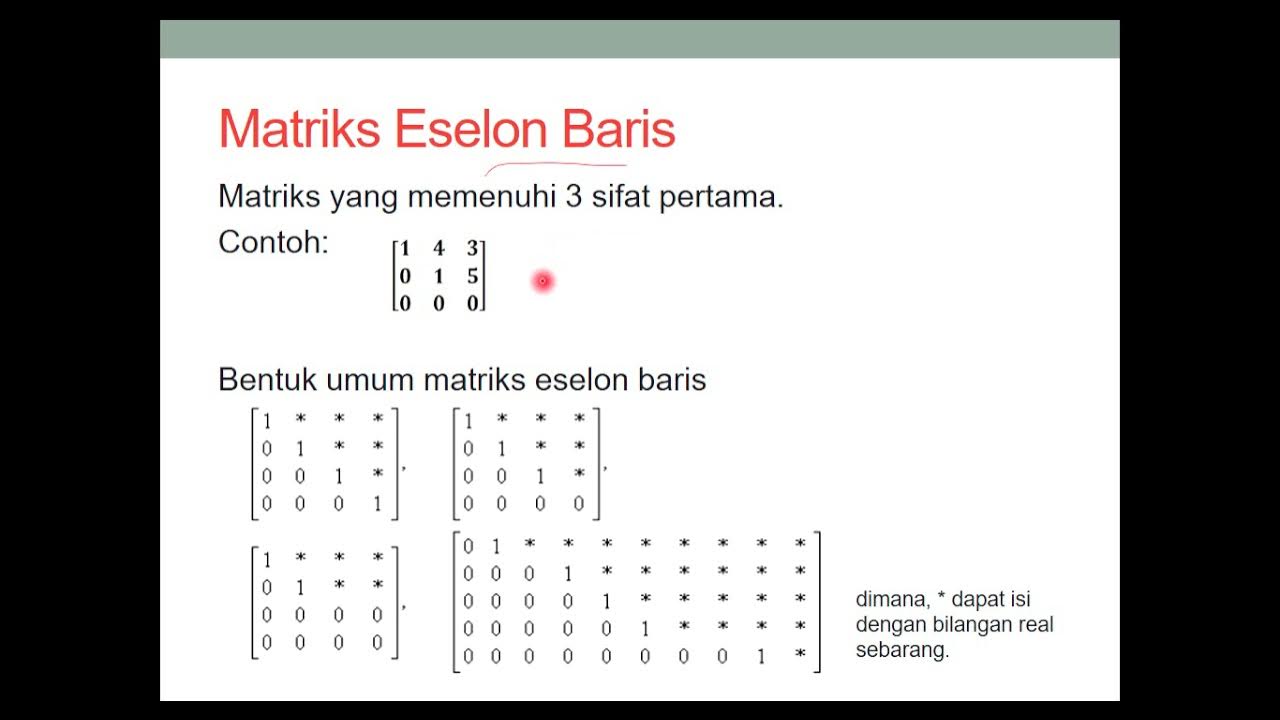
Aljabar Linear: Matriks Eselon Baris Tereduksi dan Matriks Eselon

ACT Math Topic You NEED To Know In 2023 - Matrices & Matrix Multiplication
5.0 / 5 (0 votes)
