RELATIVE PRONOUNS: Pronomes Relativos do Inglês | Resumo de Inglês para o Enem
Summary
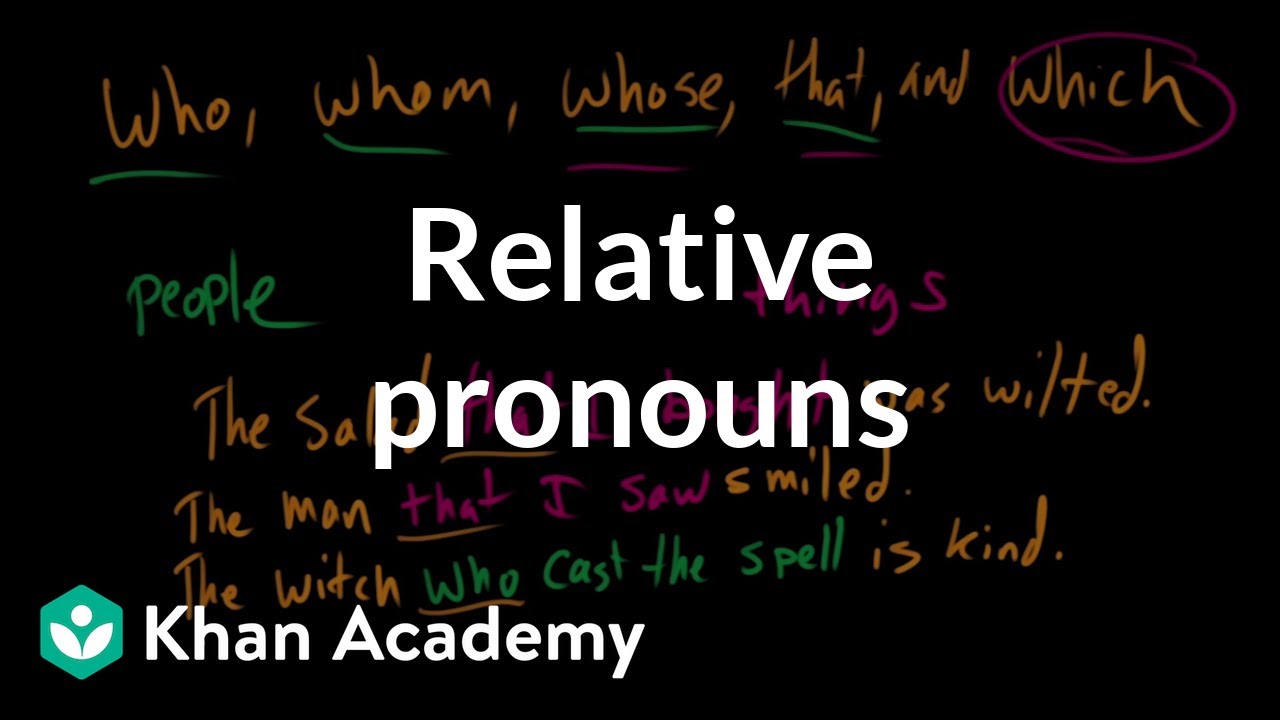
TLDRIn this video, the speaker, Guilherme, explains the concept of relative pronouns in English, emphasizing their role in linking clauses and avoiding repetition. He introduces common relative pronouns such as 'who,' 'which,' 'that,' and 'whose,' explaining their use with examples in both English and Portuguese. The video highlights the differences between restrictive and explanatory appositives, offering viewers a clear understanding of when to use each relative pronoun correctly. Throughout, Guilherme encourages viewers to pay attention to these grammatical details for clearer, more concise communication.
Takeaways
- 😀 Pronouns are used to replace nouns, and relative pronouns specifically create a relationship between two parts of a sentence, avoiding repetition.
- 😀 In both English and Portuguese, relative pronouns help improve sentence flow by connecting ideas.
- 😀 An example in Portuguese: 'I like my neighbor. My neighbor is Australian.' can be joined as 'I like my neighbor who is Australian.'
- 😀 When relative pronouns are used between commas, it can create an explanatory appositive, explaining or giving extra detail about a noun.
- 😀 A restrictive appositive, like 'I like my neighbor who is Australian,' limits the sentence to only one specific person.
- 😀 The relative pronoun 'who' is used for people, whereas 'that' can be used for both people and things in English.
- 😀 Be cautious about using 'that' in explanatory appositives as it is not always appropriate in this context.
- 😀 The relative pronoun 'whose' indicates possession and is used to connect sentences where the second sentence refers to something possessed by the subject of the first sentence.
- 😀 For example, 'I have a friend. His parents are rich.' can be combined as 'I have a friend whose parents are rich.'
- 😀 In English, 'whose' does not have a direct translation in Portuguese, but it functions similarly to the possessive pronoun 'cujo.'
- 😀 Remember to pay attention to the specific cases where different relative pronouns should be used to avoid confusion and ensure clarity in communication.
Q & A
What is the role of relative pronouns in English grammar?
-Relative pronouns create a relationship between two distinct clauses by replacing a noun, helping to avoid repetition and improving sentence flow.
Can relative pronouns be used in both English and Portuguese?
-Yes, relative pronouns exist in both English and Portuguese, serving similar functions in each language, although their usage can differ in some cases.
What is an example of an explanatory appositive in English?
-An explanatory appositive in English is when additional information about a noun is added to clarify it, typically separated by commas. For example, 'I like my neighbor, who is Australian.'
What is the difference between a restrictive and an explanatory appositive?
-A restrictive appositive provides essential information to identify the noun, whereas an explanatory appositive gives additional, non-essential information, usually set off by commas.
What relative pronoun should be used when referring to a person in English?
-The relative pronoun 'who' should be used when referring to a person in English.
When should 'which' be used in relation to objects or things?
-'Which' is used to refer to objects, animals, or things, especially when there is a specific element in common that connects two clauses.
What is the correct relative pronoun to use for possession in English?
-The relative pronoun 'whose' is used to express possession. For example, 'I have a friend whose parents are rich.'
What is the significance of using relative pronouns in sentence construction?
-Relative pronouns help to combine sentences, avoid repetition, and provide a clearer connection between ideas, making the sentence structure more concise and fluid.
How does the use of relative pronouns differ between English and Portuguese?
-While both languages use relative pronouns, English has specific rules that differ from Portuguese, such as the use of 'whose' for possession, which does not have a direct equivalent in Portuguese.
Can relative pronouns be used in explanatory appositives in English?
-No, relative pronouns like 'that' cannot be used in explanatory appositives. For example, in a sentence with commas like 'I have a neighbor, who is Australian,' 'that' is incorrect here.
Outlines

This section is available to paid users only. Please upgrade to access this part.
Upgrade NowMindmap

This section is available to paid users only. Please upgrade to access this part.
Upgrade NowKeywords

This section is available to paid users only. Please upgrade to access this part.
Upgrade NowHighlights

This section is available to paid users only. Please upgrade to access this part.
Upgrade NowTranscripts

This section is available to paid users only. Please upgrade to access this part.
Upgrade Now




5.0 / 5 (0 votes)
