Lo que nadie te cuenta del Motor 2 Tiempos, 🤯 Distintos tipos, Escapes, Funcionamiento.
Summary
TLDRThis video provides an in-depth exploration of two-stroke engines, covering various types, working principles, and performance-enhancing modifications. It explains how these engines use ports instead of valves, achieving higher theoretical performance by burning fuel every revolution. The script details different piston designs, crankcase compression, and the role of direct injection. It also highlights the advantages and drawbacks, such as simplicity, light weight, but higher emissions and shorter lifespan. From basic engines to more advanced systems like flappers and crankshaft valves, the video provides insights into the evolution and applications of two-stroke engines in motorcycles and portable devices.
Takeaways
- 😀 Two-stroke engines have fewer parts than four-stroke engines, making them simpler and more affordable.
- 😀 Unlike four-stroke engines, two-stroke engines burn fuel every revolution of the crankshaft, providing theoretical double the power output.
- 😀 Basic two-stroke engines use ports instead of valves, with the piston controlling their timing by blocking or uncovering them.
- 😀 Two-stroke engines suffer from fuel waste because intake and exhaust occur simultaneously, with unburned mixture exiting through the exhaust port.
- 😀 The crankcase in a two-stroke engine needs to be pressurized for intake and compression, making it difficult to store oil, which is often mixed with the fuel.
- 😀 Modifying the engine's ducts (similar to camshaft modifications in four-strokes) can increase power but at the cost of reduced engine life.
- 😀 Flapper systems improve engine performance by allowing longer intake durations, bypassing the piston’s movement and functioning as an automatic one-way valve.
- 😀 Crankshaft valves improve timing precision for intake but increase engine weight and cost, making them less popular compared to flapper systems.
- 😀 Piston designs include deflector pistons, which help with cylinder scavenging, and flat-head pistons, which allow for higher RPMs but waste more fuel at lower RPMs.
- 😀 Direct injection in two-stroke engines eliminates fuel waste by injecting fuel directly into the cylinder after the intake and exhaust ports are closed.
- 😀 Two-stroke engines can run in reverse if the ignition timing is set too high, which can cause the engine to move in the wrong direction unexpectedly.
Q & A
What are the main differences between a two-stroke engine and a four-stroke engine?
-A two-stroke engine burns fuel every revolution of the crankshaft, while a four-stroke engine burns fuel every other revolution. This gives the two-stroke engine twice the theoretical performance of a four-stroke engine. Additionally, two-stroke engines are simpler, with fewer parts and no valves, but require a mixture of oil and fuel for lubrication.
How does the piston in a basic two-stroke engine work with the ports?
-In a basic two-stroke engine, the piston uncovers the intake port as it moves up, creating a vacuum that draws the fuel mixture into the crankcase. As the piston moves down, it compresses the crankcase and uncovers the transfer lines, allowing the mixture to flow into the cylinder. This simultaneous intake and exhaust process results in efficiency but also leads to unburned fuel being expelled.
What challenges arise with the crankcase in a two-stroke engine?
-The crankcase in a two-stroke engine must be pressurized to allow intake and compression into the cylinder. However, this prevents the storage of oil in the crankcase, leading to oil being mixed with gasoline. This results in the characteristic white smoke and inefficiency, as the oil is burned along with the fuel.
How does the two-stroke engine with flappers differ from the basic engine?
-The two-stroke engine with flappers improves on the basic design by using a flexible metal flap that opens and closes automatically based on the vacuum created by the piston. This extends the intake timing and enhances power, as the flap operates independently of the piston’s movement, but it introduces a slight delay when the flap opens and closes.
What are the advantages and disadvantages of the crankshaft valve system in a two-stroke engine?
-The crankshaft valve system offers high precision in controlling the intake and exhaust timing, minimizing dead moments and improving gas flow. However, it increases the engine's weight and inertia, making it less commonly used in favor of simpler systems like the flapper valve, due to cost and complexity.
Why did the deflector piston fall out of favor in two-stroke engines?
-The deflector piston, which helped deflect gases to clean the cylinder, added extra weight and heat absorption, which was detrimental to high RPM performance. Modern engines favor lightweight, high-rpm-friendly designs, making the deflector piston less efficient and more prone to piston seizure.
How does direct injection improve the efficiency of a two-stroke engine?
-Direct injection improves efficiency by delivering fuel directly into the cylinder at the precise moment when the intake and exhaust ports are closed. This prevents fuel from being wasted as it is no longer exposed to the exhaust stream, ensuring that all the fuel is burned and increasing power output while reducing emissions.
Is it possible for a two-stroke engine to start backwards, and what are the consequences?
-Yes, a two-stroke engine can start backwards if it has too much ignition advance. This can cause a counter-explosion when trying to start the engine, making it run in reverse. The danger is that the rider may not realize the engine is running backwards, leading to potential accidents, such as falling while trying to accelerate.
How does a conical exhaust system work in a two-stroke engine?
-The conical exhaust system works by expanding gases from the cylinder into a cone, which then rapidly narrows, creating a pressure rise. This pressure generates a rebound wave that is directed back toward the cylinder at just the right moment to prevent fresh mixture from escaping with the exhaust gases, optimizing engine performance.
What are the benefits and drawbacks of a two-stroke engine compared to a four-stroke engine?
-Benefits of two-stroke engines include simplicity, fewer parts, lighter weight, and the ability to operate in any orientation, which is ideal for portable equipment. However, they consume more fuel, emit higher emissions, burn oil for lubrication, and have a shorter lifespan due to the inefficiency of their scavenging process. These drawbacks are partly addressed by modern oils and direct injection systems.
Outlines

This section is available to paid users only. Please upgrade to access this part.
Upgrade NowMindmap

This section is available to paid users only. Please upgrade to access this part.
Upgrade NowKeywords

This section is available to paid users only. Please upgrade to access this part.
Upgrade NowHighlights

This section is available to paid users only. Please upgrade to access this part.
Upgrade NowTranscripts

This section is available to paid users only. Please upgrade to access this part.
Upgrade NowBrowse More Related Video

4-Stroke & 2-Stroke Engine | Its Parts & Working Explained

Motorcycle Speech

MATERI AUDIT SEKTOR PUBLIK - Gambaran Umum Audit Sektor Publik
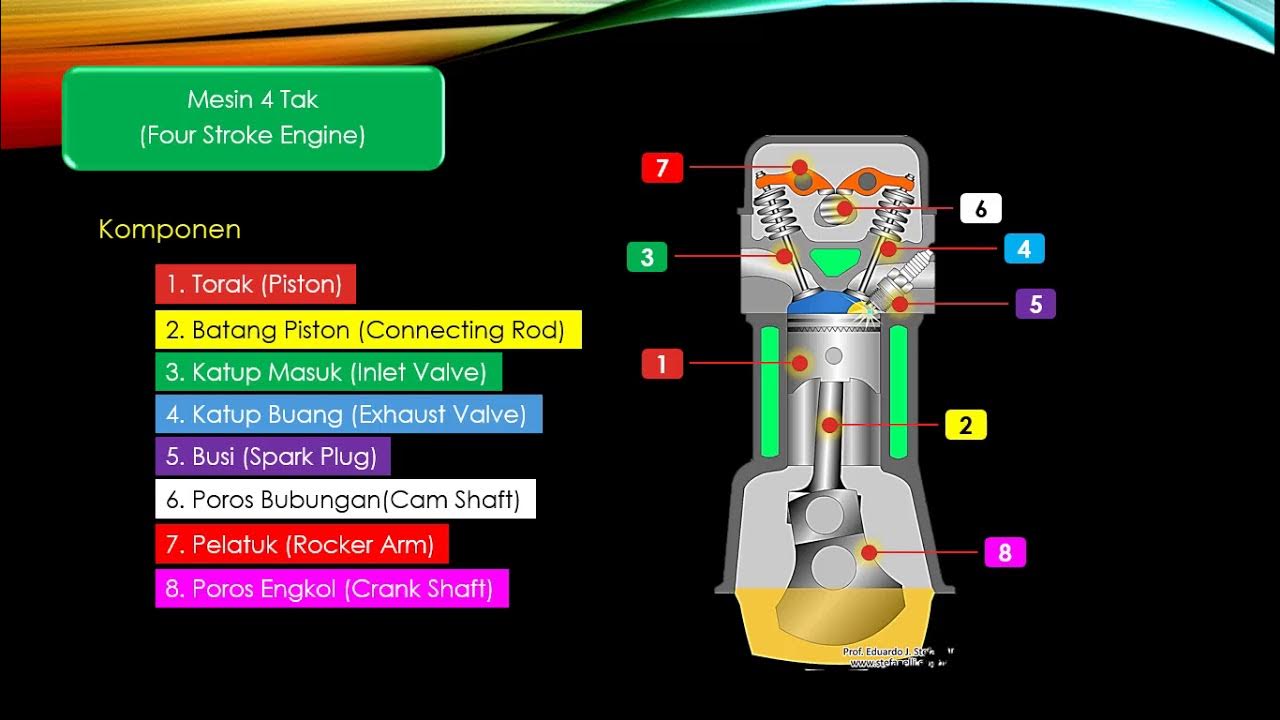
TDO Semester 2: Mesin Konversi Energi Part.1 (Mesin 4 Tak)
How Does A Small Engine Work? 2 & 4 Cycle

The Only Video You'll Ever Need to Watch to Know how 4 Stroke and 2 Stroke Engines Work and Differ
5.0 / 5 (0 votes)
