Tubo de Pitot | Experimento y aplicación
Summary
TLDRIn this presentation, Andrés Piraban explains the application of the Pitot tube, invented by Henri Pitot. The device measures fluid speed by comparing stagnation and static pressures. Using air as the fluid and water as the flow, the presenter demonstrates how to calculate speed through Torricelli’s equation, derived from Bernoulli's principle. Two experiments are conducted, showing how changes in airspeed correlate to height differences in the tube. The formula and density values are used to calculate velocities, concluding the presentation with an understanding of how the Pitot tube can be applied in various fluid speed measurement scenarios.
Takeaways
- 😀 Henri Pitot was a French physicist and engineer who invented the Pitot tube.
- 😀 The Pitot tube is used to measure the speed of fluids, like air or water, in various applications such as aircraft, boats, and ducts.
- 😀 The Pitot tube operates based on the concept of stagnation pressure and static pressure to calculate fluid speed.
- 😀 The model presented uses a hose with stagnant flow to measure the speed of air, with a hole allowing the fluid to enter.
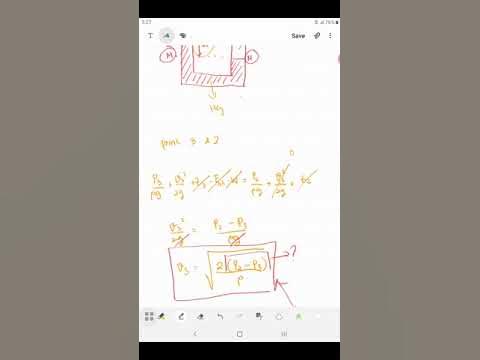
- 😀 The speed of the fluid is determined using the Torricelli equation derived from Bernoulli's principle.
- 😀 Torricelli's equation for fluid speed is: speed = √(2 × gravity × height × (density of water / density of air)).
- 😀 The density of water is 1000 kg/m³, and the density of air is 1.225 kg/m³.
- 😀 In the example, the measured height difference of 1 cm (0.01 meters) resulted in a speed of 12.65 m/s.
- 😀 A higher fluid speed of 3 cm (0.03 meters) led to a calculated speed of 21.92 m/s using the same formula.
- 😀 The practical application of the Pitot tube demonstrates how changes in height can be used to calculate the speed of the fluid entering the tube.
- 😀 The experiment and calculations show the accuracy of the Pitot tube in measuring fluid velocity, both with an average and higher speed.
Q & A
What is the main application of the Pitot tube?
-The Pitot tube is primarily used to measure the speed of fluids, such as air in aircraft or water in boats. It can also be used to measure the speed of fluids in ducts and channels.
Who invented the Pitot tube, and what was his profession?
-The Pitot tube was invented by Henri Pitot, a French physicist and engineer.
How does the Pitot tube determine the speed of a fluid?
-The Pitot tube determines the speed of a fluid by measuring the difference between stagnation pressure and static pressure. This difference is then used in an equation to calculate the fluid's velocity.
What physical principle is applied in the Pitot tube's operation?
-The operation of the Pitot tube is based on the principle of Bernoulli's equation, particularly focusing on the relationship between stagnation pressure, static pressure, and fluid velocity.
What equation is used to calculate the speed of a fluid using the Pitot tube?
-The speed of the fluid is calculated using the Torricelli equation, which is derived from Bernoulli's equation. It states that velocity is equal to the square root of 2 times the gravitational constant, times the height difference, multiplied by the density ratio of the two fluids (water and air).
What densities are involved in the calculation of fluid speed with a Pitot tube?
-The densities involved in the calculation are the density of water (1000 kg/m³) and the density of air (1.225 kg/m³).
How does the speaker apply the Torricelli equation in the demonstration?
-The speaker applies the Torricelli equation by measuring the height difference caused by the air flow in the Pitot tube. They then substitute the measured height and known densities into the equation to calculate the fluid's velocity.
What is the significance of the height difference in the experiment?
-The height difference is crucial as it represents the change in pressure between the stagnation point and the static point in the Pitot tube. This height difference is used to calculate the fluid speed based on the Torricelli equation.
What was the result when the airspeed was increased in the experiment?
-When the airspeed was increased, the height difference in the Pitot tube increased as well. This was observed when the height reached 3 centimeters, which corresponded to a higher fluid velocity of 21.92 m/s.
How does the Pitot tube relate to the study of both water and air flow?
-The Pitot tube can be used to study the flow of both air and water. In this case, water was used as the flow to create the pressure differences, while air was the fluid being studied to measure speed. The different densities of air and water are considered in the calculations.
Outlines

Этот раздел доступен только подписчикам платных тарифов. Пожалуйста, перейдите на платный тариф для доступа.
Перейти на платный тарифMindmap

Этот раздел доступен только подписчикам платных тарифов. Пожалуйста, перейдите на платный тариф для доступа.
Перейти на платный тарифKeywords

Этот раздел доступен только подписчикам платных тарифов. Пожалуйста, перейдите на платный тариф для доступа.
Перейти на платный тарифHighlights

Этот раздел доступен только подписчикам платных тарифов. Пожалуйста, перейдите на платный тариф для доступа.
Перейти на платный тарифTranscripts

Этот раздел доступен только подписчикам платных тарифов. Пожалуйста, перейдите на платный тариф для доступа.
Перейти на платный тарифПосмотреть больше похожих видео


5.0 / 5 (0 votes)

